

In which we share occasional news items, ideas, and other assorted posts about the book trade, from publishing to bookselling.
How personal is publishing?
Tuesday, 27th November 2012. Comments are closed.
The following is an edited version of the introduction to our new anthology, Crying Just Like Anybody, which is due out in the next few days.

How personal is publishing?
It’s a question that hangs in the background of almost everything I do at The Fiction Desk, from the editorial policy to the cover design.
It’s fashionable these days to think of publishing as a technical, financial process in which manuscripts are selected using a spreadsheet and then processed into books with a minimum of human intervention. While we may identify certain imprints with a specific genre or style of writing, it’s easy to forget that — large or small — a publisher’s list usually represents the individual tastes of an editor, or a small group of editors. And the tastes of those editors in what they choose to publish can be as unique and personal as the books they choose to put on their shelves at home.
Publishers usually foster a semi-anonymous image for themselves: even the terms ‘editor’ and ‘publisher’ are confused and vague, especially in smaller publishing operations. The different roles, and who performs them, are rarely defined for the public, and I doubt most readers could name the editors behind even their favourite books. In Italy, the publisher is the editore and the editor the curatore, which in some ways makes more sense than our own terminology: I’m not talking here about the technical work on the text, which is necessarily invisible and anonymous because the text must always belong to the author, but about the curatorial editing.
In the early days of publishing, the publisher’s name usually was the publisher’s name: John Murray, Chapman & Hall, Martin Secker, and so on. When Herbert Jonathan Cape left (Gerald) Duckworth to found his own company in 1919, he may have called it Page & Co at first, but it wasn’t long before he rechristened it after himself. These days, new fiction publishers are almost always named for objects, mythological figures, or abstract ideas: Telegram, Hesperus, Peirene, Salt, The Fiction Desk. There are very few recent publishers that use the founder’s name for the imprint; offhand, the only one I can think of is Charles Boyle’s CB Editions.
There are probably a few reasons for this change in convention, from the phenomenal success of Allen Lane’s Penguin brand in the 1930s to the number of imprints now launched by large publishing houses rather than by individuals, and it’s by no means a change unique to publishing. Still, I wonder how it has affected readers’ perception of publishers, and even publishers’ and editors’ perception of their own roles.
I have no intention of changing the name of The Fiction Desk, or of introducing a red man as a new logo, but something that’s surprised me over the last couple of years has been just how personal my relationship to these books actually is. The stories presented here are very much my own selection; another editor would have chosen different stories from the same set of submissions. (As is normal for a publisher, we often publish stories rejected by other journals, and I’ve rejected several stories that I’ve subsequently seen published elsewhere.)
This is carried through to the design of the books: for example, they’re printed in Goudy Old Style because that typeface reflects my own belief in the values of traditional storytelling forms over more experimental techniques.
The introductions to individual stories are also a challenge: how personal should they be? Should they be in my own voice, or in a disembodied generic editorial voice? The former is a more honest and accurate reflection of the curatorial process; the latter perhaps quieter and less distracting from the stories. Should I start popping up from behind the furniture at the start of each story, like Rod Serling at the start of Twilight Zone episodes?
No. No, I probably shouldn’t. But I’ll continue to think about the editor’s role, the voice of that role, and where and how that voice should feature in these volumes, aiming to find a balance that renders the curatorial process transparent without detracting from the integrity of the individual stories.
Roast Books: an interview with Faye Dayan
Wednesday, 21st September 2011. Comments are closed.
 Like many people, I first noticed Roast Books when they published A.C. Tillyer’s collection of short stories, An A-Z of Possible Worlds. It was a highly entertaining read, but also an exciting piece of publishing: the elaborate production, involving a boxed set of 26 booklets, was both eye-catching and perfectly suited to the material.
While An A-Z… might be Roast Books’ most elaborate volume, it’s be no means the only one: they started with a series of paperback novellas and short story collections called Great Little Reads, and more recent publications include Nik Perring’s collection of flash fiction, Not So Perfect. Their most recent book is Dogsbodies and Scumsters, a quirky collection of short stories by Alan McCormick with illustrations by Jonny Voss. Here’s the trailer:
With such a diverse and interesting selection of publications, I decided it was time to find out more about Roast Books and their plans, so I got in touch with their publisher Faye Dayan…
For a young publishing house with relatively few titles, you’ve managed to create a wonderfully diverse range: from the Great Little Reads with their textured covers, to the simple square of Nik Perring’s book, through to the extravagant A-Z of Possible Worlds, I’m not sure that you’ve tackled any two projects in the same way. What made you decide to take this approach?
Each book of short fiction Roast Books has published has deserved its own approach because we try to match form to content. I think it’s important that the shape and character of a book can reflect and relate to the stories inside.
Will you be revisiting the Great Little Reads series?
The novella is such a great genre, and often overlooked I think, so I would love to revisit the Great Little Reads series, although for the moment Roast Books is focused on short story collections.
Is it challenging to create a strong identity for Roast Books when you’re using a variety of formats? As opposed to, say, Peirene Press, who have one very distinct look to their titles.
You are right, this presents a challenge in creating an image for Roastbooks, but it is the philosophy of production, rather than the production itself which is consistent across all our books. The creative process of working with an author and collaborating on the design is very rewarding and something I would like to believe that our readers acknowledge and appreciate.
I’m sure they do. Your list is very focussed on short stories and novellas—a focus I can strongly identify with! I can see how short stories would be a logical choice for an experimental publisher like Roast Books, because the reading experience of shorter works can be more flexible than that of longer novels, where the book perhaps needs more to disappear more behind the writing. What’s the attraction for you in publishing short stories?
The genre of short stories is extensive, and there are fewer accepted publishing traditions associated with them. So firstly, as you said, as a new publisher, it gives more flexibility to experiment. Secondly many short stories are appreciated as they provide light bites of entertainment and stimulation, and the book format can be something which enhances this rather than detracts from it.

Do you see Roast Books moving into ebook publishing, or would you prefer to focus on the physical reading experience?
It’s interesting because the physical aspect of the book is intrinsic to Roast Books, so we will not release digital books without their physical counterpart. Having said that, we are developing an exciting little e-project which will give users the ability to self publish and distribute.
That’s interesting. More traditional publishers seem to be getting involved with self-publishing projects these days. It used to be very much a no-no, causing issues with credibility and conflicts of interest, but that certainly seems to be changing. How do you plan to reconcile the two very different types of publishing with Roast Books?
I agree it is changing. The type of self publishing where publishers put out a physical book in return for a hefty fee isn’t the only model any more. With ebooks, authors can create and distribute their own book online, in a speedy and cheap process, and this is something which part of our e-project will facilitate. Aspiring authors can bring their ebooks to the attention not just of potential readers but also potential publishers. There won’t necessarily be any overlap between this and our physical books at all.
How have you found the experience of entering the publishing industry? Do you think it’s a receptive world for new independents? Have you had any particular frustrations or pleasant surprises?
As you know things are changing very rapidly in the book industry and there is a lot of speculation about where it’s headed. But i have been certainly met some people within the industry who are extremely supportive and genuinely want new independents to succeed. It’s undoubtably tough, but you just have to keep going and see what’s around the next corner. We have just sold the film rights to My Soviet Kicthen by Amy Spurling, to Tailormade productions, which was an unexpected but welcome development.
What kind of team do you have? Do you work with a lot of people, or are you largely self-sufficient?
I work with the same designer, editor and publicist on each book, so its a very small operation, but I think this has its benefits! We work quickly, and it’s a lot of fun.
Are there any other emerging independent publishers that you particularly admire?
lol The Fiction Desk! Various Authors introduces a really interesting spectrum of new talent and I’m really enjoying it.
Thank you! I wasn’t fishing, I promise… Finally, what’s next for Roast Books?
We have some great projects planned for 2012, all collections of short stories, and also the development of our self publishing platform.
Find out more about Roast Books at their website, www.roastbooks.org.
Peirene Press: an interview with Meike Ziervogel
Wednesday, 15th June 2011. Comments are closed.
 The world of independent publishing, for all its challenges and controversies, is full of fascinating, energetic, and creative people. New publishers are appearing all the time, looking for fresh ways to connect readers with great writing. Over the next few months, we’ll be exploring some of this innovation by featuring a series of interviews with other independent publishers. First up is Meike Ziervogel (photo right) from Peirene Press.
Peirene launched their first titles in 2010. They publish translated novellas, “that can be read in the same time it takes to watch a DVD.” We reviewed one of their titles, Portrait of the Mother as a Young Woman, last year.
I’m sure many of this blog’s readers are already familiar with Peirene, but for those that aren’t, would you like to start by telling me a little about your latest title, Tomorrow Pamplona?
Tomorrow Pamplona by Dutch author Jan van Mersbergen is a road movie in book form. It tells the story of two men, a family man and a boxer, who take a car journey from Amsterdam to Pamplona where they join in the bull run. It’s a book about men, their aggression and desire for freedom on the one hand, and their need for intimacy on the other.
Was it really only last year that Peirene published its first title? You’ve done a great job of establishing Peirene in a relatively short time. Part of that I think is down to the distinctive branding: the cream paperbacks with the cropped images and flaps. Could you tell me a little about how you settled on that design?
 Thank you for the compliment. From the start I knew that I wanted to go for a strong branding. I initially had a different designer and design, but that was before the first book was printed. I wasn’t happy with it. Then I found Sacha Davison-Lunt, Peirene’s current designer. She is great and we work well together because she understands to combine quality and elegance with individuality.
I think it would make me nervous to have one consistent design like that: What if I got bored of it? What if people stopped responding? Do you have any plans to publish in any other formats, or can you imagine doing so? I’m thinking of perhaps a hardback edition of a special title, as Hesperus have done a couple of times, or a radically different one-off cover design—say, as CB Editions did, breaking their distinctive typographic cover style for Knight Crew and Marjorie Ann Watts’s book.
Our design is very flexible. Next year will be Peirene’s Year of the Small Epic, short books with over 30 chapters each. Although the design will still be recognizably “Peirene”, the covers will reflect the annual theme.
Do you have any plans to release ebook editions of your titles?
Yes, we have just signed a contract with Faber Factory who will do the ebook distribution for us.
That’s interesting. What made you decide to work with another publisher on the ebooks?
About 60 publishers have already signed up with Faber Factory. They will do the e-book distribution for us. Since they are experts in that field, it’s much better that they do it for us rather than we trying to do it all by ourselves.
When do you expect to release the first ebook titles?
Very soon.
And in terms of content, can you see Peirene every publishing a book of short stories, or a longer novel, or even a book written originally in English?
Peirene No 6, Maybe This Time by Austrian Alois Hotschnig, which will be published in September, is a collection of short-stories. As for an English novella? If a well-known English language author has a novella in his or her drawer, I’d be delighted to have a look.
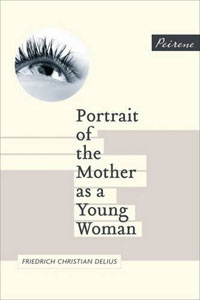 Speaking of translation, one thing that worries me as a publisher about translated fiction is in the editorial side, the fact that one loses the immediacy of being able to work directly with the author, because effectively, however good the translation, the author and the publisher are always looking at different texts. This often wouldn’t apply to you, as I know you’re multi-lingual, but is that lack of an immediate connection ever an issue?
No, I wouldn’t say that. The original book and the translation are of course two different texts. I love texts. What is important to me is to present the English reader with a text that is true to the essence of the original but at the same time is a perfect English text, “as if it were written in English”, without of course changing names, street names etc.
Aside from the publishing, you also run a regular Salon. Could you tell me a little more about these events? Would you say they have played a big part in Peirene’s success to date? Do you have more plans for different types of event, perhaps touring the salon around the country?
The Peirene Salon is our flagship event. They take place in my own house, where I invite up to 50 people – readers, book lovers, critics, colleagues. Some people I know, others I have never met before. These Salons very much represent what Peirene stands for – to build a cohesive community of booklovers and readers. The evenings don’t present boring readings but are parties with performances, conversation, dinner and wine. In fact the Salons are now funded by The Wine Society and so the hospitality is always excellent. We are always booked up with a waiting list in place. The majority of the guests leave around 11pm but some stay on until 2 or 3 in the morning, drinking and talking. It’s wonderful. We also run regular Coffee Mornings in a local cafe. There we reach out to a different readership. Even children are welcome. And then we also have an event series called Peirene Experience where we present books in unusual places and different ways. For example, in March we held an event with the actor Jack Ellis and our German author Matthias Politycki in a bookshelf designer shop. The evening was a huge success.
Overall, how have you found the experience of entering the publishing industry? Any particular frustrations (naming no names, of course!) or pleasant surprises?
It’s an incredibly exciting journey because the book market is changing so fast and no one yet knows where it will take us. And to be right in the middle of this is a huge privilege.
And finally, just so that I’m absolutely certain, how exactly does one pronounce “Peirene”?
Watch the movie below and the mystery will be revealed…
One way to improve the relationship between bookshops and publishers.
Monday, 16th May 2011. Comments are closed.
There is usually somebody in The Bookseller talking about the need to improve the relationship between bookshops and publishers. From today alone, we have High Street Bookshops Need Greater Support and Children’s Indies Concerned Over Cover Prices.
This kind of talk usually sparks fear and defensiveness all round: neither side can really afford to give up any discount, or to switch to some other stockholding method that involves moving books around without actually paying for them. While these arguments go round in circles, leading to nothing but bad feeling, ebooks and online sales steadily erode the bookshops’ market share.
However, there is one very clear way in which bookshops, publishers, and even book buyers could all get a better deal. It should be possible to improve relationships across the trade, and even reduce cover prices, all without reducing the quality of the books we all work so hard to produce and sell.
A look at two pricing models
Here are two potential pricing models for a new trade (large format) paperback:
(A)
RRP £9.99
Price through online retailers (e.g. Amazon): £9.99
Price direct from the publisher: £9.99
Price from your local independent bookshop: £9.99
(B)
RRP £13.99
Price on Amazon / online retailers: £13.99 around £9-£11
Price direct from the publisher: £13.99 £9.99
Price from your local independent bookshop: £13.99
Model (A) is the one we currently use at The Fiction Desk, which is why Various Authors is £9.99, a relatively low price for a large format paperback. Model (B) is much more common in the industry, as any regular book buyer will know.
It will surprise nobody to learn that we’re under a certain amount of pressure to move from (A) to (B). What might surprise you is the source of that pressure: it’s coming not from Amazon, but from the independent bookshops.
Behind the numbers
To explain what’s happening, we need to look at the economics behind those two pricing models.
To create model (A), we set up a very simple system. All the books that leave our distributor destined for the retail trade do so at the same discount, which is 40%. The tiniest independent or the largest chain (or online shop) receives a fixed 40%. Because of this, we can be sure of receiving the other 60% to cover our distribution, printing, author fees, handling returns, and other costs. At the moment, a £5.99 cut should do this for us, so we can comfortably set the RRP at £9.99.
The difference behind model (B) is that we would now be supplying wholesalers at a higher discount: they demand between 57.5% and 60% discount from RRP. So instead of receiving £5.99 from the price of a £9.99 book, the publisher would receive as little as £3.99. In order to make a reasonable margin per copy sold, the publisher therefore needs to push up the RRP: in fact, at £13.99, the publisher would still only make £5.59. (To keep the same revenue per unit they had before, it would be necessary to push the RRP up to a massive £14.99.) Economy of scale doesn’t really apply here either: wholesalers don’t create sales, so much as reroute them.
So, in order to supply through wholesalers, it’s necessary to push up the RRP, and this is a rise in price that adds no additional value to the end consumer. The retailer gets something close to the same 40% discount they would have got direct from the publisher, so it makes no great financial difference to them. But the publisher doesn’t need that higher RRP, so they can offer a little discount on their websites. The higher RRP, along with better relationships with wholesalers, also means that Amazon et al have more room for discounting. The final result, as in model (B) above, is that only the indies are left selling the books at a now too-high £13.99.
You would think that independent bookshops would do anything to avoid this situation, but in fact, many of them actively encourage it: they refuse to buy stock except from wholesalers, and we’ve even heard of people being told that our title isn’t available to purchase at all, when it’s setting in our distributor’s warehouse with immediate availability. The message is clear: the only way we’ll get our titles into many indie bookshops is to make them available to wholesalers, and therefore price them too high for the bookshops to be able to sell them.
Breakdown in communication.
Aside from creating artificially high RRPs, there’s another serious problem resulting from the presence of wholesalers in the supply chain.
When bookshops purchase stock from a wholesaler, the publisher has no idea who they are. When we launched, we had plans to feature an online list of stockists, to provide those stockists with promotional material, and to actively promote them on our website. We’ve had to shelve all of these plans, because we have no idea which bookshops are stocking us at all. Of the few trade sales we’ve had, the only stockist I definitely know of is the excellent John Sandoe in Chelsea. All the rest could be anybody—they could well be Amazon sales.
What can be done?
Put simply, if we want to retain (regain?) a healthy and efficient supply chain, we need to encourage bookshops to purchase stock directly from publishers and their distributors. Only by doing this can we maintain (regain) realistic RRPs, some level of price equality, and strong lines of bookshop-publisher communication on which to build joint promotional efforts.
For bookshops, this means turning away from wholesalers and maintaining and using accounts with larger publishers, and with the distributors who directly represent smaller publishers. This means extra paperwork—more small invoices instead of fewer large ones—but that’s a small price to pay for the benefits of a more efficient and fair supply chain.
For publishers and distributors, it means working to ensure that their ordering systems are as efficient and flexible as possible, with low minimum orders and delivery costs, and efficient customer services to make the process as easy as possible for the bookshops.
I can’t speak for the industry as a whole, but I can speak for The Fiction Desk: We intend to maintain our 40% trade discount, making the book immediately available to any bookshop that cares to stock it. But we won’t be offering additional discount to wholesalers, or getting involved in the kind of short-sighted high RRP / high discounting that’s causing so much damage right across the supply chain.
As always, comments from people across the industry are much appreciated. I’m sure there are things that I’ve missed in the above summary, but I do believe that this is the general direction in which we need to be heading.
Literary agents and publishing: a conflict of interest?
Friday, 13th May 2011. Comments are closed.
According to this article in The Bookseller, the ethical dam that has traditionally prevented agents from becoming publishers may be about to break. At least one agent is in the process of setting up a list, with others ready to follow. This is a worrying development, as there is clearly a conflict of interest when an independent advisor enters the business on which he or she is supposed to offer independent advice.
Part of the debate centres on the wording of the constitution of the Association of Author’s Agents. Presumably, this is the line under debate:
An agency or agent who is also employed by publishers or purchasing principals, other than for selling rights, shall not be eligible for membership.
Although this refers to an agent also being employed by a publisher, it seems clear that this line is intended to avoid the same conflict of interest that arises when an agent also becomes a publisher.
It’s worth pointing out that the presence (or otherwise) of an idea in a constitution is not in itself a validation of that idea, but it does demonstrate a traditional perspective, and provide an appropriate starting point for debate.
Four questions immediately present themselves, although I suspect more will follow:
- How can an author hope for unbiased, independent advice from an agent who stands to make a great deal more money from one publishing route than from another?
- How can a publisher enter into potentially sensitive negotiations with a competitor?
- Will format fragmentation, with sales revenue potentially being split by format between different publishers, make it less possible for publishers to take a chance on new authors?
- What exactly are the agents’ motivations behind this move, and is there a more appropriate way to meet these goals, one which might benefit the industry as a whole and avoid potential ethical issues?
At some point, The Fiction Desk as a publisher will have to adopt a position on these changes. Before that happens, I’d be very interested in hearing people’s thoughts on any or all of the above questions.
Amazon launches in Italy – with a unique advantage
Tuesday, 23rd November 2010. Comments are closed.
Amazon has launched its latest branch in Italy, and from the looks of things, they have a unique advantage, thanks to the remarkably complex laws regarding book pricing in Italy.
According to a publication from the Federation of European Publishers (download the .pdf here), bookshops in Italy are limited to offering a maximum of 15% discount from the publisher’s recommended price.
There are exceptions: old stock can sometimes be discounted, as can books sold to schools. Unusually, though, they also allow unlimited discounts for books sold online.
Effectively, this means that Amazon’s Italian store will be able to sell books at an unlimited discount, while their bricks and mortar competitors will be limited to – at most – knocking 15% from the price of their books.
This may be a unique example of a case where price protection laws could actually work against the independent bookshops, and in favour of Amazon.
Don’t you walk away from me with your hat on!
Tuesday, 7th September 2010. Comments are closed.
Got a historical thriller in an urban setting? Well, nobody will know what you’re talking about unless you give it a sepia-toned cover in which a man in a hat (and preferably a cape or swishing frock coat) is walking away from the camera:
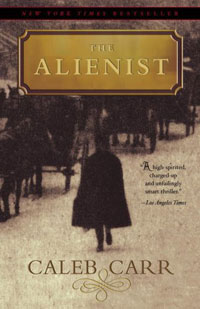
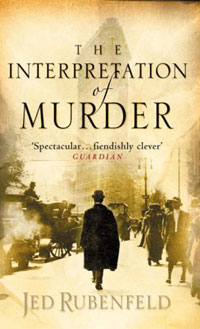
(Actually, is the guy on the cover of The Alienist walking towards us? Oh, and take note of the man on the cover of The Interpretation of Murder – you’ll be seeing him again in a moment…)
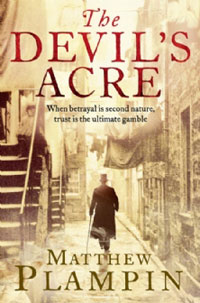
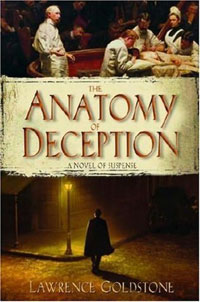
Sepia may be a bit old hat now, so you could always go with blue instead: (more…)
The curious incident of the free book in the night-time
Friday, 27th August 2010. Comments are closed.
 Last year, publisher Gallic Books formed a partnership with London bookstore Big Green Bookshop. I loved the idea of a bookshop and publisher teaming up, which used to happen all the time (John Murray, for example, started as a bookseller / publisher), and the partnership between Gallic and the Big Green Bookshop seems to be still going strong today.
Now, Gallic Books have come up with another smart partnership, this time for their new novel, The Baker Street Phantom. They’ve partnered with a hotel, the Park Plaza Sherlock Holmes Hotel on Baker Street. Through September, anybody checking in at this “Holmes away from home”* will receive a complimentary copy of the novel.
It’s a nice concept, and another bit of smart promotion from Gallic.
*Sorry.
Where do eBooks go when you die?
Friday, 19th February 2010. Comments are closed.
Here’s a question: What happens to eBook collections when the user dies? I’ve asked this a couple of times over on Twitter, but nobody seems to know.
Avid readers (or bibliophiles, or bibliomaniacs) can accumulate quite a collection of books over a lifetime. They’re sometimes dealt with separately in a will, sometimes fought over by descendants, and sometimes sold off as a job lot before the earth has settled on the grave. (more…)
IndieBooks website to sell titles from independent publishers
Friday, 27th November 2009. Comments are closed.
On Tuesday, Legend Press will launch a new online bookshop dedicated to independent publishers.
The project, entitled IndieBooks, will be selling a range of just fifty titles from a variety of independent presses. Each month, the twenty-five lowest selling titles will be replaced with new titles, while the other half are carried over to the next month—in effect, creating a situation where half the stock is editorially selected, and the other half determined by sales figures. (more…)
