

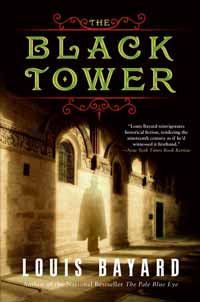
 Salon.com and New York Times critic Louis Bayard has spent the last few years carving out a niche for himself as a writer of historical crime stories featuring real-life individuals and characters from classic fiction. Mr. Timothy (2003) followed the continuing adventures of Timothy Cratchit from A Christmas Carol, while The Pale Blue Eye (2006) was set around West Point Military Academy and featured a young cadet by the name of Edgar Allan Poe. Both novels had a lot to recommend them; in particular, The Pale Blue Eye was a more entertaining book than 2006’s other Poe-inspired yarn, Matthew Pearl’s disappointing The Poe Shadow (which was published on the same day and as a result must have drawn at least some of the limelight from Bayard’s novel).
In his new novel, The Black Tower, Bayard turns his attention to the French Restoration and the exploits of real-life criminal-turned-detective Eugène François Vidocq.
The story is narrated by a Dr Hector Carpentier, into whose world Vidocq makes a suitably dramatic entrance, accusing the doctor of involvement in a murder. As it turns out, he is involved, although not quite as directly as first appears, and so he’s drawn into an investigation that centres on his late father’s treatment—and possible rescue—of Louis XVII, the “Lost Dauphin”, believed to have died in prison as a child.
While Bayard can certainly spin a tale, a lot of the pleasure of his books is in his slightly off-centre prose, which frequently makes confident and able use of vivid imagery. Take this passage, in which the narrator Dr Carpentier and Charles, who may or may not be the Dauphin grown up, are escaping a pursuer by climbing out of a window:
“I’ll go first,” I say. “Then you can follow…”
“Oh no, you don’t!”
Without a second’s more hesitation now, he sets his foot on the first length of pipe and, finding it secure, lowers himself to the next level. Three seconds later, he’s vanished.
I follow close behind. There’s no more than a sliver of moon to light the way, and my legs are heavy and my hands are numb. My eye sockets feel as if someone is pressing a thumb against them. And looking up, I can see Herbaux’s candle, lit once more, weaving circles in the night.
I take a long breath. I lower my leg, and another elbow of pipe is miraculously waiting to greet it.
By now, I’ve lost all sense of where Charles is. I could almost imagine I’m alone in the world—until my bare foot wriggles into a strange niche, not part of the original architecture. There is an answering squeal, then a chivvying at my toes. And then they’re all over me.
An ocean of rats, red-eyed with outrage. They scuttle through my hair and shrill in my ear and fasten on my limbs. Groaning, I shake them off, but more come from every quadrant: silken fur, rasping teeth. And as I slide down the building face, swinging from pipe to pipe, they follow me like a thousand reprimands.
It may be that I leap that final distance, but it feels more as if I’m riding those rats, as one might ride a wave. We breach together in the alley below, and we lie there for a while, stunned and spent.
Other Bayard signatures are in evidence here: father-son relationships; secondary narrative techniques including diary fragments, notebook entries or unsent letters; and a certain type of ironic humour. In this scene, Charles, who doesn’t quite seem to be all there, is being interrogated/tormented by Carpentier’s student lodgers:
[…]Lapin, blotting the claret from his lips, sallies forth.
“Monsieur Charles, I believe our hostess has been only too modest in her claims on your behalf. She speaks only of your coming into a fortune, when you appear already to have carved out a formidable military career.”
And when Lapin receives (as he expected) a look of puzzlement from his prey, he says, as dryly as he dares:
“Those are spurs I see on your boots?”
Lifting his leg, Charles surveys his feet with unfeigned surprise (for these are not his boots).
“Spurs! You’re right!”
“I expect you’re likely a cuirassier,” says Lapin. “Perhaps you will regale us someday with stories of battles won.”
Smiling as though in perfect concord, Charles answers:
“I had a pony once.”
A slight pause. Then Rosbif comes gliding forward.
“Are you sure it was a pony, Monsieur? Your vest looks to be made entirely of goatskin.”
“So it is,” says Charles, newly astonished.
“I wonder, Monsieur, did you dress in the dark?”
Far from resenting the question, he absorbs it, like an oyster wrapping itself round a piece of grit.
“Dress in the dark,” he says, wonderingly. “What fun! Tomorrow, we shall all dress in the dark!”
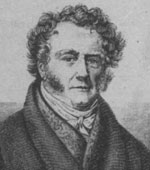
Eugène François Vidocq
Vidocq (1775-1857) was an army deserter and fugitive who became first a police informant, then a detective, and finally rose to be the first chief of the Sûreté. He inspired two of the characters in Les Miserables, as well as Émile Gaboriau’s Lecoq, and Poe’s C. Auguste Dupin, making him the literary grandfather of Sherlock Holmes, and so arguably the real-life source of the modern detective story.
His own memoirs are still in print, and there’s more information about him on the website of the Vidocq Society, which meets regularly in his name to investigate unsolved cases.
The story itself works well, with Carpentier and Vidocq fighting to keep Charles safe without quite knowing whether or not he is who others have claimed him to be. (Even Charles himself doesn’t have much to say on that subject.)
I’m not sure I always agree with the decisions Bayard makes or the techniques he employees: The Pale Blue Eye had a slightly quirky narrative style, and Mr. Timothy was unremittingly bleak. While both were deliberate choices reflecting aspects of their narrators’ characters, I felt the techniques might have worked better applied with a slightly lighter hand. However, these same techniques made for stimulating and interesting reading, and their equivalents are applied more smoothly in The Black Tower than in the previous two novels.
The Black Tower, then, is a fine tale of murder and conspiracy in early nineteenth century France, and a further step in the evolution of Louis Bayard’s distinct prose style.
The Black Tower is published in the USA by William Morrow. While John Murray have Mr. Timothy & The Pale Blue Eye (review on “Books to the Ceiling”) in print in the UK, there aren’t currently any plans for a UK publication of The Black Tower.



December 7th, 2008 at 2:58 pm
This sounds like the book that could make me like detective stories.
December 7th, 2008 at 2:59 pm
… you don’t like detective stories?
December 8th, 2008 at 1:38 am
Never heard of Louis Bayard, but I love that bit of dialogue!
I didn’t read The Poe Shadow. The Dante Club was alright, though.
December 10th, 2008 at 2:31 am
I love this book and also Mr. Timothy. I didn’t find Mr. Timothy particularly bleak but perhaps that is because it is a Dickens character and you just expect that. I can’t wait to get to the Pale Blue Eye but the TBR pile has exploded around here.
December 10th, 2008 at 2:39 am
I am having trouble getting you onto my blogroll. It brings up an oops page that redirects you. Any suggestions?
December 10th, 2008 at 10:32 am
Hello Candy. You’re in for a treat when you do get to The Pale Blue Eye. I think it may be my favourite of the three, although perhaps that’s also because it was the first one I read, and so there was the pleasure of discovering a new writer as well as the book itself.
Regarding the blogroll, I’m not sure. The Oops page suggests that you’ve added something after the “.com”. The whole url should be – http://www.thefictiondesk.com – Did you maybe have something after that? Thank you for trying, anyway! :)
December 10th, 2008 at 11:12 am
Well I tried it two or three times. I will look at it again tomorrow. It’s not a problem for me because it is just one more click to get to you but others may not get that.
December 10th, 2008 at 11:01 pm
Okay got it fixed. Apparently I had left some html from the blog I deleted to add you in. My problem.
December 11th, 2008 at 12:37 pm
Great! Thanks again for the link!
March 26th, 2012 at 12:51 am
a very good read.