

One of the hardest challenges for a novelist is knowing what to leave out of the book. Whether the background details to a story are invented by the author or based on historical research, it’s the author’s responsibility to make choices, inserting only the most relevant information, where it’s most useful, and keeping things tightly to the theme of the story. Too much superfluous detail can suck the life right out of a story, and this is the problem with The Last Dickens, Matthew Pearl‘s tale of a hunt for the final installments of Charles Dickens’s unfinished final book.
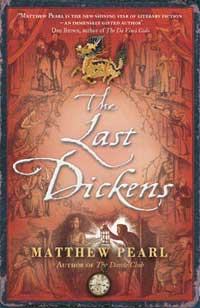 The Last Dickens is Matthew Pearl’s third stab at a literature-themed thriller. The first was The Dante Club, a tale of murders surrounding the first American translation of the Divine Comedy. From what I remember, The Dante Club wasn’t badly executed at all. Pearl came unstuck with his follow-up, The Poe Shadow, which presented the reader with plenty of research, but little in the way of story.
The Last Dickens comes somewhere between these two: it pays more attention to story than The Poe Shadow did, but it’s still hampered by constant asides into research.
For much of The Last Dickens—at least until the final hundred pages, where Pearl begins his sprint for the finish—every page seems to have a heavy dose of background information. When we meet a new character, we’re told a little too much about him. Real-life incidents are constantly shoehorned into the plot, or simply referred to for no apparent reason. There are regular digressions, providing unnecessary background information, and people constantly refer to their own pasts, presumably because the author doesn’t want to waste the days he spent reading up on them.
There’s an aspect of wood-for-the-trees here too, as the sheer weight of information seems to make Pearl lose track of what he has and hasn’t already described. Take the “bookaneers”, a gang of mercenaries who prowl the Boston docks on the look-out for imported (and therefore copyright-free) manuscripts. It’s a concept of which Pearl must have been particularly fond, because by the time they’re most dramatically announced, around page 100, he’s described them two or three times already. The Staplehurst railway crash, in which Dickens was nearly killed, is also introduced and described twice. It may be a plot point, and worth coming back to, but there’s no need to introduce the subject twice.
Lengthy flashbacks to an earlier Dickens tour of America, and to the adventures of his son Frank in India, are also misjudged, screaming “look at all this stuff I found out!” rather than “on with the story!” The fact that they tie loosely in with the main plot doesn’t really justify their extent. In places, the book becomes so absorbed with reporting the trivia of Dickens’ life that it begins to read more like a biography than a novel, and for a long time, it’s hard to get an angle on exactly what story Pearl is trying to tell.
In general, the desire to share “true information” fits uneasily into a novel, because the reader can’t trust anything you tell them: they’re reading fiction. If, as Pearl does sometimes, you really labour the point—”here is a true and interesting fact, now we have a fictional element, and now another fact”—you completely break down the illusion of the storytelling… and the reader still can’t take anything you’ve told them to the bank, because it’s still a novel.
One also gets the impression that Pearl’s efforts into research may have actually sapped his energies when it came to the story itself. There are some nice ideas here, but the improbable coincidences are slightly too improbable, the revelations are slightly too signposted, and clichés abound.
Despite all of this, however, there’s a sense that Matthew Pearl is a good writer, and could be a fine storyteller, if only he’d free himself up from the pedant’s burden. His sentences are fine, and many of his settings and characters breathe, but his storytelling is shot to pieces by the other problems. I’ve read interviews in which he talks about his desire to write non-fiction, and I wonder whether novels might not be the wrong genre for him right now. They may be more lucrative in the short term, but for the sake of his long-term career, it might do him good to spend some time writing the biographies or critical works in which he clearly has an interest, and get some of this excess information out of his system before returning to fiction.



April 9th, 2009 at 7:36 pm
I haven’t managed to finish The Dante Club yet so I am not running out for his other books. I prefer Bayard.
April 9th, 2009 at 7:48 pm
So do I. Interestingly, Bayard is thanked in the acknowledgements of The Last Dickens, as part of Pearl’s “reader’s circle”.
I’d be interested to hear your impressions of The Dante Club—at least, what you’ve read of it. It’s been a while since I read it, but I don’t remember it as having the same problems (to the same extent) as his later books.
April 9th, 2009 at 8:44 pm
Well I didn’t get very far but it just didn’t grab my interest. I have not given up on going back to it but it has been two or three years and there are just far too many really good books to read. I am rereading Shadow of the Wind right now in preparation for his new book coming out in June. If you have not read it it is breathtaking.
April 11th, 2009 at 8:13 pm
This book was a big disappointment for me. I really liked his first two books, including The Poe Shadow. But I am finding The Last Dickens to be extremely flat and hard to even get through. No “magic” there at all.
April 15th, 2009 at 2:30 pm
I like Pearl’s books, but the point about weighty historical details is indeed well taken. What bothers me about Bayard is that the plots ultimately have nothing to do with the literary gimmick. There is no reason why the young cadet in _Pale Blue Eye_ must be Edgar Allen Poe. Make him any random cadet, and the plot does not change at all. Same with _Mr. Timothy_. Make the main character anyone else in the world other than a grown-up Tiny Tim, and you have the same book. If Pearl relies too heavily on detail, Bayard relies too heavily on gimmickry.
April 28th, 2009 at 10:42 pm
Like Candy, I never got through The Dante Club, which I bought on the foot of all the hype at the time (I am really quite susceptible to that sort of thing). I thought it turgid, though happily accept that I didn’t give it much of a chance – but in any event it seems even less likely that the subsequent books would tickle my literary bits.
April 29th, 2009 at 11:03 am
I just had an odd thought: Maybe The Dante Club is worse than I remember it being. Perhaps I should take another look at it.
Or maybe I should just move on to that looming TBR shelf…
September 14th, 2009 at 1:25 pm
[…] books like The Last Dickens shoehorn the fruits of the author’s research into the main narrative, Libby Cone adds the […]