Although all writers are different (or so we like to believe), there are a few reference books that are all but indispensable to all of us. As a first post in the Writer’s Bookshelf category, here’s a list of three books that no writer can do without. Whether you’re a novice writing a science fiction epic, or an experienced professional writing a pacy crime thriller, the following should always be within arm’s reach:
The Oxford Dictionary of English
There are many single-volume dictionaries on the market, and the Oxford University Press is not without its quirks—for example, their adherence to Oxford spelling, with which British words that usually end in -ise are made to end in -ize, in the American style. But there’s still a lot to be said for Oxford, and the Oxford Dictionary of English is a vital addition to any desk.
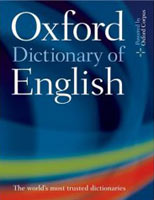 This edition is a little larger than the Concise Oxford, but more manageable than the twenty-volume flagship edition. (If you’ve got a real passion for words, and a little extra money handy, consider the Shorter Oxford Dictionary, a two-volume condensed edition of the twenty-volume edition.)
The insistence on Oxford spelling is irritating but bearable, with both spellings being given. Many entries have examples of usage, which are particularly helpful; and information on word origins, which can be interesting, and occasionally useful when you’re trying to get find that one perfect word (or avoid dropping an accidental clanger).
Incidentally, users of recent Macs running OS X may discover that they’ve already got the New Oxford American Dictionary on their computer. It should be present both in the applications folder and on the Dashboard as an optional widget.
The Elements of Style
When William Strunk, Jr., a professor of English at Cornell University, decided to provide his students with a short pamphlet on correct English usage, he probably didn’t imagine that he was laying the foundations of one of the classic works on the subject, still in use nearly a hundred years later.
Since its original edition, The Elements of Style has undergone numerous revisions, with the latest edition (the fourth) being released in 1999. It’s a short, snappy book, barely making it over the 100-page line. As well as the usual business of where to put a comma, there is also some general advice on constructing elegant and effective sentences.
Concise, thought-provoking and affordable, The Elements of Style is a terrific first step along the road of style guides, and it will continue to be useful, even when you’ve got half a dozen of the things.
The Writers’ and Artists’ Yearbook
The Writers’ and Artists’ Yearbook is the classic reference book for anybody who wants to sell their writing. As well as general information, the Writers’ and Artists’ contains lists of publishers, agents, newspapers, magazines and other potential markets for your work.
 Of particular interest to new writers will be the list of agents, but this should be used with care; don’t just start with the As and then move onto the Bs. Instead, take your time and put together a list of appropriate agents. If they’ve got a website listed, get online and find out as much as you can about them. Are they interested in your kind of book? Do they represent other writers like you?
The Writers’ and Artists’ Yearbook also has its own online presence, where you can register for free with a code taken from a copy of the book. As its title suggests, the Yearbook updates annually, usually in July.