

City of Thieves by David Benioff
Friday, 25th July 2008.
David Benioff’s new novel, City of Thieves, tells the story of two young men—one in his teens and one just out of them—who are arrested during the siege of Leningrad and given a stark ultimatum: find a dozen eggs for the Colonel’s daughter’s wedding cake, or be shot. As they begin to search the ruined, starving city on their impossible quest, City of Thieves unfolds into an involving and well-told adventure, that suffers only from a distracting and unnecessary framing device.
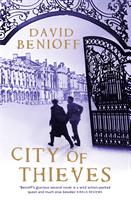 David Benioff can write. There is proof on almost every page of City of Thieves, passages I want to show to my clients or bookmark for future use as examples. There’s no empty description here; everything is shown in terms of how it relates to the things around it, and to the story. See how he reminds us of his characters’ precarious physical state, not by bludgeoning us with repeated, shoehorned references, but by bringing it up where it’s relevant, and where we can see how it influences the story:
We ran for the stairway door, abandoning our firefighting tools, racing down the dark stairwell. We were fools, of course. A slip on one of those concrete steps, with no fat or muscle to cushion the fall, meant a broken bone, and a broken bone meant death.
This is much, much better than just peppering the text with synonyms for “skinny”. And as Lev and Kolya walk around the city, we see not just what they see, but how they see it and the impression it makes on them. Read the full review >>
The Creator’s Map by Emilio Calderón
Tuesday, 22nd July 2008.
Rome can be a dangerous city to write about. There’s so much culture and raw information tied up in the city’s streets, buildings, and monuments, that it’s easy for a writer to get distracted from the job in hand. In The Creator’s Map, author Emilio Calderón has trouble setting aside the guidebook and concentrating on the story. Read the full review >>
Mistakes writers make
Saturday, 19th July 2008.
 Of the many different sorts of shark that operate in the freelance editing business (and more specifically, the critiquing business), one of the more uninspiring varieties is the critique copy-and-paster. When you get a critique from one of these guys, what you actually receive is a collection of barely personalised pieces of generic advice, copy-and-pasted from their database. They pick whatever seems to fit the bill, and slap it in. It’s the equivalent of modern customer service emails, where you get a barely-relevant, generic reply. Only, of course, you pay a lot more for the critique. (Keep reading …)
The Widow’s Secret by Brian Thompson
Monday, 7th July 2008.
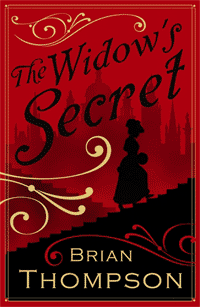 What marks out a new detective series? There’s the era, of course, with historical crime fiction becoming ever more popular. Then there’s the character of the detective, whether an alcoholic Ethiopian tramp in a Roman suburb or a forensic anthropologist in Canada, and then there’s the nature of the crimes to be investigated.
Finally, there are the tools of justice; crime stories don’t always have to end with the amateur sleuth peering over the bridge into the torrents below (where a top hat can be seen being tossed to and fro in the foam), or handing their prey over to an obliging if misguided constable. For example, in The Widow’s Secret, Brian Thompson has created Bella Wallis, a nineteenth-century sleuth who settles her quarries’ hash by ruining their reputations through thinly veiled caricatures in sensation novels. (Keep reading …)
Advice for young writers
Thursday, 3rd July 2008.
I often get emails from teenagers and younger writers looking for advice (or simply moral support) on their writing. For a while I’ve had a sort of generic advice email that I’ve sent them, but I thought it might be worth expanding on that and posting it here in the blog. (Keep reading …)
