

Burial (and Always the Sun) by Neil Cross
Saturday, 31st January 2009.
One of the pleasures—and privileges—of my work is watching a manuscript evolve through rewrites, as the author develops new ways to settle the prose around the story. It’s also fascinating to watch published authors evolve from novel to novel, and thanks to Simon and Schuster, I’ve recently been doing that with Neil Cross. I started with Always the Sun, his fourth novel (published in 2004), and then moved on to his new book Burial. (Keep reading …)
Scrivener Review: software for writers
Wednesday, 21st January 2009.
As a rule, I’m highly mistrustful of software that targets itself at fiction writers. While the elaborate formatting conventions of screenplays mean that Final Draft is a useful tool for screenwriters, there’s a large part of me that believes the only things prose writers need are something to write with, something to write on, and a dictionary. Software that, for example, allows you to input a number of aspects of your novel—character name, inciting incident, plot twist 2b—and then arrange them into a pre-formatted structure, is a bad thing. Writers need to be do these things for themselves; if they can’t, they’re very likely going to have deeper problems that a piece of software isn’t going to fix.
So, when I read on the BBC Website that Neil Cross does most of his writing on a piece of specialist software, I was a little sceptical. Still, I thought I’d take a look. As is so often the case when I overcome one of my many prejudices, I’m glad I did. (Keep reading …)
Lichtenberg and the Little Flower Girl by Gert Hofmann
Saturday, 10th January 2009.
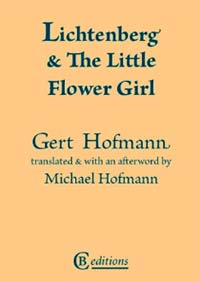 Sometimes, when you read a lot of fiction, it all begins to feel much the same. A monotony sets in: sentence follows sentence, chapter follows chapter, book follows book, all trudging past like prisoners on a death march across a blasted winter landscape. The prose does what it must in order to survive, plodding ever forwards, and once in a while a book misses its step, falls, and receives a shot to the back of the head. (I mean that it gets put down unfinished. Bear with me.)
Then a book comes along that’s filled with such vital, remarkable prose, that it reminds you what fiction is capable of. Lichtenberg and the Little Flower Girl is such a book, an explosion of language that leaves the reader wondering, as the publisher might say, How did he do that? This is the kind of prose that makes you want to get up and run around the room, and it’s another feather in the cap of CB Editions, who’ve finally given it a UK publication. (Keep reading …)
Crime Classics from Atlantic Books
Wednesday, 7th January 2009.
I have a theory that I revisit once in a while, but don’t often share with others because I suspect it’s largely nonsense. It goes something like this: Each of the main types of genre fiction, e.g. crime, romance, science fiction, etc. in some ways represent a distillation of one element of the writer’s art. So, for example, romance concentrates on character motivation, the drives of the separate characters and how they might conflict or be aligned. Fantasy—when it’s done well—might be said to look at the description of society and social setting. Crime fiction, following this theory, is all about the mechanics of story and plot exposition. After all, crime stories are often (although certainly not always) quite literally about the process of exposing the plot.
 So whatever genre a writer might be working—or wanting to work—in, it’s worth taking a little time to explore some of the others and see what might be learned from them. For a lot of writers, the chances are that they’ll start such an exploration with crime fiction. Crime, after all, is often seen as “The genre it’s okay to like”, lacking the stigma of fantasy, sci-fi or romance. So, having decided to explore crime fiction, a writer would want to read some modern authors and the classics. The question of where to begin with an exploration of classic crime fiction has been neatly answered by a new series of Crime Classics from Atlantic Books. (Keep reading …)
The Maze of Cadiz by Aly Monroe
Saturday, 3rd January 2009.
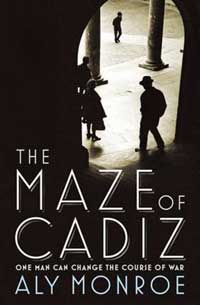 Publishers John Murray have a penchant for thrillers and adventures set around the world, often written by expatriates. One example from last year was The Creator’s Map—Emilio Calderón’s tale of espionage in wartime Rome—and more recently they’ve published The Maze of Cadiz, the debut novel from Aly Monroe.
The Maze of Cadiz introduces British “economic warfare” agent Peter Cotton, who’s set to appear in a series of novels from the author. This first story sees Cotton sent to Cadiz in the closing days of the Second World War. His mission is initially to locate and relieve R A May, a British agent assigned to watch imports and exports in the port, and who seems to have gone rogue, withdrawing large sums of money and not replying to communications. Before Cotton can reach him and discover the reasons for his strange behaviour, May turns up dead. Cotton’s left to tidy up the mess, his only official contact in the region an obstructive vice-consul. (Keep reading …)
Doctor Olaf van Schuler’s Brain by Kirsten Menger-Anderson
Friday, 2nd January 2009.
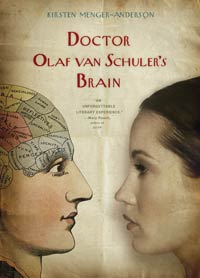 Doctor Olaf van Schuler’s Brain, the debut collection of stories by Kirsten Menger-Anderson, uses compact, unsettling prose to follow the strains of madness and obsession across a dozen generations of a family of doctors.
The early stories in the collection are short and focussed almost entirely on their characters, with just enough period detail to fix them in place and time. This sparseness of setting makes some of the stories seem strangely intangible, like dreams related by somebody who’s just woken up, and adds to the curious atmosphere of the book. Those descriptive details that do exist have an unsettling quality of their own, such as this early description of Dr Olaf van Schuler’s relationship with his mentally ill mother:
When he was home, he sometimes released her so she could pace the thirty-foot length of their single-room dwelling, or kick the straw pallet he slept on. He let her shuck the corn that grew wild in the small lot behind their back door, and stir empty pots, which he set up on the dining table. She liked tangled yarn. He left bundles—in every color—on the floor amidst the clutter. He recited scriptures to her, knelt with her in prayer, and said nothing when she woke late at night to call upon God and plead for forgiveness.
The best books I didn’t read this year
Friday, 2nd January 2009.
I’m doing something a little different for the end-of-year round-up this year. Instead of the best books of 2008, here are some of the titles that I’m sure would have been good… if only I’d got around to reading them. (Keep reading …)
