

 I think I’ve mentioned before on The Fiction Desk that I’m partial to reading the odd literary biography. The Brief Lives from Hesperus are handy little books, but nothing quite matches the satisfaction of a bulkier, blow by blow account of an author’s life, particularly when that author is as interesting as Arthur Conan Doyle.
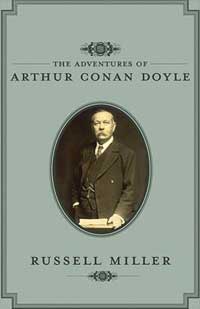
Russell Miller’s The Adventures of Arthur Conan Doyle was published late last year by Harvill Secker, and as usual with that imprint, it’s a lovely edition. (Am I the only person who wishes more publishers gave their hardbacks the solid, flat spines that Harvill Secker use?)
The basic facts of Arthur Conan Doyle’s life are pretty well known by now: the creation of Sherlock Holmes, his experiences as a wartime doctor, the obsession with spiritualism, and the unfortunate incidents of Piltdown Man and the Cottingley Fairies.
He was born into a family with a high mortality rate, and his father spent much of Conan Doyle’s life institutionalised for insanity brought on by alcoholism. His brother and son both died soon after the First World War from pneumonia related to the 1918 influenza pandemic (the famous Spanish flu, which killed far more people than the war itself).
As well as recounting some of the lesser known episodes from Arthur Conan Doyle’s life—for example, the summer he spent seal-clubbing in the Arctic—Miller’s book allows us to follow the chain of cause and effect, both literary (the creation of Sherlock Holmes as a consequence of his meetings with Dr. Joseph Bell and a perceived changed in the needs of London’s magazine readers) and personal; Miller does a good job of examining the author’s rising interest in spiritualism as a partial consequence of the loss of his brother and son. He also examines the effects of spiritualism on Conan Doyle’s own life and work. (His later novels, now largely forgotten, seem to have been muddled and unsuccessful attempts to blend adventure with heavy-handed allegorical references to his new beliefs.)
Aside from the damage he did to his literary reputation, what really stands out from Arthur Conan Doyle’s story is the way he seems to have become an anachronism in his own lifetime. He lived from 1859 to 1930, and that’s a complicated period over which to have lived a life. The world after World War One was a very different place to what it had been before the Boer War. A constant campaigner for a wide variety of causes, perhaps Arthur Conan Doyle wasn’t able to adjust to the changes in society with as much success as he had when he campaigned for change, and there’s a sense in the book that it was these changes as much as his bereavements that might have led Conan Doyle in seach of new causes, and new ways to try to make sense of the world.
Towards the end of his life, Arthur Conan Doyle was interviewed by a film crew about the creation of Holmes and his interest in spiritualism. The interview is described in the book, and you’ll also find it on Youtube.




March 2nd, 2009 at 8:24 pm
Hi, Rob,
This is absolutely fascinating. I’m going to read this book. I loved the interview, too – how amazing to see Conan Doyle himself!
Elaine
March 2nd, 2009 at 8:33 pm
Hi Elaine!
It’s certainly an interesting book, so I think you’ll enjoy it. I was was surprised to find the interview as well. One tends to forget that these old authors were captured on film (there’s even some footage of F. Scott Fitzgerald knocking around somewhere, though not much of it).
Let me know how you get on with The Adventures of Arthur Conan Doyle!
March 2nd, 2009 at 10:31 pm
This is so interesting. I didn’t realize he had such a complex life.
Maybe I will read the biography myself!
March 3rd, 2009 at 4:11 pm
It’s definitely worth reading… have you ever read any Holmes?
March 5th, 2009 at 11:00 am
Nope! I suspect though that they’re more expensive, as the boards which make up the covers and spine are much thicker. (In fact, most hardback spines don’t have board in them at all.)
I have read most of the Sherlock Holmes stories and thought my interest in Conan Doyle’s life had been adequately served by Julian Barnes in Arthur & George. But maybe not.
You justify, or at least seek to explain, Conan Doyle’s interest in spiritualism and other anachronisms by reference to the times he lived in – but H.G. Wells his close contemporary (born six years later) and had much more ‘modern’ ideas. Perhaps ACD was just a silly old duffer. Who wrote some very good books.
March 5th, 2009 at 2:13 pm
Hello John!
I’m sure you’re right about the cost implications of those spines. Shame. I’m sure I’ve actually bought books for that spine in the past.
I was thinking not so much that ACD’s spiritualism was a product of the times he lived in (except in a general way), but rather that he went off-centre because he wasn’t able to adapt as those times changed. He seems to have been rooted very much in what were increasingly outdated ideas of behaviour and Britishness. He had a strong character, and I think that when strong characters are robbed of their context, they’re more likely to shoot off in a very strange direction than to lie down quietly.
The comparison with H.G. Wells is interesting. I must admit that I don’t know a thing about his life. I can believe he was more adaptable to the changing times, though: his writing seems more interested in the possibilities of the future, while ACD was interested primarily in the past.
Or maybe I’m just talking nonsense.
March 5th, 2009 at 2:50 pm
No, I think you’re speaking perfect sense.
A moment of synchronicity: I am currently reading Rana Dasgupta’s novel Solo, and the mention on the current page of Sherlock Holmes reminded me of this review and I came to this page to read your comment. Then I turned back to Solo, and found that the very next sentence made reference to H.G. Wells.
Clear evidence of ‘spiritism’ and fairies.
March 5th, 2009 at 2:59 pm
What isn’t? :)
March 7th, 2009 at 10:54 am
[…] I was reading The Adventures of Arthur Conan Doyle, I came across the following passage in which Conan Doyle described his reasons behind moving […]
March 7th, 2009 at 9:36 pm
Sold! To the man with too many books already. Bought this in Waterstone’s the other day, after noting that the good quality fine paper meant the book is not actually all that thick despite being 500 pages long. This of course is highly important when it comes to fitting on the shelves which will be its home for the next two-and-a-half years before I actually get around to reading it.
March 10th, 2009 at 10:17 am
That’s great, John! I hope you enjoy it, whenever you get around to reading it. It is a lovely edition, isn’t it?
Incidentally, I remember you were interested in Edward Hogan’s Blackmoor too. Keep an eye out – it came out in paperback last week…
March 10th, 2009 at 12:08 pm
Yes I was, and I saw it in the shop last week too. I resisted though, as I just have too too many books awaiting attention at the minute, most of which – Baker’s Human Smoke, Fallada’s Alone in Berlin etc – seem to be over 500 pages long. Also I seem to be reading a lot of fiction in translation at the minute – some Independent Foreign Fiction longlist titles – and for some reason, Blackmoore doesn’t appeal right now in the middle of all those (even though, logically, it might do precisely because it’s not like them).
March 10th, 2009 at 12:17 pm
Argh, the long books!
I see your recent life changes haven’t interfered with your reading as much as you thought they might. You’re an inspiration to us all…
March 10th, 2009 at 5:21 pm
Well, only because Mrs Self is on feeding duty during weeknights so she goes to bed about 9pm, which gives me until midnight with nothing to do except watch over a sleeping baby till his last feed, and read and blog. When he actually starts sleeping through the night, I’m screwed.
March 11th, 2009 at 12:45 pm
Maybe you could start slipping espresso into that last feed, just to throw things a little in your favour?
April 3rd, 2009 at 3:42 pm
[…] setup is not wildly different to the one that Conan Doyle would later employ for Sherlock Holmes: the stories are narrated by a companion, who meets the […]
November 6th, 2009 at 2:38 pm
[…] Perhaps this primarily British appeal explains the title of Roland Chambers’ new biography of Arthur Ransome, The Last Englishman. It’s a bit of an off-the-peg title, catchy but not particularly fitting, evoking an anachronistic quixotism that might have been more appropriate for Russell Miller’s Conan Doyle biography. […]
December 15th, 2014 at 9:06 am
In March 2009, above, I wrote about buying this book and referred to “the shelves which will be its home for the next two-and-a-half years before I actually get around to reading it.”
How optimistic! It’s actually been five-and-three-quarter years, as I’ve just started it. And very interesting it is too, even though I am rarely interested in writers’ formative years, and really just want to read about how they wrote the books, their publication and reception etc.