

Rome can be a dangerous city to write about. There’s so much culture and raw information tied up in the city’s streets, buildings, and monuments, that it’s easy for a writer to get distracted from the job in hand. In The Creator’s Map, author Emilio Calderón has trouble setting aside the guidebook and concentrating on the story.
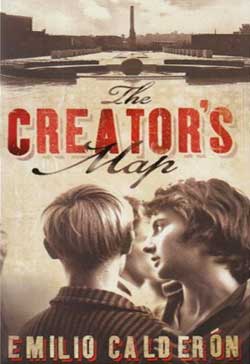 Set in Rome before, during, and after the Second World War, The Creator’s Map follows José Maria Hurtado, an architect staying at the Spanish Academy, as he finds himself drawn into the world of wartime espionage. He also falls for Montse, a girl whose family is sheltering at the Academy. His pursuit of her, and attempts to understand their subsequent relationship, provide the backbone of the novel. (The Creator’s Map of the title is essentially a MacGuffin to bring all the characters together.)
There are some good ideas here, as Hurtado and Montse are drawn into the world of espionage in wartime Rome, with its parallel realities and obscured truths, but while the characters come to life, their surroundings never quite make it. And while Emilio Calderón has clearly been inspired by the time he himself spent in the city, that inspiration doesn’t reach the novel.
Instead, the Rome of the past is pieced together from a string of factoids and pieces of trivia. Take for example this early scene in which the future lovers take their first walk together:
When we got to Piazza Navona we stopped in front of the Fontana dei Fiumi, Bernini’s most famous fountain.
“They say that the giants who represent the Nile and the Río de la Plata are shielding their eyes so as not to see Borromini’s church of Sant’Agnese in Agone,” Montse said, repeating a popular legend. “Apparently, there was great enmity between those two great artists.”
“Everybody tells that story, but it’s not true,” I said. “The fountain was built before the church. The giant who represents the Nile is covering his face because he doesn’t know where he comes from.”
…and so on. This kind of dialogue belongs to the “stilted exposition” school, except that what’s being exposed—at the cost of realism—has absolutely nothing to do with the story. And these conversations and observations crop up throughout at least the first half of the book. In the same vein, it isn’t necessary to know every road a character takes to get from A to B, and he should be able to drink a cappuccino without somebody “happening to mention” the origin of the word. These are the kind of pedantic trivialities one expects to find in self-published expat memoirs, rather than commercial thrillers; a good rule of thumb to avoid this sort of problem is ‘if it’s in the Rough Guide, don’t put it in your novel’.
There’s also nothing to fix Rome in the period: The mid-thirties Rome of The Creator’s Map could just as easily be Rome today, and when the Germans arrive, rather than attempt to evoke what must undoubtedly have been a hellish atmosphere (think Rome, Open City), Calderón seems to give up describing the city altogether. In place of a serious attempt to evoke the atmosphere of the doubly besieged city, he simply mentions one or two of the more famous atrocities. These stilted surroundings give the curious impression that the characters—who are themselves well realised—are floating slightly outside of space and time.
The story itself is a good one, and again the characters are convincing, and there’s enough there to provide an enjoyable, light summer read, but a little more imagination—as opposed to research—into the setting would have made for a better book.



July 22nd, 2008 at 3:02 pm
I think I’ve read one or two of those expat books! At least this has a story to it, though?
July 22nd, 2008 at 3:28 pm
A story and characters! It’s really almost there, but the handling of the environment is so badly done, it’s strange. If that had been fixed up, and maybe slightly more polish applied to the ending, this would be a nice little classic European thriller. As it is, it’s good enough for a holiday read but it doesn’t have the power it might have done.
I did wonder whether I was being over harsh because of my familiarity with Rome, but I don’t think that’s it. I think Rome’s just particularly susceptible to this kind of problem, because of the sheer quantity of information about the city. A lot of the trivia that crops up in the book are cliches of expat and tourist conversation in the city, and I can almost see Calderón getting home at the end of a day’s exploring and scribbling down every interesting tidbit he heard. I’ve made the same mistake in my own writing, and seen it in many other people’s, and it’s always worst when it’s Rome.
July 24th, 2008 at 11:57 am
Interesting review. I see your point about using cliche’, it seems like a common mistake among writers setting their novels in well known cities. Could you recommend a good book on Rome?
July 24th, 2008 at 12:09 pm
Hmm… a novel, you mean? There must be loads, but I can’t think of any right now. I’ll have to have a think…
August 6th, 2008 at 12:51 pm
Do you think the difficulty may in part be that, having done the research, the author wants the research to show on the page? Even where, as here, that leads to exposition and to a rather artificial break in the story?
I didn’t think your review came over as harsh by the way, you identify serious failings (evocation of time and place is surely critical to a novel of this sort) but you also complement him on characterisation, story and readability which (again for a novel of this sort) are no small matters. It seemed to me fairly balanced, there is good in the novel and it’s not simply bad, but it also has deep flaws which Calderon could usefully address in future.
Interesting question from Petulia, I know Rome pretty well myself and I can’t think of any. Has Michael Dibdin done any Rome based Aurelio Zen novels? He must have done, but it’s hard to recommend such without having read them.
Rome to me is a cinema evoked more in cinema than literature, but that may just be a lacuna in my reading.
August 7th, 2008 at 8:43 am
Hi Max,
I think it may be a particular problem with Rome. There’s so much information in the city, tied up in every monument and every street corner, that it’s easy to fall under the impression that you’re privy to some special, obscure piece of information that’s worth sharing. It’s exciting to learn this stuff for the first time, and I think sometimes people forget that it doesn’t make for great storytelling. You probably know what I mean.
I suspect the city (and Italy as a whole) also attracts more than its fair share of those terrible expat memoirs full of trivia and swooning observations on the taste of gelato.
I think you’re right about Rome being more evoked in cinema than literature, too. I’ve had trouble thinking of any (English language) books set in modern Rome, but cinematically it’s a goldmine.
August 7th, 2008 at 4:31 pm
My wife has an extensive collection of Italian social realist cinema, which rather spoils me in that regard (though I’ve personally only watched a fraction of them so far).
I’m pretty sure there’ll be a Dibdin set in Rome, which would be contemporary. Otherwise I’m empty on that one. Of course, we are seeing more contemporary Italian crime fiction crossing over in translation, so it might be worth looking more to that. Europa Editions http://www.europaeditions.com/index.php are very good for translated Italian crime (among other things).
August 12th, 2008 at 9:43 am
Sounds like a good collection to have. I’ve got a few, but not as many as I’d like.
I have an Italian friend who writes crime fiction set in Rome, but he hasn’t been translated. Bitter Lemon Press is another publisher that brings a lot of Italian crime into English.
August 19th, 2008 at 2:10 pm
[…] The Creator’s Map demonstrated the expat writer’s pitfall—the risk of going away to another country, only to […]
January 3rd, 2009 at 6:04 pm
[…] have a penchant for thrillers and adventures set around the world, often written by expatriates. The Creator’s Map, Emilio Calderón’s tale of espionage in wartime Rome was one example from last year, and […]
August 28th, 2009 at 6:27 pm
[…] and adventures set around the world, often written by expatriates. One example from last year was The Creator’s Map—Emilio Calderón’s tale of espionage in wartime Rome—and more recently they’ve […]