

This summer saw the publication of The Seven Lives of John Murray, Humphrey Carpenter’s biography of that great independent publishing house. It’s a terrific read all round – of which more below – but something particular that struck me was its description of a publishing model common during the late 18th century, when the first John Murray arrived in London and started his business.
Most likely, you’d start by opening a bookshop. With this as your base, you’d then begin to acquire copyrights and print books, either by yourself or with other publishers, each taking a percentage share in the project. You’d sell these through your own shop, and at a discount to other shops – meanwhile buying their books to sell yourself. The result was that the industry across London functioned as a kind of loose cooperative, with shops selling their own books and each other’s.
The back and forth of stock apparently meant that money rarely changed hands between the booksellers: instead, a web of IOUs and credit notes would cancel each other out. The money came in from the customers nonetheless.
Today, as the available markets continue to shrink for small publishers, and with all the new tools available with which small businesses can build brands and communities, I’m wondering whether this might not be a model that small publishers could return to, at least in part.
For a bookseller-publisher, costs can be spread across both sides of the business: premises serving as retail outlet, event space, and office; stockroom or shopfloor staff fulfilling web & mail orders in quiet moments; brand awareness campaigns benefiting both sides of the business.
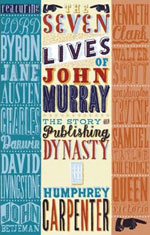
The Seven Lives of Juhn Murray
John Murray, one of the oldest, greatest independent publishers was finally sold in 2002, after 234 years of trading. Humphrey Carpenter was hired to produce a definitive biography of the house, published this year in paperback.
Although Carpenter passed away before finishing the book, it’s a very entertaining and informative read that covers the various Murrays’ dealings with Jane Austen, Byron, Charles Darwin, and countless other authors, as well as showing the progression from those early days of “gentleman” publishing to today’s less forgiving commercial environment.
Many publishers, like Melville House or Persephone Books, do have a dedicated retail space but some only use this to sell their own titles, or only a very limited range, which effectively means that the retail space is likely to be preaching to the choir, rather than making new converts – it certainly does nothing to spread risk. The advantage of a full-fledged bookshop is that it enables publishers to present their titles in the context of a fuller contemporary range, and to promote them to casual browsers and customers. The only examples of this full-fledged bookshop/publisher that I can think of off the top of my head are the aforementioned Melville House, and City Lights in San Francisco, but I’m sure TFD readers can think of plenty more.
Combining bookselling and publishing might help with promoting and positioning the books, and the two complementary businesses, if run well, can provide each other with some kind of backup, but there are obviously much higher set-up costs involved if you’re going to launch a new list as well as stocking and staffing a bookshop.
It’s interesting therefore to read of the collaboration between Big Green Bookshop in London and Gallic Books. This experimental project sees Big Green Bookshop carry Gallic stock in prominent areas of the shop, in return for which they receive better terms, as well as additional custom as fulfillers of Gallic’s mail order business. They’ll also be holding regular events for Gallic Books, and the two companies’ websites are well linked. The best part is that it doesn’t involve price promotions: this isn’t about getting the books out cheaper than the other guy, it’s a proper, sustainable program to build audience for both publisher and bookseller.
The twinning of Big Green and Gallic Books seems to me like a fantastic way for both bookseller and publisher to reach new audiences, and it’s going to be interesting to see how it works out for them as they experiment with ideas which, while they might seem new, hark back to an era when John Murray I was urgently reissuing editions of Rousseau, hoping to capitalise on news of the French Revolution.




November 17th, 2009 at 6:38 pm
The new independent publisher, To Hell With Publishing, who run To Hell With Journals and are launching To Hell With First Novels next year (or maybe end of this year?), operate out of a bookshop called Amuti on Woburn Walk. They are renovating it at the moment and it will be full of great books they love, special editions of things they do bespoke, plus their own books as the list builds up. They’ve got some cracking furniture and art in there too that I hope they keep.
Here’s their website: http://www.tohellwithpublishing.com/
November 17th, 2009 at 8:51 pm
That looks like an interesting project. I’ll have to drop by next time I’m in London.
November 17th, 2009 at 11:13 pm
Rob: Check this out ( http://www.rizzoliusa.com/bookstore.html ) for perhaps the ultimate in publisher-bookstores. Since the site is only a few blocks from the Museum of Modern Art in New York, between 5th and 6th Ave., it is located in very high-rent territory. Okay, Rizzoli’s publishing menu of art, design, fashion, etc. is equally high-end, but it is a wonderful bookstore just to wander around if you happen to be in that part of New York. And their books are equally wonderful if the subject matter happens to be your cup of tea (my wife has a fashion collection that is her pride and joy).
Perhaps more relevant to your post is an exploration of publisher-based online bookstores. I know they all have them now, but no one seems to be able yet to match online bookseller discounts and free shipping. I’m intrigued by some of the “buy all we publish” for a bargain (Pushkin, I think) but can’t see that really catching on. But given that the oligopoly retailers are already beating them up for discounts, I have to believe that someone will find the right model soon — I suspect some of the more specialist genres that I don’t follow may have already found it.
A most interesting post, by the way.
November 18th, 2009 at 9:12 am
Great article Rob! I agree, that new and more focussed ways of getting books to readers are needed. You solution makes a lot of sense, especially for small imprints. This is also the idea behind One Book Press, where readers can commission image-driven books on the topic of their choice.
November 18th, 2009 at 11:43 am
Kevin – the Rizzoli bookstore does look like a wonderful place. From what you say, it sounds like it’s well placed too.
You’re right that publishers should put more thought into their online bookstores, but I think that competing on price is the wrong answer – in the past, Amazon has even tried to stamp this out by threatening to apply any publisher webstore percentage discount to the wholesale price they pay. Publishers probably can’t win that game (and make a profit), so they need to find other compelling reasons to purchase directly from them.
You’re right that those ‘buy all we publish’ models are interesting and often tempting. PS Publishing offers a one-off lifetime subscription to their limited editions, and judging from the eBay listings, it looks like rare book dealers have snapped up some of those.
November 18th, 2009 at 12:52 pm
[…] the field and I fell I really should have given them a little more credit. Interesting article at The Fiction Desk discusses the role of the bookseller publisher after the publication of teh house’s history […]
November 18th, 2009 at 2:45 pm
Really interesting article, and having met the Big Green Bookshop guys I hope it proves very successful for them, and Gallic Books. I love the idea of a publishing book shop – but it would have to be so central to make it viable as a retail outlet. Internet sales are good but a cold experience, with only discounts and free P&P to make them anything other than a poor alternative. It’s the whole ambience thing of a shop which makes it attractive.
I sell my books direct from my website, and my USP is that any book ordered will be dedicated to the recipient and signed by me. Not much else you can do online to make it an attractive proposition.
The other point for the publishers’ shop idea is to sell additional merchandise linked to the books or the publisher (thinking of the Penguin mugs, deckchairs, etc). I sell greetings cards, posters and T-shirts all linked to my books, and am currently producing a range of beautiful jewellery (as mentioned in the Stonewylde books) too. Book related merchandise may well be the way forward for book shops, and in fact Mostly Books in Abingdon said once that their highest selling product was greeting cards. Maybe they should rename themselves “Mostly Cards”!
November 18th, 2009 at 5:38 pm
Great read. I’m reminded of the underground press and I think we’ve seen this bookstore-publisher trend happening in the horror genre for awhile now. Delirium Books, for instance, is attached to their electronic bookshop, at horror-mall.com It seems to succeed when mainstream publishing marginalizes a genre when it doesn’t trend, fomenting into a niche audience where sellers collectors and readers can trade. But there’s a degree to which newcomers to the community (say new, potential vampire fans) get lost in the mix, which is worrisome. The mass market is important if only to turn new audiences on to dialogues and communities that they wouldn’t hear of otherwise. Perhaps the internet age is reducing the need for the mass market to do so, but it’s still an issue.
— Mike Arnzen (writer)
November 18th, 2009 at 6:51 pm
The creation of the Espresso Book Machine by On Demand has the potential to resurrect the publisher/bookseller model, and do so while allowing booksellers access to many of the same books they now offer.
However, for that to happen mainstream publishing will need to rethink its addiction to the hardcover, perhaps by offering same in limited/collectors editions while publishing for the general book buyer in trade paperback and ebook.
Until that happens, booksellers could look at the offerings of small publishers utilizing the printing services of those companies with arrangements to supply the EBM. As the books are printed onsite at time of purchase the major obstacle to such an association–the refusal of many of us to agree to accept returns–becomes a non-issue.
November 18th, 2009 at 8:36 pm
Interesting. That’s beginning to happen here in the U.S. a bit with the Espresso Book Machine. In the UK the EBM is used for printing public-domain books, while in the U.S. independent bookstores are setting up their own imprints: The Northshire in Manchester, VT has Shires Press, and in St. Johnsbury, VT it will be Railroad Press. (The Harvard Bookstore is trying this out too.) But these are open to anyone; there’s no editorial selection. I’ve brought out my book “The Therapist’s New Clothes” through the Northshire (my local bookstore) and have been documenting the various implications of this model on my blog: http://litadventuresinpod.blogspot.com. As someone who’s published plenty the old way too, I feel there’s a lot to be said for publishing via the bookstore. There’s definitely more of a we’re-in-this-together feeling.
August 27th, 2010 at 12:55 pm
[…] Last year, publisher Gallic Books formed a great (and still going) partnership with London bookstore Big Green Bookshop. I loved the idea of a bookshop and publisher teaming up, which used to happen all the time (John Murray, for example, started as a bookseller / publisher). There’s more about this here. […]