

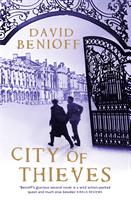
David Benioff’s new novel, City of Thieves, tells the story of two young men—one in his teens and one just out of them—who are arrested during the siege of Leningrad and given a stark ultimatum: find a dozen eggs for the Colonel’s daughter’s wedding cake, or be shot. As they begin to search the ruined, starving city on their impossible quest, City of Thieves unfolds into an involving and well-told adventure, that suffers only from a distracting and unnecessary framing device.
 David Benioff can write. There is proof on almost every page of City of Thieves, passages I want to show to my clients or bookmark for future use as examples. There’s no empty description here; everything is shown in terms of how it relates to the things around it, and to the story. See how he reminds us of his characters’ precarious physical state, not by bludgeoning us with repeated, shoehorned references, but by bringing it up where it’s relevant, and where we can see how it influences the story:
We ran for the stairway door, abandoning our firefighting tools, racing down the dark stairwell. We were fools, of course. A slip on one of those concrete steps, with no fat or muscle to cushion the fall, meant a broken bone, and a broken bone meant death.
This is much, much better than just peppering the text with synonyms for “skinny”. And as Lev and Kolya walk around the city, we see not just what they see, but how they see it and the impression it makes on them. (This is the sort of imagination and atmospheric detail that was missing from The Creator’s Map.)
We walked alongside the frozen Fontanka Canal, the ice littered with abandoned corpses, some covered with shrouds weighted down with stones, others stripped for their warm clothes, their white faces staring up at the darkening sky. The wind was beginning to wake for the night and I watched a dead woman’s long blond hair blow across her face. She had taken pride in that hair once, washed it twice a week, brushed it out for twenty minutes before going to bed. Now it was trying to protect her, to shield her decay from the eyes of strangers.
Kaputt
Curzio Malaparte is best known to Italian schoolchildren as the author of La Pelle (The Skin), which recounts his experiences in Italy in the latter years of World War II. (The Skin makes a nice counterpart to Norman Lewis’s Naples ’44, which presents the Allied perspective.)
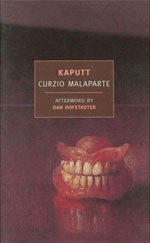
Before The Skin came Kaputt, which covers the early years of the war, when he was reporting on the Eastern front for a fascist newspaper. He observes the execution of Russian intellectuals, is given guided tours of ghettos and dines with various important (or self-important) figures in the Nazi hierarchy. The book has quite a myth to it, with a disgusted Malaparte having written it in secret and smuggled it back into Italy, but it’s also come under criticism for flights of fancy, with critics saying that he wasn’t present at some of the events he describes. As with Norman Lewis, though, Malaparte’s fantasising helps to tell the story he’s trying to tell, and contributes to many of the haunting scenes in the book.
Kaputt is published in English by NYRB classics.
While his descriptions work together, so the scenes of the story flow neatly, one into the next. Perhaps he’s helped by his experience as a screenwriter (he wrote Troy, although I don’t remember that being particularly exceptional), but clearly David Benioff knows how to spin his ideas and his research into a coherent, cohesive world.
Speaking of Benioff’s research, there are several moments in the book that strongly reflect Curzio Malaparte’s Kaputt (which is actually acknowledged as a key source at the back of the book). I’m thinking particularly of the scene in which the Germans test their Russian prisoners’ ability to read, which follows a scene in Kaputt so closely that one can almost see Malaparte hovering there in the corner of the courtyard, taking notes.
But while the story itself is a fine adventure, well told, there is a curious distraction in the form of a very brief first chapter, in which a writer called David visits his grandparents, and begins to ask his grandfather about his experiences in Russia during the war, which then leads into chapter one; essentially, the story is presented as being the experiences of Benioff’s grandfather.
The problem here isn’t the fact that it’s not true (this is a novel, after all), but that there’s absolutely no point to it. It feels like a half-cooked metafictional conceit that should have been trimmed from the first draft for redundancy. And I suspect the strange shadow it throws over the book may be at least partly to blame for the emotional detachment that other reviewers have complained about—because certainly the meat of the storytelling is engaging enough.
So why is it there? Are authors today afraid to spin a straight tale? Do they feel the need to pack some kind of post-modern tidbit into every book they write, to prove how “now” they are?
Perhaps the truth in this case is more an awareness of his market. During an interview in the Independent earlier this month, Benioff commented on what the article called “an unshakable prejudice in America against novels set abroad”:
“One of my best friends wrote a book and the first chapter was set in Poland. He got a note from his editor saying: ‘I wonder if we should move this opening chapter from Poland to the States? It’s hard for me to imagine that anyone will be interested in a story that takes place so far away.’ An editor at a major publishing house.” Benioff shakes his head and says that he told his friend to send the editor a letter beginning: “In a galaxy far, far away…”
While he may dismiss the idea in the interview, I really can’t see another reason for the presence of that first chapter; Benioff seems to be trying to comfort the reader by offering some connection between the story and America, the story and today, and (most uncomfortably), the story and himself.
There is one other possible explanation: maybe David Benioff is just frightened of beginnings. Certainly, he’s put considerable energy into both of the book’s opening lines. The first, introductory chapter, begins My grandfather, the knife fighter, killed two Germans before he was eighteen. The second chapter begins the “real book” with You have never been so hungry; you have never been so cold. Both seem overly eager to please, to promise great, dramatic things before you have the chance to put the book down. Benioff even pokes fun at himself; Kolya, the older of the two boys, is discussing a novel that opens with the line In the slaughterhouse where we first kissed, the air still stank from the blood of the lambs. Lev is quick to dismiss this as melodramatic, although it’s no more so than either of Benioff’s opening lines. Perhaps this framing device is simply an extension of that; a difficulty in warming up, in trusting that the story will be enough.
Whatever Benioff’s reasons for writing it, that first chapter is redundant and distracting; but skip it, or forget it, and City of Thieves is a terrific, well-written adventure.



July 28th, 2008 at 10:57 am
Troy, “Not particularly exceptional”? :-) I suppose it depends how much you value your Homer…
July 30th, 2008 at 12:30 am
I am really going to have to read City of Thieves. thanks for bringing it to my attention! :-)
July 30th, 2008 at 8:49 am
Marie, you’re welcome. Let me know what you think when you’ve read it!
Darren, the problem was, I remember not liking Troy, but I don’t remember anything about the film itself—just my not liking it. So I didn’t want to knock a film that I couldn’t remember…
August 6th, 2008 at 12:18 pm
Nice review, it’s good to know that the first chapter is extraneous, knowing that makes quite a big difference to how I’d approach the book (and indeed makes it more likely I will approach it, otherwise I might have read the first few pages in a shop and put it aside).
One for the to be read pile I think.
August 6th, 2008 at 12:55 pm
Rob, you say that the opening chapter reads like a metafiction conceit or an example of an attempt to prove how “now” the book is – but couldn’t it also be a throwback to the framing device which features in so much (particularly European) literature of the 19th and early 20th century? Recent stories I’ve read by Tolstoy, Turgenev and (most of all) Zweig are presented in this form: the narrator is relating something which was related to him, and the story proper only begins after this entirely extraneous introduction.
On the other hand, the editor’s advice you quote is compelling evidence.
This point also reminds me of the advice (by whom? I can’t remember) that writers should consider chopping off the last chapter of their novel to see if it provides a more satisfactory conclusion; apparently often it will.
Finally I am intrigued by the reference to Curzio Malaparte’s Kaputt, purely from my mild fetish for NYRB Classics. Can you tell us more about it, Rob?
August 6th, 2008 at 3:36 pm
Lermontov uses that device too, it’s particularly common in Russian fiction of the periods John cites. This doesn’t sound like a novel aiming for that sort of effect, but perhaps it is more ambitious than one might imagine.
I’m also curious to hear more of Kaputt, which I’ve never heard of before.
August 7th, 2008 at 8:56 am
Hello John and Max,
You both make a good point about that kind of framing device—it made me think of old-fashioned ghost stories, those “cosy by the fire” openings which I suppose also serve to create a bridge between the reader’s home environment and the world of the story. In this case, though, I don’t think he had the traditional model in mind. Aside from what I said in the review, he’s also talked about it in a few interviews, and he hasn’t mentioned anything about traditional precedents; he’s just focussed on his right as a storyteller to blur the line between fiction and reality.
Regarding Kaputt, funnily enough I reviewed it last year on another blog, but have since lost the post. Let me go back into the review and add a sidebar about it. Watch this space…
August 7th, 2008 at 9:26 am
There we go—I’ve added some more about Kaputt, although from memory, so apologies if it’s a little vague.
August 7th, 2008 at 4:26 pm
Thanks Rob, an interesting aside, much appreciated.
August 12th, 2008 at 9:40 am
You’re welcome!
June 5th, 2009 at 12:49 pm
This book is now out in paperback, with a garish red cover and a ‘belly band’ promising satisfaction or TWO free Sceptre books in return. One of the Sceptre books you can choose is Jill Dawson’s excellent Fred & Edie, so it might be worth buying City of Thieves just to be disappointed (not that one would be, according to your review Rob) and get two decent titles in return. Neat.
June 5th, 2009 at 1:06 pm
Funny, John, I thought exactly the same thing!
I’ve not read Fred & Edie, but was always struck by the similarity of the cover with one of the Great Gatsby covers:
June 5th, 2009 at 1:14 pm
Oh that’s most interesting! Call the Caustic Cover Critic!
June 5th, 2009 at 1:21 pm
*calls*
June 5th, 2009 at 1:47 pm
Not yet, you fool! He’s in Australia, you’ll wake him up.
June 5th, 2009 at 1:50 pm
Oops… um… it was you! You made me do it! With your excited baby face!
(That’ll make no sense next time you change your Gravatar.)