

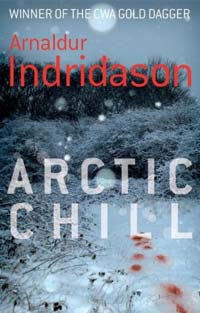
 I’ve come across a few references recently to Icelandic crime writer Arnaldur Indridason. All of them have been positive, praising his use of the Icelandic setting and the development of his brooding detective, Erlendur. His latest, the first I’ve read, is Arctic Chill.
The book begins, naturally enough, with the discovery of a body. This time it’s a young boy, the son of a Thai immigrant, who’s found dead on the ice outside his apartment building. From this beginning, Indridason builds his theme of tensions surrounding Iceland’s immigrant communities, set neatly against the backdrop of the freezing weather. All of that’s exactly what you think it’s going to be: it’s good, it works. But there’s rather too much of everything else.
Arctic Chill is Indridason’s seventh Erlendur title (the fifth in English), and over that time, the detective has picked up a sidekick or two, and a few elements of backstory, and a lot of them are on display here. At times, it feels like there’s too much going on. There are estranged relatives to be dealt with, dying ex-bosses to be visited, traumatic memories to be revisited, and so on. There are also three investigating detectives, and the narrative switches between them in a way that’s sometimes fun but still feels unnecessary. I suspect that this might be a better, tighter book if the other two—the ones that aren’t Erlendur—were simply sent on holiday for the duration.
If the novel’s story suffers from feature bloat, the narrative in Arctic Chill can also feel a little plodding and repetitive at a paragraph level, such as this scene in which Erlendur enters a suspect’s apartment:
Erlendur was more aware this time of how sparsely furnished the flat was. When he first entered he’d had the impression that it was larger than Sunee’s place, although they were, in fact, identical. Standing in the middle of the living room, he thought he knew why: there was very little furniture in Gestur’s flat.
It goes on to describe the contents of each room, and guess what? There’s not much furniture. Elsewhere are other repetitions. Events are sometimes first shown and then described in dialogue. The discovery of the murder weapon is one example: we’re shown the discovery, than one of the characters reports the discovery. In all, some of the details are repeated four times within the space of a dozen pages.
Sadly, this kind of repetition, which appears at both a sentence and scene level, really works against the book; together with the underdeveloped (here, at least), and possibly too-numerous lead characters, it prevents the prose from ever really getting off the ground.
Which is a shame, because Indridason seems to have a good eye; his observations on racial tensions in Iceland form a decent setting for the novel, and some of the minor characters are nicely developed. But overall, Arctic Chill could have used some trimming to give it a tighter focus and allow those superior aspects of Indridason’s prose more room to breathe.
I suspect that at least some of my criticisms are the result of my not having read the other books in the series beforehand, and certainly Arnaldur Indridason has a great many supporters—Adèle Geras is a self-declared Indridason bore, Glenn at International Noir Fiction is a fan, and Eurocrime thinks this might be the perfect crime fiction novel. For me, however, Arctic Chill would need to lose a good quarter before it could live up to Arnaldur Indridason’s reputation… a reputation which is, along with the qualities of this book, still enough to make me consider going back to the beginning and his first (translated) novel, Tainted Blood. As for Arctic Chill, while I can well imagine that it contains a lot of pleasures for Indridason’s fans, I’m not convinced that it will make many new ones.



March 9th, 2009 at 12:22 pm
Hm, I recently bought Tainted Blood, originally published under the far better title of Jar City, but haven’t started it yet.
Often if crime series are successful, later books are fatter than earlier ones. Physically fatter. I’ve noticed it with Rankin, I’ve not noticed a drop in quality with him (indeed I’ve read about seven of his and they actually show steady improvement if anything), but it does suggest to me a writer increasingly less within editorial control. That could be an issue here, success grants authorial power and so limits editorial influence, thus leading to fatter books.
Anyway, thanks for the review, it sounds like one for the fans. If you’ve read the first four, revisiting the characters and their messy lives might be a pleasure in its own right, quite additional to the crime elements. For a new reader, probably not.
No excuse for the repetitive descriptions though, that just sounds clumsy. Ah well, hopefully I’ll still enjoy Tainted Blood.
March 10th, 2009 at 10:14 am
Hi Max,
I really do still need to investigate Rankin. I’m sure I’ll enjoy him, but there are always a dozen other books to be read, usually by last week. I think you’re right about editorial control, and sadly it’s not limited to the crime genre.
I’d be curious to know what you thought of Tainted Blood (and I agree with you about the title) whenever you get around to reading it. There are good things in Indridason’s work, and I suspect I just started in the wrong place.
March 10th, 2009 at 12:19 pm
Interesting review. I don’t know if I’ve ever read a single book from Iceland, but I remember when Jar City came out, it was meant to be good.
March 10th, 2009 at 12:25 pm
Darren – me too. I actually had a copy there for a while. Annoying that I lost track of it before I actually managed to read it!
March 10th, 2009 at 3:15 pm
The best Rankin I’ve read so far, which I suspect may also be the most recent Rankin I’ve read (I’m working through the Rebus novels in order) is Mortal Causes. I thought that a great bit of Scottish crime fiction, using the genre to explore Scottish sectarianism – a topic many writers would not risk touching.
If you don’t want to start on the first, Knots and Crosses (and it’s only ok, it’s a first novel and rather derivative in places) then I’d suggest Mortal Causes. If you don’t like that, I doubt you’ll like any other Rankin.
If you do like Mortal Causes, I’d then go back and start again with Knots and Crosses and read them in sequence order. There are rewards to reading them in that way, characters develop from book to book, relationships blossom and wither, plus Rankin visibly improves as a writer from novel to novel (in the early ones at least).
The other cause of textual bloat I think comes in series, where fans want to know what’s happening to the various characters – both major and minor. As time goes on, new characters come in, and readers want to explore them but keep up to date with the old ones.
The result can be a spaghetti soup of seemingly irrelevant episodes where we learn how the relationship of PC Godrunsdottr with her errant boyfriend is faring, despite that appearing to have no link to the peculiar death of the Dutch tourist or whatever.
March 10th, 2009 at 8:51 pm
I can see the problem in reading this series at the end rather than the beginning.
He doesn’t focus too much on character development at least in “The Draining Lake” but when he does it relies on knowing what has gone on before and how the relationships have evolved at least that’s how I found it after reading “Tainted Blood” I guess if you like his style enough to try another Tainted Blood is good :D
March 11th, 2009 at 12:48 pm
Max – Thanks for the info on Rankin. I really must put him on my list.
Absolutely agree with what you say about the bloat. I think that’s one of the challenges that authors have to handle, though, and they should try to incorporate those updates more seamlessly into the novel’s plot.
Gav – hello! Yes, I think I will try Tainted Blood… although when I’ll get around to it is anybody’s guess…
March 16th, 2009 at 3:46 pm
Rob,
I’m reading the sixth volume of Dance to the Music of Time at the moment. I noticed how effortlessly he reminded me who characters were, which after five preceding volumes and several months gap is no small feat.
So yes, you’re right, it is a challenge authors have to handle, and Powell does so without bloat. When I blog it, I suspect I’ll be discussing your point as part of that, because when first I read it I thought “well, we should cut some slack” but reading Powell I now see that actually you’re spot on.
March 16th, 2009 at 4:38 pm
Hi Max,
thanks for coming back with this. That’s an interesting comparison. I read A Question of Upbringing last year and loved it, but haven’t yet had the chance to go any further. I’m very much looking forward to what you have to say about the way Anthony Powell deals with these problems.
March 20th, 2009 at 9:05 pm
Hi Rob,
I’ve written it up and it’s on my blog now.
March 24th, 2009 at 11:28 am
Thanks, Max!
(Anybody else wanting to read Max’s response will find it here.)
May 5th, 2009 at 1:42 pm
[…] of the fans to see what is happening to each of the characters established in earlier works. Rob pointed out that this is simply one of the challenges writers must face. At the time, I thought him a touch […]