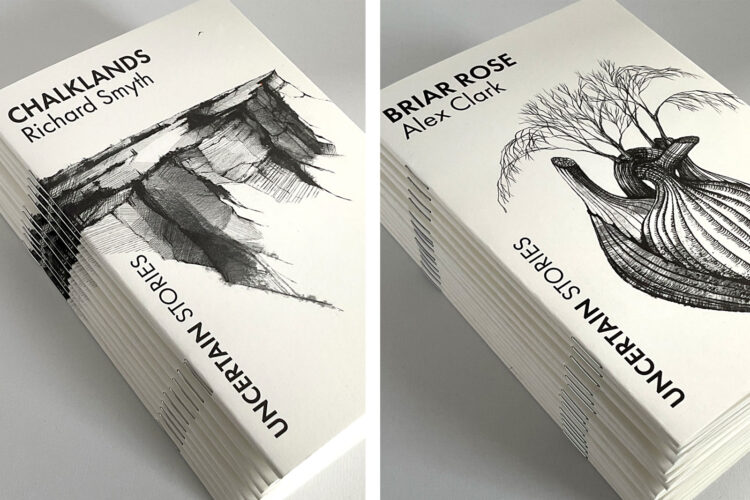
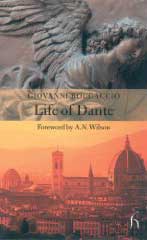
 Lately I’ve been reading two biographies: Ian MacNiven’s 800-page monster Lawrence Durrell: a biography and the Hesperus Press edition of Giovanni Boccaccio’s Life of Dante, from their “100 Pages” series. I don’t think you have to see the title of this post—or the attractive cover image on the left—to work out which one I finished first.
Giovanni Boccaccio was still a child when his fellow-Florentine Dante died in 1321. As a result of this, there’s something quite wistful about the Life of Dante, in which Boccaccio praises Dante’s virtues and rails against his enemies (including, in several stirring chapters, the entire population of Florence). It must have been frustrating to have lived so close in both time and place to Dante and yet to have missed him.
Regarding Florence and Dante’s exile, Boccaccio is less than forgiving:
Oh, what a horrible thought, infamous deed, wretched example, manifest sign of ruin to come! In place of reward, he suffered an unjust and hasty sentence, perpetual banishment, the alienation of his family estate, and, if such a thing could have been accomplished, the staining of his glorious fame by false accusations. To this the fresh traces of his wanderings, his bones buried in another country, his children scattered in others’ houses, still in part bear witness. If all the other iniquities of Florence could be concealed from the all-seeing eyes of God, would not this alone suffice to draw down upon it His wrath? Yes, indeed!
The book ends with a dream that Dante’s mother is said to have had while she was pregnant. In this dream, her son was born, fed on laurel berries, and grew into a shepherd. Then, reaching up to grasp the leaves of the laurel, he fell to the ground and turned into a peacock. At this point the mother (quite reasonably) woke up. Boccaccio goes on to analyse the dream in a tour-de-force of selective interpretation that had me running for my Freud.
Incidentally, there is some dispute as to whether Life of Dante is technically a biography at all. Specifically, this dispute takes place between pages x and xi of the Hesperus edition. On page x, approaching the end of his foreword, A. N. Wilson writes:
Although it relates to a man who suffered and died, this book is not a biography in the modern sense of the word. It is as much a work of the imagination as the Decameron or the Divine Comedy.
Wilson having put down his pen, on the following page J.G. Nichols picks up his own and begins to scratch away at his introduction:
Boccaccio’s Life of Dante may well be considered the first modern literary biography. It is certainly the first biography of Dante, and the source of many of the facts on which later biographers have drawn.
Like the dream of Dante’s mother, Boccaccio’s Life of Dante is open to interpretation. It’s also another entertaining and brisk read from Hesperus.