

Far North is my first encounter with Marcel Theroux (son of Paul, brother of Louis), and the author’s fourth novel. It’s set in a post-apocalyptic near future / alternative present / alternative recent past (doesn’t say; probably doesn’t matter), among a series of deserted towns that form a kind of new Wild East, where an increasingly desperate American population has colonised parts of Russia before all but dying out among snow, ice, and social collapse.
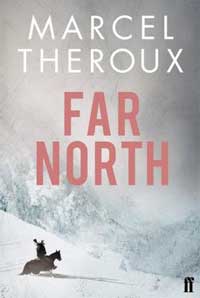 Far North is narrated by Makepeace, a peacekeeper who still does her rounds in one of these frozen, deserted towns. (Her gender is kept hidden for a few chapters, before being revealed in an Amis-like flourish, surprising but not interesting.) The first third or so of the book consists of brief, disjointed encounters with a variety of pleasant, unpleasant, and deeply unpleasant people, and concludes with her imprisonment in a labour camp. Working in the camp, she begins to hear rumours of “The Zone”, a contaminated area still full of the riches of mankind’s past…
Reading Theroux’s essay on the inspiration behind Far North, there’s no doubt that he’s taken an interesting route to arrive at the writing of this book. It was born from his experiences travelling in Russia, Alaska, Calcutta, and Switzerland, as well as his discussions with James Lovelock, originator of the Gaia hypothesis. Unfortunately, not all interesting journeys end in interesting places; sometimes they lead to a simple truism, so bland that it’s not worth mentioning. At other times, they can lead to a destination that many others have arrived at before, and this is where we are with Far North. Theroux has taken a great deal of thought, travel, and experience in order to arrive at the idea that mankind has become reliant on machines we don’t understand; that in the event of a breakdown, we’ll be living off whatever scraps we can coax from the the land and the ruins; that people in bad situations turn bad, and that one probably oughtn’t to wreck one’s own environment. It’s post-apocalyptic fiction as you’ve always seen it before, and when Theroux takes the best part of a page to share the idea that “The Zone”, once a source of wisdom to humanity but now contaminated, might be a bit like, oh, the Garden of Eden, the sheer mundanity of the cliché doesn’t feel at all out of place.
It’s a shame: the character of Makepeace has a strong voice, the narrative is convincing, and there are some excellent moments, but these feel like shiny beads sewn onto threadbare cloth. The paths that Far North follows have already been too well trodden in both genre and literary fiction.




May 28th, 2009 at 8:35 pm
Since 9/ll and with Kim Jong stupid trying to start a nuclear war I find I can’t even consider post-apocalyptic books. I am a coward and my imagination is already too good. Have you read The Road? I have it on my shelf but haven’t read it for obvious reasons.
Thanks for reading this one so I won’t have to.
May 28th, 2009 at 9:11 pm
Hi Candy,
You’re welcome! No, I’ve not read The Road, but I notice it’s often mentioned in reviews of Far North.
May 28th, 2009 at 10:26 pm
So I am not ready to read that either.
May 28th, 2009 at 10:31 pm
Never mind, Candy, there are plenty of other books out there with a more optimistic view of the future! At least, I think there are…
May 29th, 2009 at 2:03 am
Definitely there are. I can’t think of any just offhand though.