

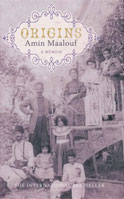
 The Lebanese author Amin Maalouf has built his career both in fiction—Samarkand, Leo Africanus, Balthasar’s Odyssey, etc.—and history, including The Crusades Through Arab Eyes.
In Origins, prompted by the discovery of a trunk containing the correspondence and notebooks of his late grandfather, Maalouf turns his research skills towards his own family background, and the result is an engrossing story of the changing shapes of families and nations during the early years of the last century.
Origins is interesting for two reasons, the first of which is the central story of Maalouf’s family. Focussing on his grandfather, the flamboyant liberal Botros, Maalouf watches as the family copes with the shifting sands of nationality—without moving from their hillside village they are Lebanese, they are Syrians, they are “from Turkey”, they are subjects of the Ottoman empire—and try to shape their lives. Believing in the importance of bolstering his country with progressive Western ideas, Botros teaches, gives speeches, and opens a co-educational “Universal school” in which the differences of religion take a back seat in favour of education. This exacerbates the feud between the Protestant Botros and his brother Theodorus, a Catholic priest who sneaks into his brother’s house in an attempt to baptise his children by subterfuge. The Universal school itself feuds with the local Catholic school, and Botros delivers impassioned speeches and writes a series of letters to a series of unheeding governments, fighting for the funding he needs to fulfill his dreams of improving his countrymen by way of a liberal education on their own land.
Meanwhile, a third brother, Gebrayel, emigrates to Cuba where he becomes successful in business but has crises of his own; in the second part of the book, Amin Maalouf travels to Havana and tries to track down traces of Gebrayel’s life and mysterious death.
The émigré’s dilemma—whether to emigrate to a country that shares your ideals, or stay put and attempt to import those ideals for the benefit of your homeland—is certainly still a relevant one, and Maalouf’s ancestors make engaging case studies.
Maalouf also talks about his approaches to his research, and the way it affects him. He starts by castigating himself for his own past lack of interest in his family origins:
How could I—by nature an inquisitive person, capable of getting up from the dinner table five times in the course of a single meal to check the etymology of a word or its exact spelling, or the date of birth of a Czech composer—have exhibited such a woeful lack of curiosity about my own grandfather?
This raises a second question: given his previous lack of interest, what were Amin Maalouf’s motivations for writing Origins? Is it an emotional journey of self-discovery? He certainly sheds a few tears along the way. Was it simply the conjunction of a researcher’s mind with the trunkful of letters? Perhaps he’s being disingenuous about having previously had no interest in his family background: the themes of the book, the issues that mattered to his ancestors, are also themes from his other writing, be they the search for personal and national identity, or the relationships between fathers and sons.
Sooner or later, Maalouf is bound to ask himself about his motivations, and he gives his answer on page 213 (Picador edition):
True, there is no need for us to know about our origins. Nor is there any need for our grandchildren to know anything about our lives. We each live through the years assigned to us, and then go to our eternal sleep in the grave. Why bother to think about those who came before us, for they mean nothing to us? Why bother to think about those who come after us, for we shall mean nothing to them? But if everything is destined to sink into oblivion, why do we build anything, and why did our ancestors build anything? Why do we write anything, and why did they write anything? Why even bother to plant trees or have children? Why do we bother to fight for a cause, or speak of progress, change, humanity, and the future? By living exclusively for the present, we let ourselves be hemmed in by an ocean of death. Conversely, by reviving the past, we enlarge our living space.
This suggests an increasing awareness of his own mortality, leading him to try to create a greater context for himself; and in his attempts to keep his ancestors alive through his writing, one can almost detect a wistful hope that he will have his own role in the story of somebody else’s origins. Could this book then be partly intended to reassure himself, that if he makes the past matter to him, he will matter to the future? If he really is seeking a kind of immortality through an encounter with his family’s past, by late in the book he has grown disillusioned:
The history of my relatives could perfectly well be told thus: the ancestors die, and from their distant deaths, their descendants die in turn. Life engenders life? No, death engenders death. This has always been for me, for us, the silent law of origins.
A sudden interest in his background, the synchronicity in the appearance of a trunkful of letters at a time when he may have needed a new project to research, or an awareness of his own mortality—whatever Amin Maalouf’s motivations for writing Origins, this book is a terrific evocation of the mindset of a genuinely interesting family, and the times and nations through which they travelled.



September 23rd, 2008 at 2:04 pm
I think I have a copy of Samarkand lying about somewhere, but I’ve never read him. Maybe I should dig it out.
September 23rd, 2008 at 2:28 pm
Fantastic! I look forward to reading this. After Samarkand and The Crusades Through Arab Eyes it will be interesting to read about stories so close to the author.
September 24th, 2008 at 6:15 am
Thanks for the review,
Amin Maaloof is a great writer.
I have not yet read this last book although it’s interesting that Amin Maaloof seems to circumvent his father by writing about his grandfather. In most of his books the father is absent or presented as a weak character. Maybe “Origins” is of the same vein as his previous works…
September 24th, 2008 at 8:46 am
Interesting point, elmaini. I’ve only read Samarkand, although we have a copy of The Crusades knocking about at home. But it’s always interesting tracing a writer’s themes and preoccupations as you discover his work. Any suggetions as to which of his novels to read next?