

 When exactly did horror fiction become unacceptable? Is there a year, perhaps, a specific date after which anything supernatural becomes the exclusive possession of the recluse, something to occupy spotty teenage boys until they discover spotty teenage girls?
I think we’re all agreed that Frankenstein and Dracula are allowed on any bookshelf. Likewise, nobody would bat an eye if they spotted the spine of an M.R. James or the ghost stories of Charles Dickens; these snuck into the mainstream through a door that somebody left open at Christmas. H.P. Lovecraft is permissible for the sake of nostalgia, and Poe, well, he wrote poems and stories set in France, so he must be okay. Shirley Jackson’s a woman, so what she writes can’t really count as horror, and anyway, she’s a Penguin classic. Horror novels aren’t published by Penguin Classics: they’re printed by suspicious-sounding paperback imprints you’ve never heard of, they’re written by people with names like Hank Buckweather; they have titles like The Rats from the Pits of the Blood Demon and covers that feature skulls with a serpent coiling out of one eye socket and a scorpion scuttling out of the other. There will also certainly be blood…
Oh, look, I don’t really have an axe to grind here; it’s been years since I gave a hoot about the reading habits of others. I’m just trying to work out why I’m comfortable talking about crime fiction on this, a supposedly “literary” site, and feel awkward when, like today, I want to write about a horror author.
As a teenager, I discovered Ramsey Campbell in much the same way that I gather he discovered his own writing voice: I had used up all the available H.P. Lovecraft, and began to look around for something new. Campbell came to my attention as the editor of a book of stories written in the Lovecraft mould. That book led me to a book of his own stories, which led me to his novels. (I’d also come across him in Stephen King’s terrific love-letter to storytelling, Danse Macabre, but don’t ask me to fit that into this timeline.) Of the writers that I was reading back then, it was Ramsey Campbell who most regularly challenged my youthful preconceptions not just of the genre but of writing in general. He often did things that I rather felt he oughtn’t to have done, whether in the style or the storyline of his books, and today when I find myself being overly censorious of a book that’s setting its own style, it’s those early struggles with Campbell’s novels that I think back to: his writing formed an important part of my development as a reader, the part where I learned that sometimes it’s okay to just sit back and let the writer set their own rules.
The point was, of course, that Ramsey Campbell’s prose is weird and unsettling and uncanny… which is exactly what horror fiction is supposed to be. Perhaps it’s the fact that many writers frequently fail at this which really explains why the genre is kept at such a distance: the truth is that a great deal of horror fiction really isn’t any good.
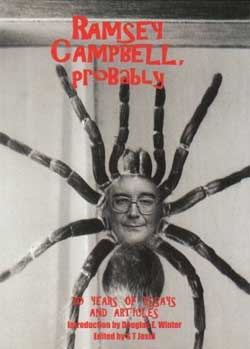
Lately I’ve been thinking that it’s high time I revisited some of those old novels—and sampled some of his new work—but as it is, the book I’ve picked up is Ramsey Campbell, Probably, a 2002 collection of his essays, reviews, and various other bits of non-fiction. There are one or two pieces that are of interest only to fans (a couple of his old forewords to reissues of his novels perhaps have little to offer the casual reader), but the vast majority of it is the kind of writing I’d push into the hands of anybody who professes an interest in writers, writing, or reading.
There’s a great deal on the evolution of his genre and its current state, along with reminiscences of many of its practitioners. It’s all entertaining, but there are some especially humorous pieces, like the essay contrasting a very bad film with a very bad novel, or ‘A Horror Writer’s Lexicon’ (Agent: 10% of a writer. Editor: somebody who admires an author’s work; the opposite of copy-editor). Several pieces touch on his upbringing, which is covered extensively in one of the cornerstone essays of the book: he had a traumatic and fascinating childhood, one that you suspect he might be making up, until you realise that the whole point is that it did really happen like that, and it was just in his early novels that he was making it up.
Speaking of censoriousness, Campbell seems to have had his share of run-ins with 1980s bugbear Mary Whitehouse, including a beautifully done and terrifying description of a meeting at which she presided. His pieces on other horror writers, which include a send-up of Shaun Hutson and an interesting take on class bias in the genre, as applied to James Herbert, could in themselves form a primer on the subject; pieces on cinema include a rather rigorous survey of the history of the spanking film.
Ramsey Campbell, Probably was printed by PS Publishing in a limited edition of 200 slipcased hardcovers and 500 (I think) paperbacks. They’re elegant as ever from PS (who wouldn’t love that spider?) but the binding on my slipcased copy didn’t survive first reading. It seems a little lacking in glue, which may have been a common problem with this edition, but certainly isn’t representative of the usual high standards at PS. Still, this is the only way you’re going to get to read his essays collected like this, and frankly it would be worth it if they were just a stack of loose sheets in a shoebox.
And as far as that goes, while I often say that some book I’m reviewing is one I’ll go back to, its usually a lie, covering a truth along the lines of “I couldn’t be bothered to follow this properly the first time; I certainly won’t bother to pick it up again and start from scratch”. In this case, however, I know for a fact that there are some sections of this book that require prompt revisiting. In fact, would you excuse me?
The last remaining copies of Ramsey Campbell, Probably, along with several other Ramsey Campbell titles, are currently available at 60% off as part of a PS Publishing sale on pre-2008 titles.




August 4th, 2009 at 9:10 pm
Glad you enjoyed it!
Sadly, some of the earlier PS titles were made before we started working with the excellent companies that now handle our printing and binding, and hence they lack the durability and tactile beauty that we like to think of as our hallmark. But as I see you’ve already discovered, the actual content of the books has always been the best we could get! :)
August 4th, 2009 at 10:03 pm
Hi Paul,
thanks for commenting. You’re right to point out the high quality of PS Books in terms of both binding and content—they’re becoming a much-loved feature of my bookcases on both counts.
August 20th, 2009 at 8:07 pm
Horror has rather suffered for credibility in recent years, hasn’t it? I suspect a lot of bad stuff was put out to be honest.
But Ramsey Campbell is nothing to be ashamed of, he’s an excellent author with real skill. I recently picked up a copy of his Midnight Sun again, a wonderful work of “Lovecraftian” cosmic horror.
As for HPL, I think he’s a tremendous writer with real gifts, I’m still very fond of him and not remotely for reasons of nostalgia.
That aside, a lot of horror relies on shock and revulsion, rather than quality of writing, for its effects. Campbell is an obvious exception, but so much of the genre is weak it taints by association that which is good.
On contemporary stuff, I understand Let the Right One In is tremendous, but that’s the only contemporary horror novel I’ve heard of that’s supposed to be genuinely impressive. I’m sure there’s more though.
Oh, and before I forget, if you haven’t read any TED Klein, based on this post you’d probably like him. You might also find TM Wright interesting.
August 20th, 2009 at 8:16 pm
Hi Max, thanks for commenting!
You seem to echo Campbell’s own comments. He talks about his time editing Best New Horror, and his reasons for quitting, which was exactly because he didn’t feel able to go on wading through the amount of bad writing that the genre was producing. I’ve been meaning to pick up Midnight Sun again as well, so thanks for reminding me about that. I’d really like to reassess his prose now that I’m older and
wiserbetter read. I suspect I’ll be delighted by what I find.I haven’t read either of the two writers that you mention at the end of your comment, but I’ll keep an eye out for them.