

 While brief biographies have their place, sometimes there’s no substitute for the brick, the breeze-block examination of an author’s life and work. I’ve been through Ian MacNiven’s biography of Lawrence Durrell twice, and I’ve been meaning to repurchase and reread Ted Morgan’s Maugham: A Biography for a while now. This summer, Jonathan Cape have added to the goldmine of big biographies with Semi Invisible Man: the life of Norman Lewis, by the writer (and sometime editor of Lewis’ work), Julian Evans.
At over 700 pages (plus notes), this is no brief life, but rather a considered and detailed examination of one of the last century’s most interesting and perhaps undervalued travel writers.
Born in Wales in 1908 (and not 1918 as he occasionally claimed), Norman Lewis began his working life as a photographer. In his early travels, it was the camera rather than the notebook that took pride of place, and it was his own photography shop, R.G. Lewis, that funded many of his early travels.
Norman Lewis & Eland
Withdrawn and reluctant in revealing the personal details of his life, Norman Lewis lacked the cult of personality of Bruce Chatwin, Lawrence Durrell, or Paul Theroux. As a result, he never crossed what the critic JW Lambert called “the mysterious barrier separating the admired from the famous”. If he’s known today, it’s at least partly thanks to the independent publisher Eland, who picked up several of his out-of-print books in the early eighties and produced paperback editions. It was their reissue of Naples ’44 that finally brought that book the recognition it deserved, and secured Lewis a place among the must-read authors for lovers of travel literature.
Eland are still going strong; their current list can be viewed and purchased at their website, www.travelbooks.co.uk.
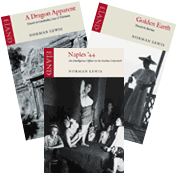
His best known work is probably Naples ’44, based on his experiences as a British intelligence officer attached to the allied invasion of Italy, and subsequent occupation of Naples, where Lewis spent fourteen months—it would be an understatement to call them “turbulent”. His account of time spent fighting or negotiating with bandits, trying to create a sense of order in the legal system, and vetting war brides is a terrific and essential read about the behaviour of cities at war, an Allied counterpart to Curzio Malaparte’s The Skin.
His experiences in Naples, along with his first marriage, to a Sicilian exile in London, gave him an interest in Italy, and specifically Sicily, that lasted throughout his career; His book The Honoured Society is one of the key works about the post-war rise of the Mafia. Other subjects he wrote about included Spain and Indo-China, and he was one of the first writers (possibly the first) to link mass deforestation in the rainforests with climate change.
It may well be that the odd detail or event in his prose has been “tidied up” in the service of the story, but, as Julian Evans argues, this is a necessity for an author who wants to get across the essential truth of what he’s describing. And the multi-faceted, shifting nature of truth is one of Evans’ themes. Norman Lewis was prone, as all good writers are, to exaggeration and deviation from the truth, and admitted as much many times over—it was something he was all too aware of, and he would often respond to the many genuine coincidences and adventures in his life with a sighed, “of course, nobody will believe this really happened.” More than once, Evans draws parallels with the film Rashomon in attempting to make sense of the many different versions of reality from which he’s drawing his research. (Lewis held high standards for other authors, though, referring to the author of As I Walked Out One Midsummer Morning as “Laurie Liar”.)
As well as his travel writing, Lewis drew on his journeys to provide material for over a dozen novels, and for much of his life saw himself as a writer of fiction with a sideline in travel writing. His sales and reputation, however, told a different story, and a quick check on Amazon today shows the majority of his travel writing still in print, but none of his novels.
A friend once told me a story that ties in all too well with the story of Norman Lewis as a “semi invisible man”; one who claimed to be able to enter a room, take in what was happening, and leave again without being seen; one who deserved to be more famous than he was but perhaps wanted, at heart, no more attention than he received.
“Norman Lewis?” he said. “My parents knew him years ago, and occasionally he’d come round to our house for dinner. They’d invite me to join them, but of course, I was young and stupid and thought, you know, I’d rather go out with my friends. Now, though, …” he shrugged sadly, “now it’s too late.”
Fortunately, Lewis is survived by his body of work, and it’s not too late to rediscover a career that spanned around thirty books and some of the most thought-provoking, entertaining, and observant writing to be commited to paper—even by a semi invisible man.



August 5th, 2008 at 2:47 pm
Interesting, I’ve heard of The Honoured Society but I’ve not read it (yet).
August 5th, 2008 at 2:29 pm
[…] life and work. There’s a full review of Semi Invisible Man: the life of Norman Lewis here. […]
August 11th, 2008 at 6:34 pm
I have to own up, I had never heard of Norman Lewis until his book Voices of the Old Sea cropped up on a reading list for an “event” I’m covering on my blog next month.Thanks for this because now I’m intrigued and can’t wait to read him.
August 11th, 2008 at 6:49 pm
I’ve not read Voices of the Old Sea yet myself, but I’m looking forward to seeing what you make of Norman Lewis!
May 20th, 2009 at 2:45 am
I have read most of Norman Lewis’s books and love them. I have been able to collect many hard-cover copies cheaply because he is relatively unknown and unappreciated especially here in Australia. It’s a pity because he is a wonderful writer. He was well ahead of his time in trying to defend the rights of indigenous people of South America.
August 28th, 2009 at 6:31 pm
[…] on his sleeve, though, as do many debut novelists: Maugham is name-checked at least once, and Norman Lewis is actually quoted in a witty early passage in which the narrator compares the travel […]
April 14th, 2011 at 11:03 pm
I accidentally fell into a Norman Lewis book “The Day of the Fox” at a secondhand bookstore. Now its is the treasure of my bookshelf. The thing I find with Lewis is that you don’t so much read him, you savor him. I’ve read the book many times. It’s always a pleasure. Sometimes I read a line so well crafted, so perfectly clear and poetic, I have to stop, and linger there on the line… You don’t get that sort of quality in most books. I only wish I could come across more of his books. The only other one I’ve managed to pick up was “Golden Earth”.
April 15th, 2011 at 12:51 pm
James, have you looked at the Eland titles? They have quite a few of his still in print. As do Picador, I think. you should definitely get your hands on Naples ’44 if you can.
December 31st, 2011 at 10:23 pm
I served in WWII Naples with the US Army 803 MP Bn. Oct 6,’43 – Jan.,’45. For most part Naples ’44 is a reliving of that experience. However, as a biographer notes, I found many instances where Lewis is “prone to exaggeration and deviation from the truth.”
December 31st, 2011 at 10:31 pm
Correction:
Dates of Naples WWII service should read:
Oct.6, ’44- Jan.,’44.