

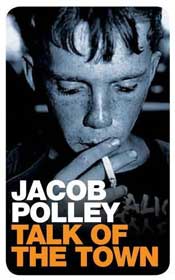
 New from Picador, Talk of the Town is the first novel from poet Jacob Polley. It’s a coming-of-age tale set in Carlisle during the summer of 1986, and narrated in vernacular by schoolboy Chris Hearsey. His friend Arthur, never the most stable of kids, has gone missing, and Chris sets out to try and find him:
There’s nee mugshot, but I’ve got one already, me own movin clip of Arthur reachin down ter give us a hand up off the deck, the sun comin out from behind his head, dazzlin away his face. I whip the paper shut and shove it back under me bed, further back than the empty mug, behind the shoebox. I get ter me feet, wipin the sweat off me palms on me jeans. There’s nowt else fer it. I reckon I have ter gan and see Gill Ross, cus it’s her who might know where Arthur is, cus of what fat Booby said yesterday on the Arches.
I shut me bedroom door softly affter us.
The Carlisle that Chris encounters outside his bedroom door is aimless and nihilistic, a violent world where solvent-abusing kids torture each other because there’s not much else to do; where a tramp has been burnt to death in the nearby park. Chris is a relatively quiet kid, his transgressions limited to the cups of coffee his mum doesn’t let him drink, a bit of booze, and tens of Regals, when he can get them. He’s also developed a complex set of rules to help him survive a day at school or just a walk down the street, without calling undue attention to himself, without making himself look vulnerable: All that effort to mek all yer do look like yer doin nowt.
Inevitably, as he embarks on his search for Arthur, his system for living breaks down and he begins to draw more and more of that attention to himself, until he’s helplessly moving towards the story’s violent climax.
While Chris is a strong character, much of the atmosphere is conjured up through the prose. Here is a passage from Talk of the Town, together with a video of Jabob Polley reading it:
Two weeks ago there was a tramp set on fire in Bitts Park, squirted in lighter fluid and his big coat lit, so he went up like rubbish, like the swept-up leaves. The talk’s bin of nowt else, on the telly and pinned ter the boards outside the papershops, all the whys and what-fors and what-must-be-dones, and this last week, every time me dad’s driven off, the black slick under his car’s looked more and more like the outline of a body left scorched inter the road. I wouldn’t know where the nutters live, whether they live under the Eden Bridge, in the city, or in one of the parks affter the gates have bin locked and the parkies have thrown everyone else out, whether they hide in a bush with their carrier bags, then sleep in the parky’s shed. But I can’t stop thinking about the man with the gappy smile, smilin at his radio in a shedful of rakes and signs. Cus ter burn someone where they lie in a heap isn’t a nutter’s work. It teks more than one ter gang up and decide what’s rubbish and deserves ter gan, and I’m thinkin of the lads like shadders outside Spar, all ganged up ter agree ter owt.
The above passage is relatively light; much of the text is more dense, and in this kind of novel there’s always a pain barrier to pass through, a point where you’re sick of pausing, rereading, and spelling out each word while the narrative drip-dries at the back of your mind. The sweat is lashing oafay ye, in other words, and you’re not sure it’s worth the trouble. That barrier does crop up in Talk of the Town, but not long after, the story begins to pick up pace, and drags you free of the pitfalls of the language. Chris’s voice is vivid and convincing, a blend of genuine insight and the kind of truisms that pass for insight at his age, and his relationship with his surroundings is, for the most part, both poignant and believable. The story is perhaps slightly less likely, but perhaps that’s no surprise when the author’s main preoccupations are character and voice.
Jacob Polley published two volumes of poetry, The Brink and Little Gods, before tackling a novel. In interviews, he’s talked about the challenge of moving from poetry to prose, especially regarding the challenge involved in telling an extended story. Talk of the Town is no bad first stab, and if he decides to keep moving in this direction, it’ll be interesting to see how he follows it up.
Talk of the Town was published in the UK by Picador on 5th June.




June 9th, 2009 at 4:33 pm
I got a review copy of this from Picador but haven’t read it yet. I did flick through and thought the effect of the language in places was very powerful – particularly the last paragraph – but I also thought it might be hard work in the way you describe. “No bad first stab” might move it a little way up the TBR pile, though probably not very far…
June 9th, 2009 at 4:36 pm
Hi John,
To be fair, “not a bad first stab” was a bit of an understatement, more to do with being able to feel his transitioning from poetry, rather than trying to damn with faint praise. It’s not a perfect novel, of course, and occasionally frustrating while I was reading it, but on reflection, it was a pretty satisfying read—and those don’t come along as often as I’d like.
June 10th, 2009 at 2:49 pm
Liked the review. I’m reading this at the moment, very good. Interesting to hear Poley reading himself in your vid.
June 10th, 2009 at 2:54 pm
Hi Laura,
Yes, it’s great when publishers make these little videos to support their books.
Glad you’re enjoying the book, by the way. Come back and share your thoughts when you’re done with it!
June 11th, 2009 at 12:15 pm
The book is marvellous, even more so, if you happen to come from Carlisle which I do! Jake captures the flavour and feel of the times very well and the fact that the language is of the town adds to the pleasure of reading it.
June 11th, 2009 at 12:20 pm
Hi Eve, thanks for the comment! It’s great to have the perspective of a Carlislian… Carlislite… of somebody from Carlisle. When writing with this kind of language, I imagine that the people who actually use it must be the hardest to please…
July 20th, 2009 at 12:21 pm
You’ve definitely interested me here Rob, I have a soft spot for novels written in the vernacular and this sounds worth some effort.
It’s also nice to see a new writer finding his own voice, I wonder if he’ll continue to write in this style or broaden out, any ideas?
July 25th, 2011 at 12:40 pm
I’m fairly new to his work, but I just featured Jacob Polley in my poem of the day series. He’s a wonderful, wonderful poet.
http://theoncominghope.blogspot.com/2011/07/poem-of-day-by-jacob-polley.html