

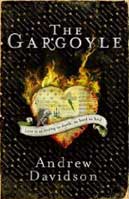
 Andrew Davidson’s debut novel, The Gargoyle, begins with a car accident that leaves its narrator, an unnamed, cocaine-addled pornographer, hospitalised with disfiguring burns. While he’s recovering in the hospital he’s visited by the mysterious Marianne Engel, who greets him with the enigmatic words, “You’ve been burned… again,” and proceeds to soothe him with tales of previous lives and lost loves.
The Gargoyle has drawn comparisons to authors including Vladimir Nabokov and Umberto Eco… but does it deserve them?
Andrew Davidson’s writing style is certainly brash and confident, and at first, this confidence carries the book, getting the reader past the narrator’s initial unlikeability. The early descriptions of burn treatment hold a certain gruesome fascination, as do the narrator’s fractious relationships with the hospital staff. But within the first couple of hundred pages, as Marianne arrives and begins to tell her stories—short, self-contained love stories and a gradually unfolding one about her supposed shared past with the narrator, stretching back almost 700 years—it becomes apparent that there’s not quite enough going on under the surface.
Perhaps it’s partly the characters: the narrator goes from unlikeable to invisible, as he leaves behind his old personality without really replacing it with anything else. Meanwhile, Marianne Engel, presumably intended to seem mysterious and alluring, instead comes across like a teenage goth’s fantasy, gabbling on about past lives, love, and death, before stripping naked to carve grotesque stone statues. Her stories-within-the-story, in particular, read like extended versions of those “true love” chain emails that used to go around: …and it was only when he died and she found his diary that she realised he had truly loved her. Pass this email on to forty loved ones so that you will receive good luck.
And while Davidson’s prose is confident, he still has some of the debut novelist’s quirks: the use of “interesting” fonts in dialogue, the odd self-conscious comment on the fact that he’s writing. There’s also a propensity for showing off that occasionally lands him in trouble. This is the second half of a list of food that Marianne brings for a special dinner at the hospital:
[…] spaghetti, fettuccini, macaroni, rigatoni, cannelloni, tortellini, guglielmo marconi, (just checking if you’re still reading), bananas, apples, oranges, pineapples, strawberries, blueberries, mixed nuts, mincemeat pies, Christmas pudding, Christmas bread, coconut shortbread, pecan pie, chocolates, chocolate logs, chocolate frogs, Bertie Bott’s Every Flavour Beans, fudge, sugar, spice, everything nice, epiphany cake, fruitcake, gingerbread men, Torte Vigilia di Natale, snips, snails, puppydog tails, cranberry punch, eggnog, milk, grape juice, apple juice, orange juice, soft drinks, coffee, tea, you say to-may-to juice, I say to-mah-to juice, and bottled water.
Was Davidson himself bored when he wrote this? In which case, why didn’t he stop? Or does he think this is funny? There are frequent places in the text where Davidson indulges himself like this, at the cost of the story. Apparently the original draft he sent to the agent was 50,000 words longer, and was rejected for being too flabby and self-indulgent. Neither problem has really been addressed.
The Gargoyle was originally bought by Doubleday in the US for $1.25 million, and has now been published in the UK by Canongate. As a result, it’s had a lot of publicity and press coverage. Davidson would have been better off without so much attention on his debut novel. He’s not quite ready yet, and he can’t live up to the claims that people are making for him. But he’s still worth watching; if he can shake off the self-indulgence, he has the makings of a confident and able storyteller. In The Gargoyle, however, he doesn’t quite have enough of a story to tell.



September 11th, 2008 at 5:58 pm
I guess the answer to the question about Eco and Nabokov would be “no”, then? ;-)
September 11th, 2008 at 6:17 pm
Yes, I’m afraid so. I think these things get blown out of proportion. Somewhere along the line, a lazy or misinformed journalist thinks “medieval… monasteries… Name of the Rose” or “burns… romance… English Patient,” makes the connection, and other people pick up on it. Before you know it, the bemused author is “the new XXX.”
In interviews, Davidson generally claims not to have read any of the books that The Gargoyle is compared to. (Actually, given the number of books in question, that makes him remarkably ill-read.)
September 14th, 2008 at 10:25 am
Ooh, that list is bad, isn’t it?
I was sent a little sampler of this book from Canongate last year – a story about a Glassblower, which I thought quite good. But I quickly lost interest in reading the whole thing. Partly this was from seeing the trite tagline on the front cover (“Love is as strong as death, as hard as hell”), and partly from the hunch that the big advances were a sign that this was a book designed to appeal to a wide demographic that likes gaudy large-print epics with injections of fantasy and sentimentality – a demographic which does not include me. The 47 (at time of writing) reviews from Amazon’s Vine programme only add to my sense of coldness toward it.
Got a pasting in the Guardian yesterday too.
September 14th, 2008 at 11:46 am
… and today in the Independent.
I try to push back the boundaries of the genres I read, partly for my work, and partly because I do believe that there’s always something to learn from the way different sorts of people tell different sorts of stories. But with The Gargoyle, I don’t think it’s an issue of genre—it could have been an entertaining cult book, but it needed to spend some time with an editor who could shout louder than Davidson (metaphorically speaking), and undergo a thorough, well, debridement.
The glassblower story might be the strongest part of the book, for what that’s worth. I suspect Doubleday thought so too, as they made it the focus of this promotional video.
September 14th, 2008 at 3:35 pm
“Basically tosh,” says the Indie. Sounds about right.
I discovered on reading Amazon reviews that that cover line is by Meister Eckhart, cited in the book as a German ‘mystic’ (though Wikipedia adds ‘theologian’ and ‘philosopher’). He is the source of other equally profound pensées such as
and
Sounds like the Paulo Coelho of his day.
September 14th, 2008 at 3:41 pm
So, in seven hundred years’ time, quotes from The Alchemist will be adorning the front covers of novels? That’s a sobering thought.
September 14th, 2008 at 7:27 pm
As someone who has read this book, I could not agree more with this review. I’ll admit I picked up The Gargoyle reluctantly from a reader’s point of view but curious to find out how a first-time fellow Canadian managed to score more than $2 million in advances. After finishing the book, I was a most disappointed reader — and still have no idea why the advances were so large. The first 100 pages are so gruesome that even those who like the novel say “I’m still in the awful part”. Then, as Rob notes, it wanders off into territory that might be even less interesting. Doubleday printed more than 100,000 copies of this in the U.S., which means it has to be selling in WalMart, supermarkets and places like that. I can’t imagine who would be buying it.
September 15th, 2008 at 12:03 am
Hi Kevin,
the whole thing is very strange. The Gargoyle has got its followers—try a Google blog search—but I wonder whether some of them really liked the idea of the book, rather than the actual execution.
I suspect there will be a lot of unfinished copies on the second-hand market before long, and I can see his next book being a tough sell.
September 15th, 2008 at 12:56 am
Part of my cynicism comes from the fact that the chapters-indigo site here in Canada had more than 30 ratings (most of them 5 star) and a number of reviews (most from chapters employees) before the book was released. There were obviously a lot of Advanced Reading Copies available in the stores — understandable given the number that were going up for sale but I can’t help but skeptically think the marketing department was manipulating the employees (and the bloggers). (From John’s comment, it looks like the same strategy was employed in the UK.) More sinister, for me, was that the reviews all tended to read the same, almost as though a reviewer’s version of politicians speaking notes had been included. I will admit that is the opinion of an ex-journalist, trained to be skeptical, who sometimes does get cynical.
The longlist for Canada’s Giller Prize is released tomorrow. It will be interesting to see if this book makes the list, given that Margaret Atwood and Colm Toibin are two-thirds of the jury (and the third member is the foreign affairs critic of the Liberal Party who is in the middle of a snap election campaign and unlikely to be doing a lot of fiction reading). Website is http://www.scotiabankgillerprize.ca if you are curious enough to check out the list.
September 15th, 2008 at 6:05 pm
The Gargoyle was conspicuously absent from the Giller longlist when it was release today, so I think it is now officially a “supermarket” rather than a “literary” novel. Two not very good novels from Random House, who published it here, did make the list — Paul Quarrington’s The Ravine and Kenneth Harvey’s Blackstrap Hawco — so I can’t help but think the judges did a little nose-thumbing with this book.
September 15th, 2008 at 6:33 pm
That’s interesting to know, Kevin – thanks for coming back with it. I’ve actually got a copy of Blackstrap Hawco on my shelf, waiting to be read. I read The Town that Forgot how to Breathe a few years ago, and found it interesting if not perfect.
Going back to the Gargoyle, the distinction between literary and supermarket novel is a little depressing. Surely even novels aimed at a popular market should be properly edited?
Oh well.
Is there anything on the Giller longlist that you would recommend?
September 15th, 2008 at 7:29 pm
I would certainly recommend The Cellist of Sarajevo and Through Black Spruce (although you do have to like frontier novels for that one — if you like Stegner, then check it out). There are a couple others that I think show promise and I’ll post comments when I have read them.
I’ve bought Blackstrap Hawco, but haven’t read it and admit it is down the pile. Will get to it eventually. The one that interests me the most is De Sa’s short story collection — I’ll be starting that this afternoon.
As for the editing of The Gargoyle, I agree completely. There is a good novel inside this book somewhere — I just don’t think the author and, more important, editor found it. And I agree with your earlier comment — a lot of people who like this book like the concept. The problem is that it was not executed properly.
September 16th, 2008 at 10:49 am
Thanks for the tips. I’ll definitely investigate some of these books, and it would be great to see your comments as you read through them yourself.
September 16th, 2008 at 5:00 pm
I’ve been thinking about your question about supermarket books, literary books and editing and would like to offer an hypothesis.
By way of credentials, in my previous life I spent 27 years in the daily newspaper business as a reporter, copy editor, section editor and editor-in-chief — so I like to think I know something about journalism editing at least. There was an old saw in the business that every young reporter heard eventually. Any competent writer can write a 1,000-word editorial (leader in British lingo) that analyzes an issue. A good writer can do the same thing just as effectively in 500 words. It takes a truly exceptional writer to do it in 250.
I think the same principle applies in well-written “literary” fiction, where a finely-crafted, well-edited less becomes more. Alan Bennett, Penelope Fitzgerald and John Berger come to mind — whatever you might think of their books, I would call them well-edited. No word is wasted. Indeed, the reader who is willing to go back a second or third time discovers new levels of meaning.
In what I have chosen to call “supermarket” fiction, my hypothesis is that what you and I would call bad editing actually in some cases becomes an asset (at least here in North America where these books tend to physically weigh a lot). Another factor — what I’ll call “cost per page” — enters the market. Buyers aren’t looking for a good book, they are looking for a book that will take a long time to read. Twenty or 30 sections of 25 pages each (which I think describes The Gargoyle — and The Northern Clemency for that matter) means 20 or 30 nights of pre-bed half-hour reading. While it drives me nuts (or at least did with both those books), for that other buyer it means great value for the money. At a $30 cost, that works out to only $1 a night for entertainment. Plus, a real feeling of accomplishment when the very long book is finally finished (note that that pride shows up in some of the online reader reviews).
Only a thought. Definitely a depressing one for anyone who respects good editing.
Cheers.
September 16th, 2008 at 5:35 pm
That’s an interesting point. So what you’re saying essentially is that while the excessive flab / dead flesh on The Gargoyle makes it a bad book, it actually makes it a good product, for its particular target audience?
That makes sense, though it’s depressing, as you say.
Still, assuming the need for a high word count, wouldn’t editing of content (maintaining length) still have made for a better book and product, pleasing both what we’ll call the supermarket punters and more discerning readers too? (Not everybody, of course, but people like you and I who picked it up ready to accept it on its own terms, if only it had been well written?) Good long books can exist, after all.
Or, if you consistently nourish a more demanding reader through a long book, do you risk exhausting a less demanding one? Would a more stimulating version of The Gargoyle have alienated the same market that’s embraced this version?
That said, I can’t see the vague ideas of The Gargoyle sustaining a good book of that length in any form.
September 16th, 2008 at 5:53 pm
In general, I think it’s difficult (or impossible) to think about these things in abstract terms; it has to be done on a book-by-book basis, because the rules change with every title. And with The Gargoyle, as I said above, I don’t think that it would have been easy to edit it into a good book while sustaining the same length. Without an awful lot of new material and ideas, I think the best they could have hoped for was a fast, short, pulpy page-turner, good for a lazy afternoon.
September 16th, 2008 at 6:31 pm
I didn’t mean to send you into an editor’s version of a death spiral — after all, every editor knows the key rule is ‘who am I editing for’? I agree The Gargoyle could have been a better book, even for its intended audience — but how can I criticize a book that earned its author more than $2 million in advances? I think the publishers made a bad bet, but I might be wrong.
I do think the key question, from an editing perspective, is “who do I want to read this book?” And what does that imply about what the book should do. John Berger doesn’t care if anybody reads his books. Stephen King does. Meeting the needs of those audiences is what editing is about.
And finally, you are 100 per cent right that this has to be done on a book-by-book basis. There is no formula, there are only guidelines. You take what you have, look at the guidelines and then create a strategy.
September 17th, 2008 at 11:18 am
I agree with Kevin that there is probably a “value-for-money” impetus among many book buyers, who feel that a 700 page book costing £8 is more appealing than a 200 page book costing £8. If this is not the case, it certainly is a perception among publishers, since I have lost count of the number of times books swell in page count from hardback to paperback. Naturally, paperbacks have smaller pages, but not so much smaller that a typical book will need to be reset. Yet we regularly see books adding 100 pages or more in the paperback edition, because the publisher has pumped up the type size and/or line spacing.
The most extreme example of this I’ve seen yet was Richard Ford’s The Lay of the Land, which in its UK Bloomsbury edition went from about 480 pages in hardback to 740 pages in paperback!
September 17th, 2008 at 11:50 am
All very bleak, isn’t it?
I hadn’t noticed the hardback/paperback difference you mention, John, but that’s quite a leap for The Lay of the Land! Is there also an argument that paperback readers prefer larger type and line spacing, though, while hardback-buying “early adopters” are more willing to accept denser type as a trade-off for a lighter book?
I’ve also been wondering for a while whether shorter books stand a better chance of coverage in book review blogs, simply because of bloggers’ needs for regular content updates. (Although that wouldn’t explain The Gargoyle’s apparent blog popularity.) All else being equal, the shorter titles tend to rise to the surface of my review pile faster than the longer ones, just so that I can get another review up (while also keeping up with my personal and work reading…)
Do you find this, John?
Don’t worry, Kevin, no death spiral. I was going to write something about my own approach to editing, but I kept sounding in my head like Marianne Engel, so I don’t think I will…
And it’s perfectly okay to criticise a book that earns $2 million, because I think we’re talking here about book rather than product. While this may be a successful product (it certainly was for Davidson; we’ll see how it does for the publishers), I think we’re agreed it’s a failure as a book. Do you think that’s a reasonable distinction?
September 17th, 2008 at 2:27 pm
Definitely. Just the other day I promoted Rabih Alameddine’s The Hakawati to my bedside table to make me read it soon, as I’ve been putting it off for its 500-page length (and very small type) since I got it several months ago. He’s a fine writer and I know it’ll be worth reading, but even so I find it hard to knuckle down to it, knowing I may spend the best part of a week reading it. How much bleaker are the prospects for a 500-page book by a writer I’m not confident about? (Well, I’d never buy it in the first place…)
Having said that, one of the benefits of the Booker longlist circus was that it made me realise that I can make pretty good progress through a book without compromising the reading too much. I’ve started reading Tim Parks’ new novel Dreams of Rivers and Seas (430 pages), which I probably wouldn’t have taken a chance on earlier this year. It helps that, blogwise, I’m ahead of myself with one review already written to go up on Friday, and another book read that I have just to write up, so I could take another week over this one and still keep up my notional blogging schedule of one review every three or four days.
September 17th, 2008 at 3:13 pm
I’ll be interested to see what you think of the Tim Parks, as that’s on my list to be read at some point in the next few months.
Well done for getting ahead, too. I think I’m going to have to spend a week with novellas at some point, just to build up a bit of breathing space. (24 for 3 was a blessing in that respect!)
Actually, the subject of what makes a good book for blogging is a pretty interesting one… watch this space.
September 17th, 2008 at 4:30 pm
Actually, this space.
September 17th, 2008 at 5:18 pm
This is a fascinating discussion. One other factor in length and impact, from my newspaper background, is that authors of longer books face a much more difficult task getting interviewed on their promotional tours because the papers just don’t have the resources to have a reporter spend three days reading a book in preparation for a 30-minute interview. A friend who knows Kenneth Harvey, author of the 840-page Blackstrap Hawco that is on the Giller longlist, says his promotion tour is very boring because no one wants to interview him because of the length of the book. (And I’ll admit it is sitting exactly where The Northern Clemency sat for weeks by my chair as I try to screw up the resolution to start it.) I did note in the advance newspaper hype for The Gargoyle that the stories were about the author’s advance, with a brief plot summary, and gave no indication that the reporter had actually tried to read the book.
I definitely think there is a “value for money” proposition when it comes to paperback versions. After all, if someone is willing to wait for some months to save the money by not buying the harcover, they probably also expect more than three or four hours of reading. I have the good fortune not to be price sensitive (and will admit my particular book snobbishness is that I very much prefer hardcover books) but I can understand the rationale.
On a somewhat different matter, Rob, since you do edit short stories, consider Anthony De Sa’s Barnacle Love (224 pages) from the Giller longlist. It is De Sa’s first book, a collection of 10 short stories although I would describe it as two linked novellas of five chapters each since the stories have the same central character and are chronological. De Sa grew up in Toronto’s Portugese community and the book, in some ways, reminded me of The Clothes on Their Backs in the way it explores the immigrant experience. The first five are set in Newfoundland and the Azores (the central character joins the Portugese fishing fleet to the Grand Banks to escape his horrible mother, abandons ship and later goes home for her death and to find a wife). Part two is set in Toronto where he and his family have moved looking for streets paved with gold (alas, they aren’t) and, as someone who lived there for a few years, is a wonderful portrait of that city’s unique multicultural community. I bought the book at 11 a.m. last Thursday, turned the last page on my first read at about 5:30 p.m. and immediately went back to the start for a second read. I think the stories are very well-written, the characters well-developed and interesting and the overall story both very joyful and very sad. The Book Depository lists it as available in the UK, although it looks to me from the price and publication information that they are selling the Canadian version with full shipping costs included in the quoted cover price. It has been published in the U.S.
September 18th, 2008 at 12:34 pm
It hadn’t occurred to me that newspaper reporters wouldn’t have more time to read longer books, but it does make sense. I’m sorry to hear about the way it’s affected Kenneth Harvey—although going by his blog, I can’t imagine him being a particularly verbose interviewee. (Actually, I suspect that blog of being a sarcastic response to some publicist’s advice that he “keep a blog to let people know what’s happening with your books”—if he has any hand in it at all).
It’s always fun spotting news items that skirt around the fact that the writer hasn’t read the book—it’s up there with trying to identify the Amazon reviews written by the publishers (not always very hard—they’re always so “on message”).
Thank you for the De Sa tip. It’s definitely going onto the list for my next binge. Short story editing is actually a tiny part of my work, and I’m considering cutting it altogether, but I do enjoy reading them. And I can’t remember the last time I read a Canadian book… yes I can; it was The Town that Forgot How to Breathe, which was ages ago.
September 18th, 2008 at 4:31 pm
Rob: Off what I have read so far, I think there are three books on the Giller list that you should read — not so much for the blog, but for the business side of the blog.
The Cellist of Sarajevo has a very interesting structure. The central image (but it hardly shows up in the book) is a cellist who resolves to play Ablinoni’s Adagio 22 days in a row in a square in Sarajevo to honor the people, lined up to buy bread, who died there in a mortar attach. The book itself is the story of three people who are trying to survive the siege at the time. I think it is a wonderful book, but even more important, from your point of view, is what it suggests to writers.
Please read De Sa. It is great. And consider Through Black Spruce, Joseph Boyden’s new book. I didn’t like his first one (Three Day Road) but a lot of people did,. This is a wonderful exploration of the First Nations experience — it deserves to be examined by someone outside the country. Besides if you order more than three books from Canada (amazon.ca is by far the best value), you can cut your shipping costs.
One last thing. Don’t stop your short story editing practice. Instead, orient it to the North American audience — e.g. Oxford-Rome based editor evaluates short stories. As the exchange on John Self’s website around Wolff indicates, short stories are a (quite valuable) North American commodity. What you need is positioning. I’d suggest you actually have it, it’s just a matter of how you describe it.
September 18th, 2008 at 4:36 pm
I must admit I took against Harvey when I picked up Blackstrap Hawco last week and saw, in the Also By page, that he divides his books into Fiction, Non-Fiction, and (something like) Compositional Narrative Structures. Bah.
September 18th, 2008 at 4:49 pm
John Self: Could I ask you not to leave such devestating, accurate comments on authors of 840-page books that I have not started, but feel an obligation to read? I do promise thoughts, if and when I finish, on why neither of you has to read this book, but you don’t have to make the process harder. I am some depressed and it is all John Self’s fault. I hope Mrs. Self undercooks the fish tonight. I am on her side.
September 19th, 2008 at 2:57 pm
I’ll definitely be looking into your recommendations, Kevin, so thanks for those.
Regarding short story critiques, I think I just prefer the more in-depth work I can do on a novel. I don’t doubt that both have their place, though.
“Compositional Narrative Structures”, eh? As you say, bah. But then, I’ve still not accepted “creative nonfiction”.
Actually, I’ve just checked my copy and it’s “transcomposite narrative”. (The “bah” holds, however.) It seems that Blackstrap Hawco itself is one of these. Read more about this here (near the bottom).
I think it’s good that he’s trying this out, and of course the technique needs a name, but I’m not sure when I’m going to be able to devote my time to reading 829 pages of it. Kevin, we’re all counting on you.
September 19th, 2008 at 3:44 pm
Transcomposite narrative! I knew it was even worse than I’d remembered!
September 19th, 2008 at 4:55 pm
You two are definitely making this project harder. Transcomposite narrative? I thought Newfoundland was about ruggedness. Still, I’m planning on starting it this weekend.
September 19th, 2008 at 4:59 pm
Oh, just ignore us. We haven’t even read it. All this mockery of transcomposite narrative is just tough talk; the truth is, we’re frightened.
So you go first, and let us know how the water is…
September 19th, 2008 at 5:49 pm
I’d love to ignore you. The problem is that both you and John have a pretty good track record, even on first impressions of books that you haven’t read. Stay tuned.
September 20th, 2008 at 8:19 pm
Only first impressions, though; I don’t think either of us was go so far as to even call what we’ve said an “opinion”.
I’m really looking forward to seeing what you have to say about Blackstrap Hawco.
September 21st, 2008 at 12:31 am
Definitely, I treat those musings as thoughtful impressions rather than considered opinions (how is that for transcomposite textual dodging?) I will certainly offer an opinion on Blackstrap Hawco — please do not hold your breath waiting for it to arrive.
September 22nd, 2008 at 5:20 pm
In case this becomes the blog that forgot how to breathe?
September 23rd, 2008 at 4:59 pm
A couple of Giller longlist books that I want to read as soon as possible arrived this morning, so I am afraid Blackstrap has moved down the list. Sorry about that, since I am sure you wanted an opinion quickly. It is still very much on the list, just delayed.
September 29th, 2008 at 12:27 pm
The Observer yesterday called The Gargoyle “almost certainly one of the worst pieces of writing you will come across this year.” Ouch!
September 29th, 2008 at 12:43 pm
Ah yes, here it is: Observer review of The Gargoyle. It also touches on the fact that there’s a 40-page dream sequence in place of any real climax to the book, although she seems to have liked that.
September 30th, 2008 at 6:39 pm
Given your business Rob, I would have one serious disagreement with The Observer review. This is not “one of the worst pieces of writing” of the year, it is one of the worst edited. The writing is not perfect, but it is not that bad.
We have talked earlier in this post about how some readers seem to like the concept of this book, even if you and I find the execution lacking (which we do). Therefore, not the author’s fault. He does have his problems, but they might admit correction.
As even The Observor review (and I certainly don’t disagree with it) acknowledges, parts of it are quite well-written — as much as I hated the book, I agree with that sentiment.
The problem is that the parts that aren’t — or are simply not relevant — take over the book. And in my experience, one of the tasks of an editor is to make sure that does not happen.
I know that not all writers are willing to listen to good editors and I would certainly entertain the notion that someone who has spent seven years writing a book is probably more editor-resistant than normal. (I am reminded of a personal experience with the development of what could have been quite a good play — it eventually got to New York. Despite great advice, the playwright said “I am done writing this play” one rewrite too soon.) Having said that, I think there was a good book here and, while an author is always responsible for the final product, listening to a good editor (if he had one and I have no opinion on that) would have made this a vastly better book. Read the Observor review from that point of view and let me know what you think. Then figure out how to turn that into a marketing advantage (that’s a bit of a ha-ha).
October 1st, 2008 at 9:14 am
Kevin,
I agree with you about the editing. I actually have the impression that Davidson was resistant to editing. Apparently the novel had already been trimmed by 50k, so maybe he thought enough was enough. That said, something about the prose style, his attitude in the video linked above, and his flippant responses to interviews suggest that he may be slightly more sure of himself than his ability warrants, so that could be another reason that he’s hard to edit.
Or maybe he just never had a decent editor… who knows?
Every writer drops clangers, or writes lumpy sentences once in a while. The editor certainly has a responsibility to catch these, but then, so does the writer. Both should do everything within their capability; neither should rely on the other.
As for structure, yes, you’re completely right. This is the kind of book that made me want to become an editor in the first place. Reading a badly edited book is like listening to somebody who has something interesting to say, but can’t communicate because they have a terrible stammer. I lie awake at night, trimming, reorganising and reshaping…
By the way, I’m reading The Cellist of Sarajevo—expect a review later this week.
Edit: There is no implied connection between the previous two paragraphs…
Later edit: And here’s the review of The Cellist of Sarajevo.
October 7th, 2008 at 1:00 pm
Incidentally, there was an interview with Andrew Davidson / review of The Gargoyle on the last Book Panel with Simon Mayo. It’s downloadable as a free podcast through iTunes, or from the BBC website.
January 2nd, 2009 at 2:08 pm
[…] Perhaps I might have, if I hadn’t realised that the author calls it not a novel but a “transcomposite narrative“. That may have been just enough to keep it from ever reaching the top of the pile. Inside by […]
August 10th, 2010 at 1:42 am
Forgive me for intruding on your self-righteous conversation fellows, I just wanted to say I found The Gargoyle to be the 3rd best book I have ever read. Not only did I find it an interesting read, but it certainly is not full of irrelevancies. You are all so pretentious! Rather than simply enjoy the book, you think too much about it, looking to criticise like a shoal of pirahanas! If all of you are such perfectionists, why not write a 500 page novel yourselves and see how it fares among the socially inept critics that plague this page? Also, forgive my grammar mistakes that I’m sure you’ll all immediatly search for to undermine my musings.
Yours,
Disgruntled 17 year old boy,
Ireland.
October 5th, 2010 at 8:19 pm
I so agree with you “Iheartthegargoyle”, instead of enjoying the book, people critize about it. personally i I am in love with the book!(:
April 29th, 2011 at 12:09 am
I agree with the reviewer that it’s overrated.
June 15th, 2011 at 4:31 am
I’ve been recommending this book to friends and they all loved it. I cant wait for his next book come out!
“shun the non-beliver.”
-blue unicorn from Charlie the unicorn