

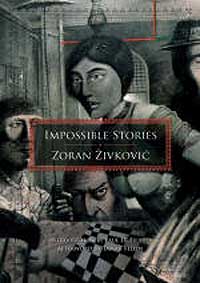
 Do we have a canon of contemporary European literature? It’s hard to imagine so, because no two European countries can draw on exactly the same sources. The view of the canon from France might include a Spanish novel that has been translated into French but not English. The Germans might be all over a Danish novel that the rest of us will never see. I might put the best of Zoran Zivkovic’s work forwards for inclusion, but this would make no sense to readers in Italy, who have yet to receive any of it in Italian.
Even where the potential for translation grants has been thoroughly exhausted, our national views of European literature are separated by cultural differences; different things matter to different races. This means that any nation’s view is refracted through not one but two separate prisms, angling certain rays into oblivion and focussing others more sharply. For a writer to claim a place in any European canon, there needs to be enough universality in his themes to angle his light directly.
In literature, what theme could be more universal than that of literature itself? It’s certainly something that preoccupies Serbian author Zoran Zivkovic, both as a creative process and an end result. He’s not doing so badly on translation, either: his blog reads like a list of foreign rights sales.
Although he’s written both novels and stand-alone short stories, Zivkovic’s trademark genre is the story cycle, in which between four and a dozen tales take different approaches to the same idea, which is developed—or concluded—in the final story. (In this sense, they do for perception what Durrell’s Alexandria Quartet does for space and time.) Take Time Gifts, a cycle of stories that opens the first volume of Impossible Stories. Here, each separate story features a character receiving a gift that has something to do with the reordering of time: a heretical monk, prepared to be burned at the stake, is allowed to see the effect of his astonomical observations on the future; a paleolinguist has the opportunity to travel back in time and find out whether her theories on early language hold any water. Finally, we find ourselves in an asylum, where a woman paints images from the other stories, which have been narrated to her by a shadowy stranger who has walked through their pages. The Impossible Encounters from that same volume include an encounter between a traveller and his future self, a priest and the Devil, and at last, between the author of these stories and his characters.
All of this structural artifice would be worth less (although perhaps not worthless) if it wasn’t for the humour and playfulness with which Zivkovic handles it. Sticking with Impossible Encounters, in ‘The Bookshop’, the proprietor of a science fiction bookshop learns to deal with the parade of eccentrics that come through his doors, sometimes keen to share very strange—and lengthy—stories about themselves:
[…] I resorted to the last means still at my disposal. Whenever an eccentric like this one drops in, I listen to his story with utmost patience, regardless of how far-fetched it is, taking great care to speak as litte as possible. My most frequent reaction is to nod or shake my head from time to time, as befits the situation, to demonstrate that I am carefully following the story. This technique has often proved useful. First of all, the whole affair is concluded far more quickly than if one were to start a discussion; second, after baring his soul almost every single visitor of this kind ends up buying a book.
Over time this proved adequate compensation for approximately a quarter hour of my attention. I could almost have made this part of my price list: “The purchase of a book gives the buyer the right to squander fifteen minutes of the owner’s time in any way he sees fit”. At first my conscience bothered me a bit, feeling this partook of prostitution, then my business sense over-rode such improvident moral purism.
In ‘The Train’, a banker finds himself sharing a compartment with a stranger, and after a moment of awkwardness, attempts to break the ice:
He bowed, perhaps somewhat more deeply than was customary. “Let me introduce myself,” he said, extending his hand towards the figure opposite. “Pohotny, banker, senior vice president.”
God shook the extended hand, bowed in response, and replied succinctly, without the blemish of superfluous additions: “God.”
The strongest story cycles are worth the price of admission by themselves (and have been published as such in other countries): Time Gifts, Impossible Encounters, and The Library stand out in the first volume, as do parts of Four Stories Till the End and Amarcord in the second.
If there’s a criticism to be made of Zoran Zivkovic’s work, it’s one that is perhaps an inevitable result of the play between symbol and structure: in some cycles, the symbols—some of which are almost certainly meaningless—and the stories themselves are arranged into neat rows and grids with an almost obsessive-compulsive attention to order. This occasionally creates moments where the structure is interesting but the actual content is not: like a fractal, by observing one point we can understand absolutely the nature of the entire piece, and this risks taking some of the pleasure out of reading.
In Four Stories from the End, for example, each story features a character near death who is visited by four people who each tell him a story, creating a kind of 4×4 grid of stories. Details are repeated: each character wears a differently shaped hat, or carries a different basket of fruit. Once the apples and oranges have arrived, we know two more baskets are due, and I’m not sure how much we care whether they contain plums or bananas, or whether the hats are shaped like cubes or spheres. There may well be more meaning in these symbols than is immediately apparent, but there may also be less. (I couldn’t help thinking that Three Stories from the End might have made a punchier read.) On the other hand, the pleasure of repetition in these tales will certainly have its fans, eager to clasp their hands each time a new bowl of fruit appears, and cry “Again! Again!”
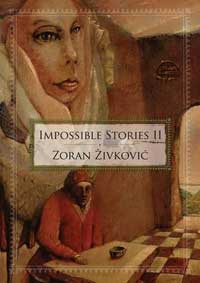 Zivkovic’s stories are at their most powerful when he allows himself more freedom within the individual tale, as he does throughout the first volume, and again in Amarcord. This sequence of ten brief stories each deals with an aspect of memory. Naming each story after a novel was a rather neat trick, as it creates a kind of memory short-circuit in the mind of the (this) reader, where part of the brain is trying to overlay the story with the plot of the original novel. The two have little in common, though, and the result is to unsettle the memory while you read stories of unsettled memories. Amarcord may be one or two stories too long, as there are occasional thematic repetitions, but these may also be deliberate, and this raises an issue. It’s hard to criticise, or even properly assess, a writer who will deliberately make concessions towards structure, because any aspect of the stories can be woven into a theory of meaning. It’s like the Bible Code: you’ll always find what you want to. This story may be a bit dud, but maybe it’s deliberately so, because it reflects the boredom of a character in another story. This one is needlessly repetitive… but could it be intended as a story about needless repetition? And so on. (No, the author isn’t dead; he just gets the benefit of the doubt.)
We have to be careful to whom we give this kind of “Get out of Jail Free” card, and nobody holds onto them forever. Zivkovic currently holds his for two reasons: one is that much of what he writes is excellent, so perfectly formed that, unless he has an intermittent medical condition or is a composite author, it’s hard to believe that there’s less talent at work in his other stories. (Not impossible, though; take a moment here to remember that the author of The Name of the Rose also cursed the world with The Island of the Day Before.) The other is the playful exuberance of his work. Even when his motivations are most in doubt, the pages keep turning. Even the least of his writing is a pleasure to read.
So I’m not sure whether a canon of contemporary European literature exists, or whether we want it too. But if it does, and if we do, then the confident, playful tales of Zoran Zivkovic certainly deserve a place in it. The assessment may be ongoing but then, shouldn’t it always be?
These two volumes of stories, along with much of Zivkovic’s other fiction, come to the UK care of PS Publishing. Each exists in a limited run of hardcover trade editions, and an even more limited run of signed, slipcased editions. The first volume of Impossible Stories, published back in 2006, is almost gone now: the trade copies are sold out, so there’s just whatever remains of the 100 deluxe editions. Impossible Stories II will be published shortly, and during September, PS Publishing are offering their other Zivkovic titles at half price if purchased with this new volume.




September 9th, 2009 at 2:44 pm
I am truly honored by Rob’s very insightful review of my two “Impossible Stories” books.
Zoran