

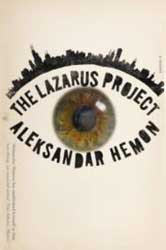
 Aleksandar Hemon’s novel The Lazarus Project opens in Chicago in 1908, with Lazarus Averbuch, a Jewish immigrant from Bessarabia, attempting to deliver a letter to George Shippy, the local Chief of Police. However, Shippy takes one look at the dishevelled foreigner on his doorstep, assumes he’s an anarchist, panics, and shoots him dead.
The second chapter introduces our narrator; it’s not Aleksandar Hemon telling us this story, but a young writer named Brik. Originally from Sarajevo, Brik has lived in the USA since before the 1992 siege began. He writes articles and columns about immigrant life in the States, and has recently become interested in the story of Lazarus Averbuch. He’s tempted to write a book about Lazarus, in fact, and soon after the novel begins, Brik receives a sizeable grant to help him write it. He decides to take the money and travel to Sarajevo, in search of Lazarus Averbuch’s roots. The Lazarus Project alternates between the imagined story of Lazarus Averbuch and the reimagined story of Brik’s trip through the Balkans.
Aleksandar Hemon and Brik have a lot in common: Like Brik, Hemon is from Sarajevo, and immigrated to America in 1992; Brik’s financial windfall is obviously inspired by Hemon’s own receipt of the MacArthur Fellowship’s “genius grant” (Brik shmoozes his money out of something called the Glory Foundation); Brik’s road trip mirrors one that Hemon took to research this novel; and both Brik and Hemon took a photographer friend along with them—many of the chapters of The Lazarus Project are illustrated with photographs by Velibor Bosovic, while others use stock images related to the 1908 case.
There doesn’t seem to be a great deal of material available on the Averbuch case, and Hemon doesn’t seem particularly interested in exploiting what there is; the 1908 chapters deal vaguely with the aftermath of the killing and its effect on Lazarus’ sister, Olga. These parts of the book feel a little shallow and half-hearted, lacking in any real historical research or flavour. Neither does Hemon / Brik attempt to draw any meaningful conclusions about the incident, or make anything but the most cursory attempt to set them in a wider context.
The killing of Lazarus Averbuch
According to Chief of Police George Shippy, Lazarus Averbuch was clearly an anarchist, come to his home to murder him. He ignored the letter that Averbuch produced, and attempted to restrain him; in the ensuing struggle shots were fired—Shippy’s son and bodyguard were both hit, and Averbuch was killed.
Shippy always maintained his claims that he was acting in self-defence, and nobody’s really come up with a solid alternative theory. One suggestion is that Averbuch, as a recent immigrant, was intending to ask Shippy for a letter of recommendation. Nobody seems to know the contents of the letter Averbuch brought with him to Shippy’s house.
You can see how the New York Times reported the story at the time here (click “View Full article” to see a .pdf of the original story).
Meanwhile, the chapters set in the present day are hampered by a sense of purposelessness. Brik isn’t particularly likeable; he’s lazy and self-involved, and the passages in which he talks about himself suffer from a lack of genuine self-awareness. His journey has no real aim, and as a result there’s no narrative drive to the present-day segments; instead, we get a series of shallow vignettes of Eastern European gangsters and corrupt officials. It’s potentially interesting material as background to a story, but he does nothing with it.
As the novel progresses, Hemon makes some half-hearted attempts to draw parallels between the two stories, for example by using character names from 1908 in the present-day one; both feature a journalist called Miller, for example, and a Brik even appears briefly in the 1908 story. There are plenty of these connections for eagle-eyed readers to spot—each thread features a character getting shot seven times, for example—but they don’t enlighten either story, and only serve to pull down the 1908 story with the dead weight of the present-day one. Towards the end, paragraphs about 1908 begin to appear in the present-day chapters, but there doesn’t seem to be any strong sense of purpose or meaning to this.
Hemon’s prose style seems to have received a lot of praise, but there’s nothing here to explain why. His writing is unexceptional, and he has an irritating predilection for sub-Amis adolescent neologisms: Jesus Christ is always “Mr. Christ”; a gun is always “a piece of gun”; “Ford Focus” becomes “Ford Feces”.
There may be potential for a great novel based on the killing of Lazarus Averbuch, and certainly for comparing the anarchist paranoia of the past to the terrorist one of today, but Aleksandar Hemon doesn’t seem very concerned about realising that potential; instead, The Lazarus Project is a half-hearted narrative that’s as self-absorbed and directionless as its narrator.



October 9th, 2008 at 4:05 pm
I read this during the summer, but never posted on it as I felt I didn’t do it justice, by rushing the second half (I was heading off on holiday the next day and didn’t want to take it with me…).
However my clear impression was that the 1908 scenes were generally very good, lucid and immersive, while the modern day scenes seemed a little self-referential and aimless.
As to Hemon’s much-praise style, I do remember finding things to love in it, like a description (just after Averbuch is shot) of gunsmoke as “moving across the room like a school of fish.” Terrific stuff.
October 9th, 2008 at 4:33 pm
Hi John,
I think it was probably a good idea to rush the second half—it’s here that the reader (and, I think, the author) begins to realise that the novel doesn’t really have anywhere to go.
Like you, when I’m reading a book for review, I mark any interesting passages (I use those little Post-It tabs, so I can strip them out when I’m done). I marked quite a few lines in The Lazarus Project, because I thought they were good or because I thought they were bad. For example, I liked the way that he slips in and out of the journalist’s report in the early parts of the 1908 storyline.
When I went back to them, however, I just couldn’t get as enthusiastic about them as I had been. They just seemed symptomatic of the bored game-playing of the novel as a whole.
Incidentally, I agreed with a lot of what James Lasdun said in the Guardian’s review of The Lazarus Project (and was amused to see that he also uses the term “sub-Amis”).
October 15th, 2008 at 5:18 pm
Congrats on identifying a National Book Award finalist (even if you found it lacking) — that’s a difficult thing to do. I’m interested enough that I will read this book — your reviews and John’s comments have produced that “low expectations” model which often makes a not-so-good book better.
October 16th, 2008 at 3:58 pm
I should really edit the review to claim (falsely) that I was predicting it as a finalist… I’m looking forward to hearing what you think of it, Kevin. Was I too harsh?
October 22nd, 2008 at 7:41 pm
I just finished the book and posted my review, Rob. I’m sad to say I agree with you – sad because the plot sounded so intriguing that I really wanted to like it. Even though I went in knowing that two trusted sources didn’t like it that much, like Kevin, I hoped that would be an asset for me. Oh well!