

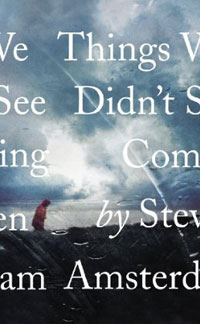
 You probably think that we survived the Millennium Bug. Perhaps you’ve even stopped nervously looking at the VCR’s clock when it starts blinking 00:00, you no longer think twice before booking flights over New Year’s Eve, or wonder whether there really are computer chips inside milk cartons.
Well, maybe you’re right. But step into the world of Things We Didn’t See Coming, the debut novel by Steven Amsterdam, and you’ll wish we’d all stuck with the abacus.
The nine or so chapters (which fill just under 200 pages), follow a single, unnamed narrator over roughly thirty post-apocalyptic years, taking him from childhood, just before the catastrophe, to an accelerated old age.
Each chapter is more or less a self-contained episode, to the point where some have described Things We Didn’t See Coming as a book of short stories. In one chapter, the narrator encounters a mother and daughter in a rain-soaked wasteland that he’s been ordered to clear of its last inhabitants. He tries to help them despite themselves, despite, really, himself. In another chapter, he’s handing out cash grants to displaced families, fighting off the attentions of a plague of stinging insects (there is something inevitably biblical about the series of challenges the world faces in the book). Another chapter opens with him considering the paperwork for his ‘practical union’, a replacement for marriage, which needs to be renewed every eighteen months:
They’ve made it simpler. You check the boxes, declare intent to proceed as responsible—though not necessarily monogamous—partners for eighteen months, with an option—if mutually agreeable, of course—to renew. Each party is assured of companionship, as well as care, if care is needed, for the designated period. If the contract is not renewed and care is needed, the state will provide (pitifully, of course, but that’s life).
Our narrator constantly adapts, without exactly changing, and it’s to Amsterdam’s credit that his character displays so many different modes of behaviour while remaining consistent and believable. In some ways, the narrator’s journey reminded me of Malcolm McDowell’s character in Lindsay Anderson’s 1973 film, O Lucky Man, and if this book was one chapter shorter than it is, I’d almost suspect that similarity wasn’t entirely a coincidence.
In fact, although the Millennium Bug is hinted at in the opening chapter, the exact cause and nature of the apocalypse is left deliberately vague. The bug hints are clever, though, for two reasons: firstly, it means that much of the story takes place in a parallel time to our own, encouraging comparisons between this world and ours. Secondly, because the catastrophe is actually passed in real life, we’re saved the Dire Warning subtext that would have come along with a nuclear war or environmental disaster.
Another consequence of the vagueness over the nature of the catastrophe is to take away the emphasis on apocalypse as a single event. If something happens between the first chapter (in which the world is still normal) and the second (in which it isn’t), just as much seems to happen between each subsequent chapter. As each one begins, we know immediately that the rules have changed again, the solutions (sometimes) arrived at in the previous chapter no longer relevant to this latest world. From the weather to the people to the surrounding fauna, nothing is constant. To paraphrase an old TV show, when you’re reading Things We Didn’t See Coming, you find yourself needing to know the plural of ‘apocalypse’.
Things We Didn’t See Coming manages to capture a strong sense of our own post-Y2K world, with all of the exhaustion, dark humour and melancholy of a world in which change has sped up to the point were we’re in a constant process of flux, where every year the world seems to destroy and reinvent itself, leaving behind old markers and bringing in new ones, to the point where the focus seems to have moved from finding ways to change the way we survive, to finding ways to survive the way we change.
(Things We Didn’t See Coming is available as a paperback and in a variety of eBook formats.)


August 25th, 2010 at 4:06 pm
Fantastic review of a very interesting book. I particularly agree with your point about the choice of apocalypse: by making it something we no longer worry about it actually makes it more chilling because it questions what could have happened and suggests where things might be had events taken a different turn.
I also agree that although the Y2K is the (presumed) first thing we didn’t see coming, every story begins with another thing we didn’t see coming, another event we only barely understand.
This is a fascinating book that is well worth reading and you’ve done a great job of conveying that.
August 25th, 2010 at 4:17 pm
Thanks, Sam! It’s very nice of you to say so.
August 27th, 2010 at 10:10 pm
It does sound rather good. I’ll take a look out for it, it sounds like it’s doing something interesting with the PA genre (which oddly enough has produced a fair number of great books, but a lot more not-so-great ones).
Electronic versions eh? I may check those out since my new Kindle should show up tomorrow or Tuesday.
August 30th, 2010 at 11:39 am
Hi Max,
The PA genre is a strange one, isn’t it? I wasn’t much interested after reading Far North, but I took a gamble on this and I’m glad I did. It’s not perfect, but it’s certainly interesting. Incidentally, PS Publishing have an anthology coming out of catastrophe fiction, which might be worth a look. Here it is.
Do let me know what you think of TWDSC if you do get a copy. And let me know what you make of the Kindle!
September 6th, 2010 at 5:15 pm
FYI: I have a Kindle–bought mainly for the free classics that are OOP. It’s great, very easy to use and very easy to read on.
September 6th, 2010 at 5:27 pm
Hello Guy,
I think that may be the most compelling reason for owning an ereader – all of the free public domain books. Even then, I suspect I’d end up using it as a sort of tester, checking out a few pages before ordering a paper copy of anything I liked the look of.
September 9th, 2010 at 6:36 am
One great use I put the kindle to recently: I was looking for a quote. I knew the words more or less, but couldn’t remember the exact wording. If I’d looked through my paper copy, it would have taken hours (it was a George Eliot novel), but with the kindle, I located the quote at warp speed. Can’t beat that.
January 18th, 2011 at 10:09 am
[…] read. What an a**SE. However, as the narrator in Steve Amsterdam’s wonderful debut novel Things We Didn’t See Coming says of his father, “He’s acting defensive […]
September 22nd, 2011 at 4:14 am
i thought the narrator did what he had to jsut to survive but people in my yr 12 class are under the impression that he was acting immorally and i dont believe that is so.. i would do similar acts if i were put in that situation.. wouldnt you??
October 25th, 2012 at 2:51 am
Very good review, i found this very helpful in getting ideas and more understanding as i am studying this book for my VCE exam on thursday.
Although.. i couldn’t get past you stated it as “short stories” where in fact they are vignettes