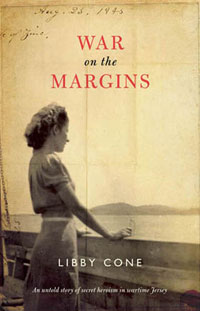
Many of the books that have crossed my desk lately have involved some kind of attempt to combine didactic fact with fiction: not just historical fiction, but books with a real desire to offload information onto the reader. Maybe “edutainment” based on real-life events or people makes for easy marketing, or maybe authors just aren’t active enough, and must find the truth of their adventures in history books rather than their own lives. War on the Margins, Libby Cone’s debut novel about the Jewish experience of the Nazi occupation of the Channel Islands, takes its own approach to the challenge. It’s successful in some ways but less so in others.
 While books like The Last Dickens shoehorn the fruits of the author’s research into the main narrative, Libby Cone adds the research itself to War on the Margins: she places entire archival documents in the text. The pieces are chosen as much for their cumulative emotional impact as for the information they provide, the majority concerning the evolving protocols of the Measures Against the Jews, and perform well at increasing the sense of unstoppable and evil bureaucracy as the occupation progresses.
The fiction, however, performs its duties less well. Despite the brisk pace of the story, there’s no immediacy here: the characters, many of whom are drawn from real people, are described rather than revealed; they seem to be acting out research rather than real lives, lack any convincing internal processes, and aren’t helped by stilted dialogue:
“Marlene, what do you think? Do you think you should move into the cellar?”
Suzanne asked this, looking intently at Marlene. Marlene held her head in her hands.
“Yes, I think so. I am afraid. I cannot get papers. I do not want to be arrested for not having papers. I don’t want to bring trouble to you…”
Lucille cut Marlene off. “Marlene, you shall move into the cellar, but you can go out sometimes with my card. I will disguise you.” She glanced at Suzanne, who looked a little less doubtful than she had a moment before.
“Is that all right with you, dear Marlene?”
“Yes, yes. It’s all right.”
“Very well, then. Let us set up the cellar.”
We’re further distanced from the characters by the occasional dump of contextual information to which they’re not privy: It’s not great to sell us a story from the islanders’ perspective, and then need to begin paragraphs with “Unbeknownst to the islanders…”. That’s trying to have your cake and eat it. The pacing (73 chapters in 250 pages) assures a brisk read, but does no favours for substance, and a sex scene between two starving refugees is so ill-conceived as to make me wonder whether it was added by an intern in an act of Wikipedia-like vandalism: aside from the situation as a whole, there are so many things wrong with the euphemism “nectary velvet” that I don’t know where to start.
This combination of static fiction with historical documents creates a kind of literary equivalent of a TV history documentary, the kind that can’t share a piece of information without forcing some hack actor—or poor sod dragged out of an RSC rehearsal—to act it woodenly out. “Leonardo Da Vinci was depressed at the news, and spent several days despondent in his rooms” [Action: muppet in am-dram Renaissance costume, looking despondently at table. Grips roast chicken leg without enthusiasm. Cut to:]
It should also be pointed out that this isn’t really a novel about the experience of the Channel Islands during World War Two. The characters spend the majority of the novel holed up in cellars, in safe houses, and in prison cells, and those settings don’t provide a great lens through which to view the society as a whole; there’s no sense here of daily life under the occupation, or any serious attempt to conjure up the geography or setting. No great changes would have been required to shift the story to any other part of occupied Europe, and this feels like a missed opportunity. Perhaps Cone’s approach can be partly explained by the original purpose of War on the Margins: this novel started life as a thesis for a Master’s degree in Jewish Studies, which limited her to a rather small subsection of the island’s community.
The appeal of War on the Margins resides more in reminding us that there’s a story to be told than it does in actually telling it. In this respect, it feels like a sketchbook for a greater, more fully realised book. Libby Cone’s combination of historical documents, re-imagined historical scenes, and fiction may be an interesting approach to the challenge of the didactic historical novel, but as much as anything, it reminds us that fiction and historical fact, unless handled with great grace, can only hobble each other.