

Lawrence Durrell: Pied Piper of Lovers and Panic Spring
Tuesday, 30th September 2008.
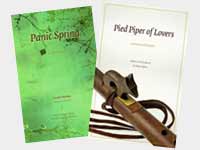 Lawrence Durrell, best known as the author of the Alexandria Quartet, wrote a total of sixteen novels. Most are still in print, but until this year, his first two novels, Pied Piper of Lovers and Panic Spring, have been impossible to get hold of. (Keep reading …)
Origins by Amin Maalouf
Tuesday, 23rd September 2008.
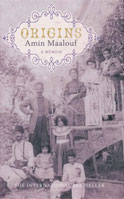 The Lebanese author Amin Maalouf has built his career both in fiction—Samarkand, Leo Africanus, Balthasar’s Odyssey, etc.—and history, including The Crusades Through Arab Eyes.
In Origins, prompted by the discovery of a trunk containing the correspondence and notebooks of his late grandfather, Maalouf turns his research skills towards his own family background, and the result is an engrossing story of the changing shapes of families and nations during the early years of the last century. (Keep reading …)
Minor characters in Lawrence Durrell’s Alexandria Quartet
Saturday, 20th September 2008.
Although it’s sometimes necessary to whisk a character in and out of a story without drawing too much attention to him, it’s generally worth remembering that a forgettable character can be a wasted opportunity. One book that really shows how much can be achieved with minor characters is The Alexandria Quartet by Lawrence Durrell. (Keep reading …)
What makes a good book for blogging?
Wednesday, 17th September 2008.
 I’ve been blogging about books, in one way or another, for a few years now—I think the first book I reviewed, on a long-forgotten website, was Yellow Dog by Martin Amis, which would make it 2003—and lately I’ve been thinking about what kinds of books are best suited to blogging.
I’m not talking about genre, because fantasy bloggers will always want to blog about fantasy novels, and literary folk will always want to blog about Philip Roth. Neither am I thinking about old-versus-new books, which again is down to the blogger’s taste. (Keep reading …)
The Gargoyle by Andrew Davidson
Thursday, 11th September 2008.
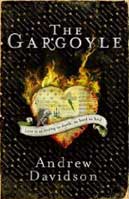 Andrew Davidson’s debut novel, The Gargoyle, begins with a car accident that leaves its narrator, an unnamed, cocaine-addled pornographer, hospitalised with disfiguring burns. While he’s recovering in the hospital he’s visited by the mysterious Marianne Engel, who greets him with the enigmatic words, “You’ve been burned… again,” and proceeds to soothe him with tales of previous lives and lost loves.
The Gargoyle has drawn comparisons to authors including Vladimir Nabokov and Umberto Eco… but does it deserve them? (Keep reading …)
24 for 3 by Jennie Walker
Saturday, 6th September 2008.
 When Charles Boyle first wrote this novella, a charming story of infidelity and cricket, told with the kind of sparkling prose that reminds us just how much fun reading can be, he so despaired of getting it published that he formed his own publishing house, CB Editions, in order to get it into print. Not wanting to seem megalomaniacal (after all, the publishing house is already named after him), he chose a pseudonym for the novel… and has been explaining Jennie Walker to journalists ever since.
Soon after the original publication, Bloomsbury bought the rights, and have now released their own edition. (Keep reading …)
Fake literary agents target new authors
Wednesday, 3rd September 2008.
 When I was a boy, dreaming my first dreams of writing and publication, it was generally known that one turned for further information to the Writers’ and Artists’ Yearbook, that august publication that lists publishers, agents, etc., along with juicy advice on everything from taxes to how to prepare your manuscript. It’s been around for years—over a century, in fact—and back in the day, everybody seemed to know that this was the place you went to if you wanted to get yourself informed.
Sure, there were those dodgy “Authors: publish your book!” ads in the pages of literary and writing magazines, and we were warned about vanity publishing, but there wasn’t the level of misinformation then that there is now; because, for really powerful misinformation, we had to wait for the Internet to arrive. (Keep reading …)
The Boat by Nam Le
Wednesday, 3rd September 2008.
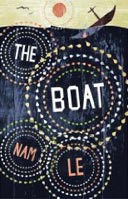 In his debut collection of short stories, Vietnam-born author Nam Le attempts to prove that an ethnic writer needn’t be constrained to writing about their background and experiences. There’s a world out there to write about, he argues, and he goes on to explore it, one continent at a time.
Unfortunately, the stories in The Boat serve as a reminder of the importance of writing about what you know, and of the dangers of a formal writing education. (Keep reading …)
