
Armed Services Editions
Saturday, 9th May 2009.
A little while ago, I finally managed to visit Rome’s Porta Portese market. The main stretch is comprised of an infinite number of stalls that sell a depressingly finite range of stock; like a British high street, it seems to be the same half-dozen stores repeating themselves as far as the eye can see. The more interesting, more unique, stalls are in the side streets, where it’s more like a car boot sale. Here, on a table with perhaps a dozen English-language paperbacks, I came across a couple of books of a type I hadn’t seen before.
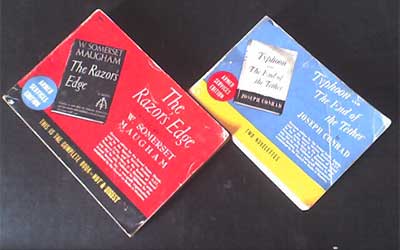
They were paperback novels, printed wide rather than tall, with two columns to each page. Maybe six titles in all; I bought Maugham’s The Razor’s Edge and a volume containing Typhoon and The End of the Tether by Joseph Conrad. Perhaps American readers of this blog will be familiar with these editions, but the Brits I’ve spoken to haven’t seen anything like them (Keep reading …)
Television for book lovers
Friday, 8th May 2009.
While book sites and blogs may be wary of turning their attention too directly towards mere television, it’s interesting how often conversation in the smoky, after hours underworld of the comments section turns to favourite series. Here, The Fiction Desk takes a look at some of the television programs most often cited and loved by the acolytes of the printed page. (Keep reading …)
The Penguin Magnum Collection
Thursday, 7th May 2009.
I’m not usually a big fan of repackaging books—it tends to happen a lot these days, and I think the noise can distract from new fiction. However, there are exceptions: I liked the recent (and ongoing) series of Atlantic Crime Classics, and the new Magnum Collection from Penguin, published today, also seems to be a good-looking little set. (Keep reading …)
PS Publishing
Monday, 4th May 2009.
Sticking with the theme of genre fiction for this second post in a series of publisher website reviews, let’s move from newcomer Angry Robot to a more established player. PS Publishing will need no introduction to British fans of horror, science fiction, or fantasy. They’ve been printing novels and novellas for a decade now, and have their own magazine, Postscripts. They regularly pick up awards, both for individual titles and for the operation as a whole, and on the few occasions that I’ve had contact with them, they’ve also seemed like very nice people. (Keep reading …)
How will Dan Brown’s The Lost Symbol affect the travel industry?
Monday, 4th May 2009.
I don’t care much either way about the plot of The Lost Symbol, Dan Brown’s recently announced follow-up to The Da Vinci Code, but I bet the travel industry does. (Keep reading …)
Angry Robot Books
Wednesday, 29th April 2009.
Following on from the post about publishers’ websites, I wanted to start looking at some specific sites and find out what they do well… and what they do badly. First up is Angry Robot Books, an imprint of HarperCollins, which I first discovered through a news post on NextRead.
The stated aim of Angry Robot is “to publish the best in brand new genre fiction – SF, F and WTF?!”, and it’s clear that their web presence is central to their imprint’s identity—as it should be. (Keep reading …)
Things a good publisher website should have
Friday, 24th April 2009.
 I seem to spend a lot of time browsing publisher websites and, with some exceptions, I’m always surprised at how little effort these sites put into attempting to engage me as a consumer. The Internet is a great tool for communicating with your customers, and for direct selling, and publishers just aren’t taking advantage of this. In this post, I’ll try to lay out some of the specific features that should, or could, go into a strong web presence. I’ll develop these ideas separately in future posts. (Keep reading …)
Why it’s important to register your own name as a domain
Friday, 24th April 2009.
If you are planning to write and publish books, or if you’re engaged in any kind of activity that would make an online presence useful, one thing you should do right now is get your name as a domain. It doesn’t matter if you’re not quite ready to start a website yet: you don’t need to do anything with the domain. The important thing is to make sure it’s yours. (Keep reading …)
The Last Dickens by Matthew Pearl
Thursday, 9th April 2009.
One of the hardest challenges for a novelist is knowing what to leave out of the book. Whether the background details to a story are invented by the author or based on historical research, it’s the author’s responsibility to make choices, inserting only the most relevant information, where it’s most useful, and keeping things tightly to the theme of the story. Too much superfluous detail can suck the life right out of a story, and this is the problem with The Last Dickens, Matthew Pearl‘s tale of a hunt for the final installments of Charles Dickens’s unfinished final book.
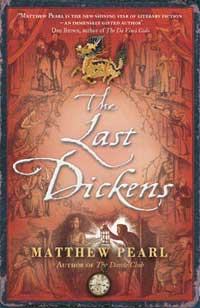 The Last Dickens is Matthew Pearl’s third stab at a literature-themed thriller. The first was The Dante Club, a tale of murders surrounding the first American translation of the Divine Comedy. From what I remember, The Dante Club wasn’t badly executed at all. Pearl came unstuck with his follow-up, The Poe Shadow, which presented the reader with plenty of research, but little in the way of story.
The Last Dickens comes somewhere between these two: it pays more attention to story than The Poe Shadow did, but it’s still hampered by constant asides into research. (Keep reading …)
The Murders in the Rue Morgue & C. Auguste Dupin
Friday, 3rd April 2009.
I’ve been revisiting the Atlantic Crime Classics range lately, taking a look at their February title, a new edition of Edgar Allan Poe’s Dupin stories, collected under the title of the first and most famous tale, The Murders in the Rue Morgue. (Keep reading …)