

Rimbaud by Edmund White
Thursday, 2nd April 2009.
I’ve preached before about the importance of reading outside your comfort zone. While usually that advice was directed at new writers, it’s a good idea for all of us not to turn too quickly away from the less familiar shelves in the bookstore.
One of my own literary blind spots is poetry. While I appreciate and enjoy “poetic prose” (and there’s a vague term for you), and have a great fondness for a well-turned phrase, straight verse has always been something of a mystery to me. I don’t read it, write it, or edit it. So, while it’s not technically poetry itself, Edmund White‘s Rimbaud: Double Life of a Rebel, published earlier this year by Atlantic Books, looked like a good opportunity for me to place at least a toe outside of my own prosaic comfort zone, and start to read around the genre a little. (Keep reading …)
Little Monsters by Charles Lambert
Saturday, 14th March 2009.
So much of the writing I see—even the good writing—isn’t connected to anything but itself. It seems to have come from a vacuum: the author knows the page, the words know the page, but neither of them have any association with the wider world. As a result, there’s nothing for me as a reader to carry away from the book. The prose is polished and utterly disposable.
The best fiction, on the other hand—the stuff that actually does matter—addresses our perceptions of the world around us, inspires us to have our own ideas, and brings us into a dialogue. To put it simply, the difference between competent fiction and worthwhile fiction is the difference between having dinner with a friend who talks knowledgeably about himself, and having dinner with a friend who talks knowledgeably about the world.
 Charles Lambert, one suspects, would address rather broader issues than his own moustache over the cacio e pepe. It’s true of his blog, and it’s certainly true of Little Monsters, his debut novel, which was published last year in hardback and last month in paperback… giving me a timely excuse to review it.
Little Monsters is a story about refugees, which is also timely—perhaps more so this year than last. The story is split between protagonist Carol’s childhood as a refugee from a broken family in 1960s Britain, and modern Italy, where Carol is volunteering as an English teacher in a “welcoming” centre for asylum seekers. (For more about the increasingly nasty situation with immigrants in Italy at the moment, I’ll again direct you to Lambert’s blog, but think “fear-mongering poster campaigns, government-sponsored vigilante gangs”.) (Keep reading …)
Sherlock Holmes and the monster of the week
Saturday, 7th March 2009.
 While I was reading The Adventures of Arthur Conan Doyle, I came across the following passage in which Conan Doyle described his reasons behind moving Sherlock Holmes from the original format of serialised novels into self-contained short stories—a move he credits with at least part of the detective’s subsequent success: (Keep reading …)
Arctic Chill by Arnaldur Indridason
Friday, 6th March 2009.
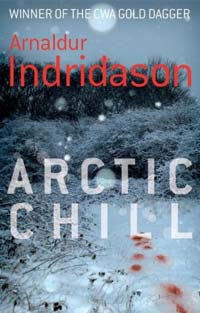 I’ve come across a few references recently to Icelandic crime writer Arnaldur Indridason. All of them have been positive, praising his use of the Icelandic setting and the development of his brooding detective, Erlendur. His latest, the first I’ve read, is Arctic Chill.
The book begins, naturally enough, with the discovery of a body. This time it’s a young boy, the son of a Thai immigrant, who’s found dead on the ice outside his apartment building. From this beginning, Indridason builds his theme of tensions surrounding Iceland’s immigrant communities, set neatly against the backdrop of the freezing weather. All of that’s exactly what you think it’s going to be: it’s good, it works. But there’s rather too much of everything else. (Keep reading …)
The Adventures of Arthur Conan Doyle by Russell Miller
Monday, 2nd March 2009.
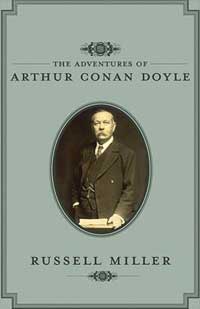 I think I’ve mentioned before on The Fiction Desk that I’m partial to reading the odd literary biography. The Brief Lives from Hesperus are handy little books, but nothing quite matches the satisfaction of a bulkier, blow by blow account of an author’s life, particularly when that author is as interesting as Arthur Conan Doyle.
Russell Miller’s The Adventures of Arthur Conan Doyle was published late last year by Harvill Secker, and as usual with that imprint, it’s a lovely edition. (Am I the only person who wishes more publishers gave their hardbacks the solid, flat spines that Harvill Secker use?) (Keep reading …)
Ten free ways to improve your writing
Sunday, 1st March 2009.
From paid critiques to writing workshops and courses, there are a lot of good ways to spend your money on improving your writing abilities. Fortunately, there are also a lot of good ways to work on your writing without spending a penny. I’ve listed ten (well, technically nine) below. (Keep reading …)
Burial (and Always the Sun) by Neil Cross
Saturday, 31st January 2009.
One of the pleasures—and privileges—of my work is watching a manuscript evolve through rewrites, as the author develops new ways to settle the prose around the story. It’s also fascinating to watch published authors evolve from novel to novel, and thanks to Simon and Schuster, I’ve recently been doing that with Neil Cross. I started with Always the Sun, his fourth novel (published in 2004), and then moved on to his new book Burial. (Keep reading …)
Scrivener Review: software for writers
Wednesday, 21st January 2009.
As a rule, I’m highly mistrustful of software that targets itself at fiction writers. While the elaborate formatting conventions of screenplays mean that Final Draft is a useful tool for screenwriters, there’s a large part of me that believes the only things prose writers need are something to write with, something to write on, and a dictionary. Software that, for example, allows you to input a number of aspects of your novel—character name, inciting incident, plot twist 2b—and then arrange them into a pre-formatted structure, is a bad thing. Writers need to be do these things for themselves; if they can’t, they’re very likely going to have deeper problems that a piece of software isn’t going to fix.
So, when I read on the BBC Website that Neil Cross does most of his writing on a piece of specialist software, I was a little sceptical. Still, I thought I’d take a look. As is so often the case when I overcome one of my many prejudices, I’m glad I did. (Keep reading …)
Lichtenberg and the Little Flower Girl by Gert Hofmann
Saturday, 10th January 2009.
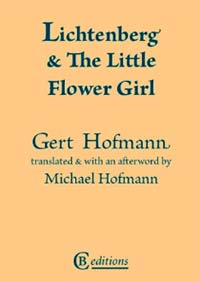 Sometimes, when you read a lot of fiction, it all begins to feel much the same. A monotony sets in: sentence follows sentence, chapter follows chapter, book follows book, all trudging past like prisoners on a death march across a blasted winter landscape. The prose does what it must in order to survive, plodding ever forwards, and once in a while a book misses its step, falls, and receives a shot to the back of the head. (I mean that it gets put down unfinished. Bear with me.)
Then a book comes along that’s filled with such vital, remarkable prose, that it reminds you what fiction is capable of. Lichtenberg and the Little Flower Girl is such a book, an explosion of language that leaves the reader wondering, as the publisher might say, How did he do that? This is the kind of prose that makes you want to get up and run around the room, and it’s another feather in the cap of CB Editions, who’ve finally given it a UK publication. (Keep reading …)
Crime Classics from Atlantic Books
Wednesday, 7th January 2009.
I have a theory that I revisit once in a while, but don’t often share with others because I suspect it’s largely nonsense. It goes something like this: Each of the main types of genre fiction, e.g. crime, romance, science fiction, etc. in some ways represent a distillation of one element of the writer’s art. So, for example, romance concentrates on character motivation, the drives of the separate characters and how they might conflict or be aligned. Fantasy—when it’s done well—might be said to look at the description of society and social setting. Crime fiction, following this theory, is all about the mechanics of story and plot exposition. After all, crime stories are often (although certainly not always) quite literally about the process of exposing the plot.
 So whatever genre a writer might be working—or wanting to work—in, it’s worth taking a little time to explore some of the others and see what might be learned from them. For a lot of writers, the chances are that they’ll start such an exploration with crime fiction. Crime, after all, is often seen as “The genre it’s okay to like”, lacking the stigma of fantasy, sci-fi or romance. So, having decided to explore crime fiction, a writer would want to read some modern authors and the classics. The question of where to begin with an exploration of classic crime fiction has been neatly answered by a new series of Crime Classics from Atlantic Books. (Keep reading …)
