

The Maze of Cadiz by Aly Monroe
Saturday, 3rd January 2009.
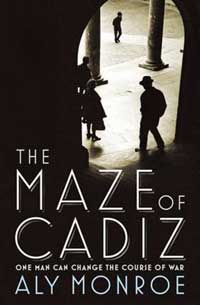 Publishers John Murray have a penchant for thrillers and adventures set around the world, often written by expatriates. One example from last year was The Creator’s Map—Emilio Calderón’s tale of espionage in wartime Rome—and more recently they’ve published The Maze of Cadiz, the debut novel from Aly Monroe.
The Maze of Cadiz introduces British “economic warfare” agent Peter Cotton, who’s set to appear in a series of novels from the author. This first story sees Cotton sent to Cadiz in the closing days of the Second World War. His mission is initially to locate and relieve R A May, a British agent assigned to watch imports and exports in the port, and who seems to have gone rogue, withdrawing large sums of money and not replying to communications. Before Cotton can reach him and discover the reasons for his strange behaviour, May turns up dead. Cotton’s left to tidy up the mess, his only official contact in the region an obstructive vice-consul. (Keep reading …)
Doctor Olaf van Schuler’s Brain by Kirsten Menger-Anderson
Friday, 2nd January 2009.
 Doctor Olaf van Schuler’s Brain, the debut collection of stories by Kirsten Menger-Anderson, uses compact, unsettling prose to follow the strains of madness and obsession across a dozen generations of a family of doctors.
The early stories in the collection are short and focussed almost entirely on their characters, with just enough period detail to fix them in place and time. This sparseness of setting makes some of the stories seem strangely intangible, like dreams related by somebody who’s just woken up, and adds to the curious atmosphere of the book. Those descriptive details that do exist have an unsettling quality of their own, such as this early description of Dr Olaf van Schuler’s relationship with his mentally ill mother:
When he was home, he sometimes released her so she could pace the thirty-foot length of their single-room dwelling, or kick the straw pallet he slept on. He let her shuck the corn that grew wild in the small lot behind their back door, and stir empty pots, which he set up on the dining table. She liked tangled yarn. He left bundles—in every color—on the floor amidst the clutter. He recited scriptures to her, knelt with her in prayer, and said nothing when she woke late at night to call upon God and plead for forgiveness.
The best books I didn’t read this year
Friday, 2nd January 2009.
I’m doing something a little different for the end-of-year round-up this year. Instead of the best books of 2008, here are some of the titles that I’m sure would have been good… if only I’d got around to reading them. (Keep reading …)
The Black Tower by Louis Bayard
Sunday, 7th December 2008.
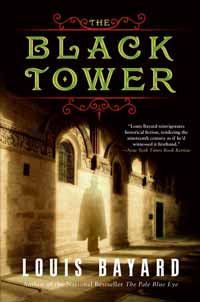 Salon.com and New York Times critic Louis Bayard has spent the last few years carving out a niche for himself as a writer of historical crime stories featuring real-life individuals and characters from classic fiction. Mr. Timothy (2003) followed the continuing adventures of Timothy Cratchit from A Christmas Carol, while The Pale Blue Eye (2006) was set around West Point Military Academy and featured a young cadet by the name of Edgar Allan Poe. Both novels had a lot to recommend them; in particular, The Pale Blue Eye was a more entertaining book than 2006’s other Poe-inspired yarn, Matthew Pearl’s disappointing The Poe Shadow (which was published on the same day and as a result must have drawn at least some of the limelight from Bayard’s novel).
In his new novel, The Black Tower, Bayard turns his attention to the French Restoration and the exploits of real-life criminal-turned-detective Eugène François Vidocq. (Keep reading …)
Inside Book Publishing
Sunday, 30th November 2008.
 Inside Book Publishing, 4th ed.
Giles Clark & Angus Phillips
Published in the UK by Routledge.
ISBN 978-0415441575
If you’re a writer, it may seem that mastering your craft is more than enough work, but it’s worth learning what you can about the industry as well. Whatever else it may mean to you, finding a publisher and getting your book into print is primarily a business activity, and as with any other business, the more you know before you get involved, the better your position will be.
Inside Book Publishing, by Giles Clark and Angus Phillips, is an excellent introduction to the subject, managing to be both comprehensive and concise. While its primary audience is academic (it’s used on several publishing courses, including at Oxford Brookes where Phillips teaches), it actually has a much broader appeal. Chapters explaining marketing, distribution and the allocation of rights are worth reading for budding authors and publishers alike, and a detailed breakdown of the costs of publishing a book will help new writers to understand why they’re not going to be able to retire from sales of their first novel. Each chapter concludes with a ‘further reading’ list, making this a perfect starting point for deeper research into whichever topics are most relevant to you.
There are shelves of books available on the subject of publishing (and in particular self-publishing), but I think it’s worth reading something that takes a serious-minded, academic approach to the core of the subject, and this book fills that role perfectly.
The latest edition was printed this summer, and is backed up by a respectable website, also called Inside Book Publishing. The site includes a blog, which has an interesting update on the potential effect of the recession on British publishers.
The Minutes of the Lazarus Club by Tony Pollard
Wednesday, 5th November 2008.
 The Minutes of the Lazarus Club is a story of murder and espionage in industrial nineteenth-century London, the kind of thing that some people call a “gaslight romance”. The central character, George Phillips, is a doctor at St Thomas’s hospital, but the novel’s being sold on a supporting cast that includes Isambard Kingdom Brunel, Florence Nightingale, and even Charles Darwin. Tony Pollard is a well-regarded historian and archaeologist, but how well does he fare when he brings the historical elements into a work of fiction?
A real danger for historians and other academics when they try writing fiction is the tendency to overload the narrative with facts and trivia. The story forgotten, they launch into a technical description of an object or a brief treatise on some aspect of the period, making the reader feel as though they’ve fallen through a hole in the story and landed on somebody’s lecture notes. This is a pitfall that Pollard largely avoids, though: after some early wobbles (the early chapters set in the hospital have some very informative dialogue in them), he does a good job of keeping things relevant to the story, and the historical information serves to colour the goings-on, rather than distract from them. (Keep reading …)
George Orwell’s manuscript for 1984
Tuesday, 14th October 2008.
 Editing and revising a novel can be a long, depressing task. A lot of the initial thrill of creation goes after the first draft has been completed, leaving behind the job of going through your work again and again: does this character come across convincingly? Could this phrase be a little tighter? In the cold light of day, does the plot really, genuinely make any sense? And the more general thoughts: How could you have made so many mistakes? What does this sea of red ink (or pixels) say about you as a writer? (Keep reading …)
The Lazarus Project by Aleksandar Hemon
Thursday, 9th October 2008.
 Aleksandar Hemon’s novel The Lazarus Project opens in Chicago in 1908, with Lazarus Averbuch, a Jewish immigrant from Bessarabia, attempting to deliver a letter to George Shippy, the local Chief of Police. However, Shippy takes one look at the dishevelled foreigner on his doorstep, assumes he’s an anarchist, panics, and shoots him dead. (Keep reading …)
The Cellist of Sarajevo by Steven Galloway
Saturday, 4th October 2008.
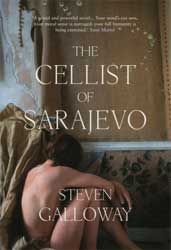 It’s the early nineties, and the city of Sarajevo is under siege by the Bosnian Serb forces. Three characters make their way through the chaos and destruction of the city streets: Kenan, on a journey across town to collect drinkable water for his family; Dragan, held up on his way to work, afraid to cross an intersection covered by a Serb sniper; and Arrow, a Sarajevan sniper struggling to maintain her independence. In the background to all of their lives is the music of the unnamed cellist of the title, who goes out into the street each day for twenty-two days, to play one adagio for each of the victims of a recent shelling. (Keep reading …)
Lawrence Durrell: Pied Piper of Lovers and Panic Spring
Tuesday, 30th September 2008.
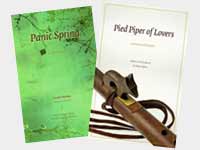 Lawrence Durrell, best known as the author of the Alexandria Quartet, wrote a total of sixteen novels. Most are still in print, but until this year, his first two novels, Pied Piper of Lovers and Panic Spring, have been impossible to get hold of. (Keep reading …)
