

In which we share advice and ideas about writing, from tips on technique and practical aspects, to the experiences of other writers. (As always, take all offered writing advice with a pinch of salt. It’s often more important to understand why a writing convention exists than it is to actually follow it.)
Quick guide to file formats for short story manuscripts
Thursday, 20th April 2023. Comments are closed.
We see a lot of different file formats here at The Fiction Desk. Although our guidelines specify that submissions should all be in MS Word format (.doc or .docx), we do our best to open and read most document types that come our way. Sometimes it’s just not possible, and we have to ask writers to resubmit their story manuscript in an alternative format.
There seems to be a lot of confusion about file formats, so here’s a quick guide to the main document types, where they come from, and their pros and cons as submission formats.
When making a submission it’s important to always follow the individual publisher’s guidelines in terms of the file formats they can accept: after all, only they know which devices and software they have access to. Still, the following should provide you with some insight into why they make the choices they do, and what you can do if your preferred formats don’t match their requirements: (more…)
Penguin Little Black Classics: a great resource for writers
Tuesday, 31st July 2018. Comments are closed.
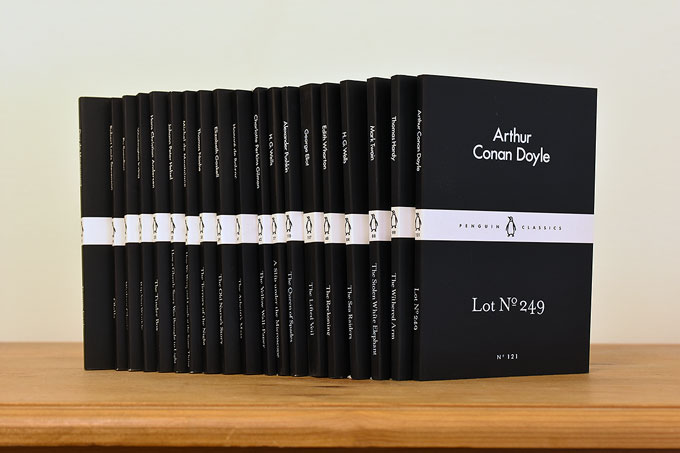
Penguin’s Little Black Classics are a collection of short books (mostly around 64 pages, although some are longer), originally published in 2015 as a series of eighty volumes, to celebrate the 80th anniversary of the founding of Penguin. These first books were priced at 80p each. The volumes cover short stories, poetry, miscellaneous bits and pieces, and the odd slice of non-fiction. All are older works, largely from the 19th century; but with some going much further back, and the odd volume creeping in from the early 20th century.
The first eighty volumes did rather well: within a year combined sales of these little books had comfortably exceeded two million copies, and so in 2016 Penguin added a further 46 volumes (the first Penguin Classic was published in 1946, you see). Now they dropped the 80p business, with the new titles priced at £1, or £2 for a few slightly longer volumes. In 2017 the United States Constitution was published as a sole additional title, making the total number of Little Black Classics in print today 127.
This isn’t the first time that Penguin Classics have bombarded us with tiny little books: the 1995 anniversary was celebrated with Penguin 60s: those cost 60p, and totalled 180 volumes covering a range of subjects including biography, travel, classics, and sixty more modern stories from the likes of Martin Amis and Muriel Spark — perhaps Penguin had more of a budget for licensing and royalties in those heady 1990s. (The full list of Penguin 60s is on Wikipedia.) In 2011 they marked the 50th anniversary of Penguin Modern Classics with fifty ‘Mini Modern Classics’, a series of slightly more recent volumes at £3 each.
#

Getting back to the current series, when the first volumes came out I took note, vaguely hoped to find a cheap boxed set of all eighty books somewhere, and then forgot all about them. I must admit, I expected them to disappear quickly. Not because they’re not worth buying (they certainly are), but because in the days of online free postage and real bookshops with squeezed margins, small very cheap books didn’t seem particularly practical. But as the list has grown, and been embraced by millions of readers and at least some bookshops (my nearest Blackwell’s has a full bay of them; or did until I got my hands on it), perhaps it bears revisiting.
For writers in particular, the Little Black Classics series is a fantastic resource. It’s vital that writers read as widely as they can, and familiarise themselves with as many authors, styles, and ideas as possible.
Anthologies are one great way to do this, whether they’re specific themed collections of periods or genres, or attempts to take in a wider picture, like the two-volume Penguin Book of the British Short Story that Philip Hensher edited a few years ago (and there are of course still wider pictures than just British short stories). As a quick overview, these anthologies are terrific; and for obvious reasons, The Fiction Desk likes anthologies.
Anthologies generally only contain one story by each author, however, and while these individual stories might bring a writer to your attention, they can only tell you so much about their work. The logical next step, the single-author collection, will take you much deeper into an author’s work, but it’s impractical to read as many of these longer collections as you might want to, particularly when you’re also trying to keep up with more modern writers.
The Little Black Classics come somewhere in between, usually containing two, three, or four stories by the featured author. Having these extra stories on hand gives you just a little of the context and depth that you normally need to go to a collection for, but the price and size makes them much more accessible, much easier to take a chance on.
#

Here then is an opportunity to find out whether Mark Twain’s humour still hits the spot, and think about why it succeeds or fails in the modern era; to take a look at how Arthur Conan Doyle’s supernatural fiction compares to the Holmes stories (sometimes Conan Doyle is surprisingly good, and sometimes he’s surprisingly bad); to examine HG Wells’ ability to spin a gripping tale with economy and vitality (Wells is one of the few authors to be honoured with two volumes in the series); to finally take a look at the short fiction of Thomas Hardy (another one); or Balzac or Washington Irving or whoever else you’ve not quite got around to yet — or whose work you need to revisit to freshen your memory.
I’m concentrating on the short fiction because that’s what we do here; the poetry and non-fiction volumes in the series offer similar delights and, again, further opportunities for exploration and discovery.
The Little Black Classics are available from some online outlets, but not all: Amazon has them in both paperback and Kindle form; The Book Depository — whose ‘free worldwide delivery’ seems to steer them away from any book costing under about £2 — have only the boxed set of the first eighty volumes. But ideally, you want to find a physical bookshop in your area that has them there on the shelf, where you can browse properly and make a habit of picking out a volume, or a handful, whenever you happen to be passing.
It would be great if the series could be expanded to include slightly more recent work, as was the case with the Penguin 60s, but there’s still plenty here to be getting on with. You’ll find that one of those nasty plastic fivers can be converted into a lot of nice black books.
— Rob
Do Fiction Writers Still Need Whitaker’s Almanack?
Monday, 12th February 2018. Comments are closed.

This year marks the 150th anniversary of Whitaker’s Almanack, a reference book whose history is intertwined with the history of British literature, both as a tool for writers and, occasionally, as a plot device.
The Almanack, which stretches in the 2018 edition to 1141 pages (plus colour plates and index), covers subjects from the workings of the British government to tide charts; from a brief guide to politics in every country of the world to a series of essays on the year’s developments in a range of art, political, and financial fields.
Want a quick rundown of the past year in literature? It starts on page 999. Decide it’s time to find out how the European Union is actually run? Pages 611 to 620 will do their best to fill you in. Pages 365 to 377 list the current fees of (almost) every private school in the UK, while an explanation of the differences between the NHS in England, Wales, and Scotland begins on page 382. It’s effectively a user’s manual for residents of the United Kingdom.
Dracula and Sherlock Holmes both consulted Whitaker’s in the course of their adventures. A character in Somerset Maugham’s story ‘The Round Dozen’ passes on Trollope’s advice that ‘the two most useful books to a novelist [are] the Bible and Whitaker’s Almanack’ (admittedly Maugham’s narrator isn’t convinced, and doesn’t himself possess a copy). Whitaker’s crops up in Orwell, too: his early novel Keep the Aspidistra Flying contains the observation that, ‘After all, all works of reference are pornographical, except perhaps Whitaker’s Almanack’.
Of course, all of the information here – aside from the various essays – is also freely available online. Isn’t a reference book like this a bit of an anachronism? Something for retired civil servants to snooze over while they digest their Christmas dinner, rather than a genuinely useful tool? It’s not a cheap book, either: the RRP of Whitaker’s Almanack has climbed rapidly over the years, to the point where the complete 2018 edition is priced at £90 for a single hardback book. That price is largely academic, though: it sells at around £55 online, and is clearly priced to be discounted. (That’s not great for bricks and mortar bookshops, who tend to get a raw deal out of this kind of pricing strategy.) There’s also a concise edition available, containing a selection of the UK material, priced at a more High Street-friendly £25.
But if you can afford it, or settle for the concise edition, it might just be worth getting hold of a copy.
*
For general usage, it’s good to be able to consult Whitaker’s rather than disappear down the rabbit hole of the internet, or indeed going near a screen at all. Even using a book, you might very well find yourself starting to browse the pages and read up on other topics once you’ve found what you were looking for, but still, the context is at least relevant. There’s no clickbait, no advertising, no notifications, nobody trying to message you.
If a question comes up when you’re with friends or family, it’s a lot more pleasant to pull a book from the shelf, rather than have everybody cluster around an iPhone, or get drawn into one of those tedious information races where everybody is trying to be the first to Google the prime minister’s salary (p.177) or what happens if you die without leaving a will (p.545), or what the flag of Ghana looks like (unpaginated colour plates, following p.800).
For a writer, having a copy of Whitaker’s Almanack nearby – shelved somewhere close to the dictionary and the style guide – means that when a question comes up about the workings of the UK, you don’t have to leave the environment of your work-in-progress in order to open a browser window, with all the dangers to concentration and productivity that entails. And much of the information contained in Whitaker’s is useful for fiction: if a character dies intestate, you won’t want to give your readers a three-paragraph summary of the relevant legislation, but you probably want to make sure that whatever happens next in the story is realistic. If you’re writing crime, your chief inspector’s lifestyle is going to need to be funded on an annual salary of roughly £55,000 (p.309) – unless he’s bent, of course.
The other benefit to having all of this information in a physical book is that although most of it might be available online, that doesn’t mean writers will actually access it. Most of the short fiction written today doesn’t take the national context into account; there’s no suggestion that the writer is aware of the workings of the country, or the particular social and political backdrop against which their story is taking place. Again, it’s not necessarily information you’d use explicitly in your fiction, but it’s background that’s worth having at your elbow. A copy of Whitaker’s on the desk of a fiction writer might get consulted less often than it would be in the hands of a political journalist, but it could also serve as a reminder of the importance of context.
*
In a book printed late last year, there are obviously things that are out of date. Political appointments change, as do politics themselves: perhaps a little optimistically, p.613 tells us that Brexit negotiations are due to conclude in December 2017. There will certainly be times when you’ll want to confirm a detail online after consulting the book. There’s something comforting in this, though, in being able to step outside of the eternal ‘now’, the telescoping of time in the digital age, and to look at the world from a fixed, defined point in time. (This might explain why some people find themselves trying to collect a complete set of Whitaker’s, all 150 volumes from the last 150 years.)
You can even access Whitaker’s online, purchasing chapters at £1 a time, or sections for £5 – although this rather defeats the purpose of the whole thing, and anyway the execution feels a little rushed, with for example the list of abbreviations separated into 25 different chapters of just a few words each. (At least they don’t charge you for X, which has no entries.) Given that people going online will be able to find the information for free elsewhere anyway, the future of Whitaker’s would probably be best assured by embracing its merits as a physical object, and fundamental difference to the world of digital information.
One purpose of Whitaker’s Almanack is to describe in uncritical detail the workings of the British establishment. Depending on your own politics, some of the content might feel redundant or complacent to the point of being objectionable. The sheer breadth of the topics covered also means that most people won’t find every section useful. But think of the book in its entirety as the real-world equivalent of all those notes JRR Tolkien made for himself as background to the Lord of the Rings, or simply as a handbook to the great machine of which your characters – if they live in modern Britain – form a part, and you may just find a place for it on your desk.
James Benmore on Love Books Love Travel
Friday, 10th October 2014. Comments are closed.
A while ago the website Love Books Love Travel (then known as Buena Vista Book Club) made a film about James Benmore, in which he wanders around London, talking about his relationship with the city and its role in his novels about the continuing adventurs of Charles Dickens’ Artful Dodger.
The film is well done, and has been split into easily digestible chunks of about six minutes each. Here’s part one:
For the other two parts of the film, and to find our more about Love Books Love Travel, visit Vimeo here.
You can also read James’s guest posts for us about the writing of Dodger: Part 1 & Part 2. And finally, James’s excellent short story ‘Jaggers & Crown’ appeared in our anthology All These Little Worlds.
Richard Smyth and the First Person
Friday, 4th July 2014. Comments are closed.
Here’s Richard Smyth with some thoughts on writing in the first person. Richard’s new novel, Wild Ink, is out now.
‘Who is the third who walks always beside you?
When I count, there are only you and I together
But when I look ahead up the white road
There is always another one walking beside you.’– TS Eliot, ‘The Waste Land’
Yeah – who is the third? Who is that, bookending dialogue with he-saids and she-saids, commentating on proceedings with a curiously proper and well-spoken detachment, mind-reading without explanation, casually omniscient, incomprehensibly well-informed, inhumanly objective? Who are these Third People, and what are they doing in our novels?
 I do most of my writing in the first person. My first novel, Wild Ink, is narrated by its main protagonist, the horridly decrepit but reliably wry Albert Chaliapin. My stories for The Fiction Desk, ‘Crying Just Like Anybody’ and ‘Chalklands’, adopted first-person perspectives, too. I’d seldom ever really stopped to wonder why – why have I so often preferred to step into my characters’ shoes, instead of maintaining a decent distance, an appropriate remove?
The way in which language is used on a word-by-word sentence-level basis – style, to use a rather loaded word for it – is very important to me. Writing your stories from inside a character’s head gives you almost unlimited stylistic freedom. Turns of phrase and figures of speech can be used that, coming from the pen of an unidentified third-person narrator, would invite unhelpful questions about who on earth is telling this story, and why they talk the way they do. Complex, original language creates, just by existing, a speaker, a person, a character; do this with a nameless third-person narrator and you will be thought to be playing postmodern games with the reader.
It’s a little unfair, of course. There’s seldom any secret about who is telling the story: their name is right there on the title page. Any quirks of language, flights of invention or unexpected editorialising come, of course, from them.
But modern literature shies away from the self-identifying storyteller. And ‘shy’ is the word: it feels unseemly, importunate, to step into the story one is telling with a bold Dickensian ‘I’; for the modern author, it seems to invite the rebuke ‘Who on earth do you think you are?’ – meant either literally, in the assumption that the author is creating an ‘author’ character, that the narrator is not Richard Smyth but ‘Richard Smyth’, or figuratively and indignantly, to suggest that the author has overstepped the mark. Sure, some writers – Anthony Burgess, James Joyce – get away with it, pushing stylistic limits in third-person narration without ever explaining how or why. But, well, we aren’t all Burgess or Joyce.
Distinctions between first and third persons are not necessarily clear-cut. There are many instances of authors breaking the bonds imposed by third-person conventions by narrating through a secondary character – to each Jay Gatsby his Nick Carraway, to each Ahab his Ishmael. This gives the work an additional layer, another dimension; we are invited to view one character through the filter of another, a double refraction of reality. The catch here is that the narrator – while they may digress, switch between narratives, shift focus from character to character and indulge in other such authorial perks – may not be omniscient.
That may or may not be a problem. Only a true know-all can narrate War And Peace. In other novels, it’s necessary for the narrator to be in the dark (like John Self in Money, for instance).
Personally, I want to be where the fireworks are. I want to know first-hand what Gatsby’s going through. I want to read Ahab’s inner monologue! I want to get as close to the action as I possibly can, which often means taking one’s seat in between the character’s ears – even though what one sees in there might not be particularly pleasant. Good first-person narration brings you face to face with an honest and flawed humanity (if it’s honest, it’s inevitably flawed). For me, that’s really what fiction is for.
— Richard Smyth
James Benmore on writing Dodger #2: the voice of Dodger
Thursday, 16th May 2013. Comments are closed.
James Benmore’s first novel, Dodger, features the return of the Artful Dodger from Oliver Twist. Last month, he wrote for us about the appeal of the Dodger and why he chose to bring him back. This month, he talks about creating the voice of Dodger, and how the character might have come to write a book in the first place.
 Whenever Charles Dickens wrote in the first-person, he tended to employ a particular type of narrator. These are often virtuous, seemingly middle-class voices who begin their own stories with an account of an impoverished upbringing blighted by some atrocious adult. This can be a cruel step-father perhaps, or a bullying older sister, and this dark parent-figure makes their very childhood, and often the first few chapters of the book, a bit of a misery.
Such hard luck stories — or what Holden Caulfield from The Catcher in the Rye bluntly described as “all that David Copperfield kind of crap” — invariably mark the start of a rags-to-riches plot. The narrator describes how, through hearty Victorian resilience, honest labour and a few well-timed coincidences, they manage to escape from this unfortunate start in life and enter into a higher, more genteel social spectrum form which they are now writing their own history.
Often the narrator will be a stand-in for Dickens himself, like the semi-autobiographical Copperfield who shares many of his author’s life experiences as well as his reversed initials, or Pip from Great Expectations whose descriptions of his own youthful snobbery and self-centeredness can sometimes be read as though Dickens is taking himself to task.
Occasionally Dickens may adopt the voice of someone very different from himself, such as the modest, female perspective of Esther Summerson in Bleak House. But all his major narrators have something in common: they are all, at their hearts, morally pure. They possess flaws certainly but it is impossible to conceive of Dickens handing the bulk of any novel over to a scheming, unrepentant rotter to narrate. He may give a rough criminal like Magwitch a few pages of contained narration nested within Great Expectations but even Magwitch doesn’t seem so bad by that point in the story.
No, if we want to read a novel narrated by a classic Dickensian villain then we just have to write it ourselves.
This is the main idea behind my novel Dodger. I tried to write the book that I wanted to read: one in which Jack Dawkins, a very different type of character from the Dickens canon, is allowed to put pen to paper and tell the story of his own life with as much freedom as David, Pip or Esther would. I was interested in what such a book would sound like, in what dialect would be employed and what different moral perspective Dawkins could bring to the familiar Victorian surroundings.
I did not want Dodger to spend much time relating his own account of the events of Oliver Twist and this was largely because as a character he is present at too few of its key scenes. Instead I wanted him to tell us about what happened to him next, after he was transported to Australia, and to describe his discovery at what fate befell Fagin and company upon his return six years later. Unlike those other narrators I did not imagine that Dawkins would be inclined to present his early childhood as a sob story. In fact, I suspected that he would look back upon his old life with Fagin and his large gang of boy pickpockets as having been a very happy time, a perversely idyllic childhood, and one that was rudely interrupted by the cruelty of the law.
The principal challenge in writing any first-person novel lies in getting the voice right, and casting Dawkins in such a role presented immediate difficulties. How literate would someone from his background even be? Dickens shows that the criminal contingent of Oliver Twist are all avid readers of The Newgate Calendar, a cheap periodical that detailed the arrests and executions of various villains throughout the capital, so we can safely assume that Dawkins possesses a decent enough level of literacy to build upon. He then spends six years in an Australian penal colony where, I like to imagine, he would have been given access to a large enough library that could have inspired a love of words and storytelling within him. Dawkins is a thief in all things and he is someone who, when he encounters the possessions of rich men, itches to take them for his own. This compulsion would extend itself to reading — or so I reasoned — to the books, stories and words of wealthy society as much as to their valuables.
 This of course does not mean that he would speak in the same pure-bred English that Pip masters after his years of education away from the forge. Nor do I truly think that Dodger would want to speak like that. Instead the voice that I developed when I began writing the first chapter is a mixture of the sort of literary language that I feel he would have met in fashionable novels, the archaic slang of Victorian London and a persistent bad grammar that he would wear as a badge of his class.
Dawkins the narrator is perfectly capable of mimicking the language of the middle-class when writing their dialogue so it follows that his own use of cockney could be a deliberate choice he is making. I have always known that the Artful Dodger is someone who covets the comforts, possessions and privileges of the high-born Englishman, but that doesn’t mean that he wants to be one himself. He does not aspire to be accepted into their world in the same way that David Copperfield or Pip do. Dodger just wants to steal what rich people have and keep it for himself, and I needed him to speak in a voice that communicates that difference.
Another aspect of writing this first-person novel that concerned me was the question of why exactly the Artful Dodger would be scribbling all this down in the first place. Throughout my book and its upcoming sequel he admits to all sorts of pickpocketing, burgling and other shameful behaviour and there is hardly any of the usual contrition in his narrative voice that you might associate with a reformed sinner like Moll Flanders. Dodger isn’t sorry for his crimes at all, in fact he’s boasting about them.
I often imagined when writing the book that Dawkins the narrator wasn’t much older than the Dawkins in the story, as if he’s composing his autobiography just a few short years later in his mid-twenties and not wanting to apologise for any of it. I never have Dawkins explain in the novel why he would be writing a book that could incriminate himself so disastrously because I want the reader to wonder about that themselves. But one thing is certain; this is not a work he can ever publish within his own lifetime.
But why should that stop him? Sometimes people write just for the joy of it or because they have a story in them that needs to come out. And just because Dawkins is barred from enjoying any real literary success while alive does not mean he isn’t subject to that same storytelling impulse that we find in those other Dickens creations like David Copperfield or Pip. Perhaps Dawkins, despite occupying a very different moral space from those other characters, has as much as in common with his creator as they do.
— James Benmore
Read James’s first post about writing Dodger here.
Dodger is out now, published by Heron Books and available in hardback from all good bookshops, as well as the usual range of ebook formats. (Read the first chapter on Amazon.) James Benmore is already working on a sequel.
You can also read James’s award-winning story ‘Jaggers & Crown’ in our anthology All These Little Worlds.
James Benmore on writing Dodger #1: the Artful Dodger and the first Dickensians
Monday, 15th April 2013. Comments are closed.
This month we’re celebrating the publication of the first novel from Fiction Desk favourite James Benmore. Dodger (published by Heron Books) revisits the character of the Artful Dodger from Charles Dickens’ Oliver Twist, seeing him return to a much-changed London six years after transportation to Australia. But he’s not yet a free man…
Dodger is a hugely entertaining book, combining 21st century storytelling with a genuine passion for the original books. In the first of two posts for The Fiction Desk, James Benmore writes here about how he was drawn to the Artful Dodger in the first place, and why he feels there is more to say about the character.
I’ve always envied Dickens’ earliest readers. The ones that discovered him back in the early 1830s when he was still writing journalism and sketches under the pseudonym of Boz. The ones who read The Pickwick Papers in a time when it was first being published in shilling instalments — not because it was written by some grand old man of literature but because it was fresh and funny and someone fashionable had recommended it to them.
Those hip metropolitans who would have been dropping the name of Charles Dickens — the sparkling young author who you simply must read — all over town and quoting his choicest bits to each other while their less literate friends listened on glumly because they weren’t getting any of the references to Sam Weller, Joe the Fat Boy or Dingley Dell. I’m talking about the long-time fans, the ones who were there at the the start and liked him even before he went all mainstream with The Old Curiosity Shop a few years later. Because, lets face it, if you didn’t know who Charles Dickens was back in 1836 then you probably weren’t someone worth talking to. You were, not to point too fine a point upon it, a bit tragic.
For these early readers — the first Dickensians we’ll call them — then the summer of love must have taken place between the February of 1837 through to the November of that same year. This was the magic period when Dickens, still only 25, was serialising his first two novels simultaneously as the final instalments of Pickwick overlapped with the opening chapters of Oliver Twist. These two novels could not be more starkly contrasted, the first being all lightness and comic fizz while the second is an angry, murderous melodrama, and they must have struck the first Dickensians as a stunning one-two punch.
One of the great pleasures of reading early Dickens is the wonderful show-offery on display: it’s as though the new author is even impressing himself with how talented and wide-ranging a storyteller he can be, and by what brilliant things he can make words do. Neither is a perfect book — Pickwick keeps spinning off down random narrative byways and Dickens is clearly making the plot of Twist up as he goes — but there is a joyous free-wheeling energy to both and this is something that fades a little in his subsequent work. Literary scholars may correctly identify later novels such as Bleak House and Great Expectations as more technically accomplished, important and mature but, as any first Dickensian will tell you, there is just something cool about the early stuff.

Which brings me to Jack Dawkins, or the Artful Dodger as the criminal community insist on calling him. For me, Dawkins is the very epitome of everything that is great about early Dickens. He makes his first appearance in chapter eight of Oliver Twist, right in the middle of that golden period, and in just a few short pages he steals the whole scene out from under Oliver’s virtuous nose. He is the very voice and swagger of a young urban London with his cockney slang and streetwise savvy and he is not someone I can imagine the author creating later in his career. Dickens went on to present his readership with an array of criminal grotesques and middle-class bounders but the Dodger represents something not commonly found elsewhere in the Dickens canon: attractive lower-class rebellion.
We aren’t invited to be disgusted by Dawkins in quite the same way that we are with Fagin and Noah Claypole; in fact there are aspects of his character that we even find ourselves drawn to. After all, what reader hasn’t fantasised about how they would fare if Dawkins was to take them out on a pickpocketing spree as he does with Oliver. About how artful we would prove ourselves to be, and whether or not Dodger would like us.
Dickens seems to have been inspired to create the character back when he was working as a court reporter. He had already written a non-fiction scene which can be found in the ‘Criminal Courts’ chapter of Sketches by Boz in which a lad of thirteen is shown being tried at the Old Bailey and proceeds to creates chaos in court with his accusations of police corruption, unlikely alibis and calls for imaginary witnesses. This clearly inspired Dodger’s final scene in Oliver Twist, when he is himself sentenced for stealing a silver snuff box from an unnamed gentleman.
Like his real-life model from ‘Criminal Courts’, Dawkins doesn’t sniffle in the stand and beg to be spared: he’s far too mischievous and unrepentant a character for that. Instead he performs for the benefit of the spectators and grins in the faces of the officers who drag him away for transportation. And it is this irrepressible comic spirit which makes Dawkins such a light relief in an otherwise dark novel. He isn’t punished for his criminality as severely as Fagin, Bill or Nancy are. Neither does he undergo an unconvincing change of heart like his friend Charley Bates does when he suddenly informs on Bill Sikes in the final act. Dodger is just allowed to be Dodger and — by mid-Victorian standards — he pretty much gets away with it.
Except of course he doesn’t, and all because of that sticky snuff box. After his sentence Dodger is removed from the action of Oliver Twist just before things turn really nasty for the criminal contingent. Perhaps this is because Dickens wanted to spare the child from the bloody end he had in store for the rest of them, or maybe it was because he didn’t want Dawkins upstaging Twist any further. Either way, I think most of Dickens’ readers — be they first Dickensians or those of us who have read the book 170 years later — must have felt disappointed that Dawkins is never mentioned again.
There’s a real sense that there was more fun to be had with the boy thief if only Dickens had wanted to have it, and I’ve often wished that the Artful Dodger could have been like Falstaff: a disgraceful yet lovable recurring character. I like to imagine him crossing over from the pages of Oliver Twist and into those of the author’s other novels, especially The Pickwick Papers during that time when they were both still running. Imagine what a surprise it would have been for those first Dickensians if he had suddenly appeared picking Mr Pickwick’s pocket in an installment of that book and then was next seen back in Oliver Twist being tried for that very crime, before continuing to show up at some point in every other Dickens novel that followed. It would have blown their Victorian minds.
And it was this thought that inspired me to write my first novel Dodger, in which Dawkins narrates what happened to him next in his own crooked, unapologetic voice and even interacts with people from other Dickens works. I wanted him to be our guide around the fascinating city to which he returns six years after his transportation, the world we are still calling Dickensian London. I don’t know if literary scholars will like my book; in fact I very much doubt it. But then I don’t think I really wrote it for them. I like to think that I wrote the book for the real fans, the ones who were there at the start. I like to think that I wrote the book for the first Dickensians.
— James Benmore
Dodger is out now, published by Heron Books and available in hardback from all good bookshops, as well as the usual range of ebook formats. (Read the first chapter on Amazon.) James Benmore is already working on a sequel. The novels are written in the first person, and in another post on our blog, James talks about reconstructing the voice of Dodger himself.
You can also read James’s award-winning story ‘Jaggers & Crown’ in our anthology All These Little Worlds.
Six rules for manuscript formatting.
Thursday, 5th July 2012. Comments are closed.
Something I’ve noticed over the last couple of years is that most writers have trouble getting their manuscript formatting right.
I suspect this is partly due to the Internet. A few years ago, the standard way (in the UK) to plan your submissions was to get hold of a copy of the Writers’ and Artists’ Yearbook, which had handy sections on manuscript preparation. They were right next to the lists of magazines and book publishers, and hard to miss for writers getting ready to send out work.
These days, a lot of people submit just by Googling variations on ‘short story submissions’, or just by contacting their favourite publications direct, and so maybe miss out on that useful information. But even in the digital age, getting manuscript formatting right is very important. It doesn’t just show professionalism on the author’s part: it also helps the editor to connect to the words themselves. (If the editor spends the first 30 seconds with your manuscript adjusting it to be easily read, that’s your first impression gone.)
The key thing to remember about manuscript formatting is that it’s not about looking pretty, or showing off creative or literary credentials. The idea is to make the formatting itself disappear, so that the focus is on the words and nothing else. And the easiest way to make the formatting disappear is to make it look exactly the same as all the others. The six rules below should help you to do that.
Incidentally, I’ve written this post specifically with regard to electronic submissions, but the rules below apply equally to printed submissions (though the reasons may vary). And all publishers vary: if a specific publisher asks for different formatting, it’s always best to give them what they ask for.
The Basic Rules
1. Use 12-point Times New Roman. Everybody is used to seeing Times New Roman on their screen (or on paper), and every computer has it. It’s the most invisible font there is. On a standard paper size (see below), 12-point text is comfortable to read, and if reading on a screen, the editor will be set up for it.
2. Double space your text. Even if the days of making notes between lines are over—on the screen, at least—the extra white space helps your writing go down easily. Always apply double-spacing through the formatting menu: don’t just hit ‘return’ twice at the end of each line. (We get a few of those.)
3. Mark a new paragraph by indenting the first line; don’t leave an empty line between paragraphs. Each new paragraph, or line of speech should be indented. Again, there’s an option to indent the first line of each paragraph automatically in the paragraph formatting options: don’t use the tab key to do it. Leaving a complete blank line between paragraphs is something you’ll see when reading online, including on this site but, has no place in text documents.
3a. If you want to mark a change of scene or time, the kind of thing that would have a blank line left in a printed book, mark it with a centred hash, as I’ve done at the bottom of this list. This means it will still be visible when the text is copied into other software for typesetting. An empty line may just get lost at this stage.
3b. Don’t indent the first line of the story, or the first line following a chapter break or scene change – anywhere you would expect to see a blank line left in a printed book, or marked with a hash as in (3a) above. (The job of an indent is to make it clear that there’s a new paragraph starting, and this isn’t necessary in these cases as there’s no paragraph immediately above.)
4. Leave margins of roughly an inch and a half. A little more or less won’t hurt, but don’t go too far in either direction. There’s no need to shrink the margins to squeeze more words onto the page, or to make them larger to give the text ‘breathing space’.
5. Use a normal ‘paper’ size. In Europe this means A4, in the USA use US Letter. Don’t try to mimic the page of a book or use any other size.
6. Use a simple header. Personally, I’d suggest having author name on the left, title centred, and page number on the right. For the first page, use a unique header (it’s a Word setting) that has your full name and contact details, and word count. All of these details belong in the header and nowhere else: never try to put the page number at the top of each page within the body of the manuscript, because the smallest edit near the top will make a mess of the whole thing. (It’s rare that people do this, but it does happen.)
#
So there are six basic rules. If you can stick to those, your formatting will be in the top 1% of manuscripts we see. And while it may feel like you’re jumping through hoops, it’s really just about making sure that you’re showing off your writing to its best advantage.
How travel can damage your prose
Tuesday, 19th June 2012. Comments are closed.
 For writers, international travel is generally a very good thing: even if you don’t write about your travels directly, encountering different places, cultures, and people gives you a certain perspective and insight when you come to write about your own.
There are however certain dangers, afflictions that can show up in a travelling writer’s prose, a sort of literary equivalent of 19th century Grand Tourists coming home with venereal disease. I’ve identified four of them below.
(The examples are invented, but the afflictions are all too real.)
1. A pedant writes…
This condition is particularly common among visitors to cities that have a strong and visible history, a typical example being Rome. The sufferer becomes so overwhelmed by the information they receive and research about the city that they need to pass it on to their readers, whether it belongs in the story or not.
Example:
The two new lovers arrived at the Trevi Fountain in Rome, and stopped to admire the elaborate Baroque craftsmanship.
‘It was originally designed by Bernini in 1629,’ he said lovingly. ‘But not constructed until a century later. It’s 26 metres high and 20 metres wide.’
‘I notice that people are throwing coins into it,’ she said, pointing at a coin glimmering in the water and hoping that he might continue to talk about it for ages. He sounded so erudite when he spoke; just like Wikipedia. She moved a little closer to him.
‘It’s funny you should notice that,’ he said. ‘They say that up to €3,000 are thrown into the fountain every day. The money has been used in part to subsidise a supermarket for the city’s poor. People often try to steal the coins, too.’
‘That’s very interesting,’ she said. ‘Now could you recommend me three hotels in the €50-€75 bracket, and perhaps share some useful weblinks?’
2. “I am literally the only person who has ever eaten a pizza!”
Or a baguette, or a croissant, or a frankfurter actually served in Frankfurt.
Example:
I bit into the pastry: it was sweet and fresh, not at all like the croissants sold in supermarkets at home. It was still a little warm from the oven; the pastry flaked lightly away as I bit, and drifted around me in a cloud of flour-based ecstasy that nobody who hadn’t been to Paris could possibly imagine.
I lingered for a while. I may have been a space detective sent back in time to capture the evil Marspirate CheLuck, but right now I was having my croissant moment.
3. “The Henry Miller rush”
This one is most frequently found in prose coming from Paris, where idealistic young authors go in search of poverty and cheap wine, in the mistaken and perplexing belief that sleeping under a stolen urine-stained blanket will somehow make a writer of them.
The symptoms visible in the prose are an almost complete lack of story, an impressive amount of energy expended going nowhere, a hint that there’s probably a very interesting rhythm underlying the prose, if only you as a reader can consume the exact same combination of cheap French wine and narcotics as the writer. Some extreme cases will also leave the reader with the slightly uncomfortable feeling that the author was probably sat naked at a typewriter when he wrote it.
Example:
I’m walking down the streets and they’re the wet streets, the wet, the rain-soaked, the boulevards under the torrents and the thunderclouds that aren’t like the ones back home but this is something new and different and I can feel it in my veins like back home and like where I’m going. Pierre told me once that the real wine, the good wine is like another thing, not wine at all but a way forwards, into your life and into yourself and Pierre was right, damn him, damn Pierre, damn Pierre with his moustache that cried in the winter back there in Avignon where I was before my trust fund ran out.
But there are other Pierres and I have other trust funds and the sky is grey like the mercy they showed him and maybe they’ll show me; like God’s mercy and the mercy of these boulevards that they call the boulevards of dreams, the old dreams, European dreams and hopes and I have my notebook in my pocket and two old pencils with the ends chewed and the leads blunt but my wits are alive under this rain; as alive as Pierre is no longer alive; as alive as the cockroaches in my garret that costs me three thousand euros a month, money I stole – I had to steal! – from the Trevi Fountain when I was there.
Now, let me tell you about the girl.
No. Let’s not let him tell us about the girl.
4. This story sponsored by Linguaphone
More of a technical problem, this, but some writers can get terribly unstuck when it comes to dealing with foreign languages.
Example:
‘Guten tag,’ said Berthold in German. Hello.
‘Hello,’ I said, using Gerthold’s own language: Guten tag.
‘Wie geht’s?’ he asked me: how was I? ‘I hope that you had a good trip, and didn’t have too much trouble with your passport at the border. The guards have been getting more strict later, since the recent political changes.’ He said all that in German as well, but I can’t be bothered to transcribe it.
‘Nein,’ I replied in the negative. ‘Es war nicht a difficult trip, aber it could have been shorter.’
There was a pause. Somewhere in the distance, ein hund barked.
So there you go: four conditions to watch out for when travelling with your muse. The cure, sadly, is almost certainly not less travel but much, much more.
Why you shouldn’t start a short story with a quotation
Monday, 2nd April 2012. Comments are closed.
Quite a few of the short story manuscripts we receive at The Fiction Desk are headed with quotations from other sources. These can be anything from religious texts to ’80s pop lyrics; sometimes the writer provides two or three — or a pageful — before getting to their story.
We are very, very unlikely to publish a story that starts like this, and if we did accept one, it would almost certainly be conditional on losing the quotation(s). I thought it might be worth writing a quick blog post here on why that is, and why writers might want to avoid the temptation to add quotations to their short stories.
As usual with our posts aimed at writers, the following is specifically from the point of view of The Fiction Desk, but much of it will apply to other publishers as well, or to good writing practice in general.
1. Thematic cannibalisation
Often, quotes are used by writers to simply express in brief the idea or theme that the story is going to explore in more detail. If the story explores the ideas well, there’s probably no need for an accompanying quote, and it can even take some of the punch out of the story. If the story doesn’t succeed, sticking a quote on the front won’t save it. (That said, there are times when a quote might give a different or more humorous take on the subject to the one the story provides.)
2. Typography
Take a look at the first page of one of our short stories: at the top is a comment introducing the story, then there’s a space, then the title, then the author’s name. The story itself begins at least halfway down the page. If we were to shoehorn a quote in there between the author’s name and the start of the story, there would probably only be three or four lines of story on the page, and so many different styles of text that the first page would be a hell of a mess, and not terribly tempting for the reader.
3. Pomposity
Using a quotation, especially a poorly chosen one, can sometimes make the writer look a little pompous. Novels seem to get away with it in a way that short stories often don’t.
4. Depowering the opening
The first few lines of a short story are where you meet the reader and have your chance to engage them and set the tone. Why compromise such an important moment by delegating it to Janis Joplin?
5. Rights issues
This doesn’t always apply, but if the quoted text is still in copyright, we’d likely have to get permission to use it. This takes time and often money, neither of which we really have to spare.
There are of course exceptions to every rule, and certainly not all of the above points apply in every case. But it’s worth thinking them over, even if you ultimately decide you disagree; and if you’re sending work to us, it’s definitely worth clipping Cicero or Pink Floyd off the top before you do.
