

Ten tips for writing an author bio
Tuesday, 28th February 2012.
When writers send us their short stories, one part of the submission form that often seems to present problems is the field asking for a brief author bio. This is the line or two designed to tell us who the writer is, what kind of publications they’ve had in the past, and sometimes, what credentials they have relating to the story they’re sending. It works exactly like the biographical paragraph in a cover letter. (In effect, all our form does is arrange the information into a digital cover letter and forward it to us.)
People often feel uncomfortable when called upon to describe themselves like this, and the bio section of the form is often one of the weak points of a submission, where writers come across badly, or miss opportunities to come across well. Having gone through several thousand submissions over the last year, I thought it might be worth sharing some tips on writing a good author bio. Although these are written very much from The Fiction Desk’s perspective, they should be helpful when preparing to send your short fiction anywhere.
If you have no previous publications
- Don’t be embarrassed about being unpublished. Everybody has to make their debut sooner or later. Many editors love to discover new authors, and personally I’m always keen to have more debuts in our anthologies. On the other hand…
- Don’t make a big deal about being unpublished. Writing may be your lifelong passion, and seeing your work in print may be your life’s ambition, but this is a professional communication, and pouring your heart out looks unprofessional. Don’t harp on about the years you’ve been writing without publication, as this won’t instil much confidence in the reader.
Good: I have no previous publications.
Bad: I have been writing for twenty-seven years, and love to write, but have never been published. It’s my lifelong dream. Mr Hedgehog, my stuffed and only friend, will give you a big kiss if you make my dream come true!!
Listing previous publications.
- Only list relevant publications. You may have worked on technical manuals in the 1990s, or have written greetings cards, or 2,000 search engine optimised descriptions of shoes, but none of that has any bearing on your abilities as a short story writer. You don’t want to give the impression that you can’t tell the difference between the forms of writing, so if you mention this kind of experience at all, do so in passing. Feature writing and journalism may be more relevant, so use your judgement.
- If you have a lot of publication credits, only list highlights. We sometimes receive submissions featuring great long lists of publications in all sorts of journals we’ve never heard of. After a while, this begins to inspire various unhelpful thoughts, like ‘Is the writer making some of these up?’, or ‘If they’ve had so many publications, how come I haven’t heard of them?’ Be proud of all (well, most) of your credits, but pick highlights when you’re trying to impress other people. Choose those highlights based on where you’re submitting; so in the examples below, you might mention Tin House and Postscripts to us, but point out Hippies with Inkjets and Flower Picker if you’re submitting work to a stapler-wielding hobo with mice living in his beard.
Good: My short stories have featured in several publications including Tin House and Postscripts.
Bad: I have been published in Tin House, Spatula Fun Magazine, Short Short Shorts, Photocopied Ineptitude, Staples Down the Side, Fictional Fiction, My Mate Alf’s Telescopic Love Machine, Hairy Tales for Frightened Youths, Flower Picker, Flower Picker II: More Stories we Received, Friends’ Tales, Spurious Journal, Postscripts, The Online Degree-Granting Unaccredited University Journal, Printouts in My Study, If Stories Were Horses, and Hippies with Inkjets.
Grinding an Axe
- Don’t do it. Writing – like publishing – is a personal business, and we all have things that frustrate us, or have disappointed us in the past. But your submission isn’t the place to air these grievances. Remember, you are a happy, flexible, laid-back person to work with.
Good: [nothing]
Bad: I DO NOT WANT TO PUBLISH THIS ONLINE, but in a real book because computer books are rubbish, and authors are always taken advantage OF because they think we’re thick. WE DON’T EVEN Need publishers anyway, but IF I let you use my story, I do not expect to be EDITED SEVERELY, especially by a foreigner.
Personal Experience & Credentials
- List anything relevant to the specific story under submission. For an editor who doesn’t know you from Adam, it’s reassuring to hear if you have credentials or experience relevant to the subject matter of the story. If the story is about a meteorologist, and you’re a weatherman, a pilot, or a sailor, say so. If the story is set in some remote African village, and you’ve worked in that area, that’s good to know. If it’s historical fiction, mentioning your credentials in that area will give the editor confidence. Don’t panic if there’s nothing relevant to mention, though: we’re dealing in fiction, after all.
- Say something about who you are. A few words (and no more) to say where you live and what you do can really make a good impression. If it’s not relevant to the story then don’t dwell on it, but it’s still worth a mention.
- Mention academic qualifications, but don’t dwell on them. If you have a writing qualification or certificate, again this is something that you should mention, but don’t give the impression that you think it’s all you need.
Good: (Especially when submitting a story about a farmer) I run a small holding in Devon.
Bad: I have an MFA in Creative Writing from Tinyborough University. [And nothing else to say about myself.]
Bad: When I was sixteen I got a job part-time in a newsagent, but it was really full-time, because there was this guy who was supposed to work Thursdays and Tuesdays, only he couldn’t always come in, and so they’d call me, and that was fun but then later I moved for university, and I did some bar work, which I didn’t enjoy much although there were some good tips. After college I entered a graduate position at a local company specialising in IT analysis and visited businesses in the area giving information and advice on transitions from Windows to Mac, although Apple’s recent prioritising of the consumer market has led to…
Putting it together
- Make it brief and professional. The bio really just needs to be two or three lines. Stick to the point, don’t repeat yourself, and try to avoid any spelling mistakes (yes, even though this site is full of them). Remember this isn’t for publication, so it doesn’t have to be entertaining. You’re essentially just introducing yourself to a prospective business contact.
- Make it targeted. Although it’s good to have a couple of basic bios ready to go, on individual submissions take a few moments to make sure that they’re relevant to the publication you’re submitting to and the story you’re sending.
Good: For the last three years I’ve been living in Iceland with my family. The enclosed story draws on my own experiences driving a taxi in Reykjavík. I have had stories published in Ploughshares, Stinging Fly, and several other magazines.
Short, to the point, and shows that the writer is drawing on his personal experience for his writing.
Good: I recently completed a Creative Writing Master’s degree with Colborough University, and now live in Ohio where I keep chickens. I have no previous publications.
This may not be exciting, but it’s simple, to the point, and professional.
Bad: I prefer not to talk about myself.
That’s all very well, but talking about yourself is part of being a writer. Is this a sign that the author would be unprofessional or difficult to work with?
Ultimately, the author bio may be a small part of the submissions process, and I’ve certainly turned down work from authors with great bios, and accepted stories from authors with lousy ones. But if you get good at writing your bio, and tailoring it to each submission, it’s going to be one more thing in your favour, and might just help to put the editor in the right frame of mind when they turn to the story itself.
Our latest stockists: Shakespeare & Company
Tuesday, 31st January 2012.
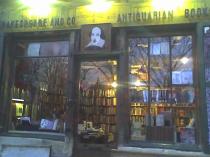 I’m delighted to see that our anthologies are now being stocked by Shakespeare & Company, one of the world’s most iconic bookshops.
Although we’ve got subscribers in quite a few countries now, most of our bookshop sales to date have been at home in the UK, so it’s great to be on sale in France too.
Find out more about Shakespeare & Company at their website here, and if you’re in Paris, make sure you drop by.
(And if you’re a bookshop interested in stocking us, drop me a line, or get in touch with our distributors Central Books.)
James Benmore wins the Fiction Desk Writer’s Award
Thursday, 15th December 2011.
 The votes are all in, and it’s time to announce that James Benmore has won the Fiction Desk Writer’s Award, for his story ‘Jaggers & Crown’. As well as the credit from his colleagues, James will be getting a cheque for £200 from The Fiction Desk, which should keep him in ballpoint pens for a while.
Read more about the award here, and if you’ve not yet read James’s winning story, you’ll want to grab a copy of All These Little Worlds.
The Fiction Desk Writer’s Award
Thursday, 8th December 2011.
We’ve just finished the voting for the latest Fiction Desk Writer’s Award, which covers the stories in All These Little Worlds. I’ve not written much about the award before, but it’s quite an important part of what we do.
The Fiction Desk Writer’s Award is a cash prize for the best story in each volume, and it’s judged by the contributors themselves. The idea is that the stories are judged by the people who write them; as editor, even I don’t have a vote.
The amount of the prize and the exact voting method will vary from time to time, as we fine-tune it: for the first two volumes, it’s been a special prize of £200, and each contributor has had two votes (the second to be used in case of a tie).
Ben Lyle won the award earlier this year for his story ‘Crannock House’ in Various Authors, in a very close competition: we eventually had to bring in John Self from The Asylum to break the tie.
I’ll be announcing the winner for All These Little Worlds at the end of next week. The news will be here on the blog, and in our newsletter.
Christmas gift subscriptions
Monday, 5th December 2011.
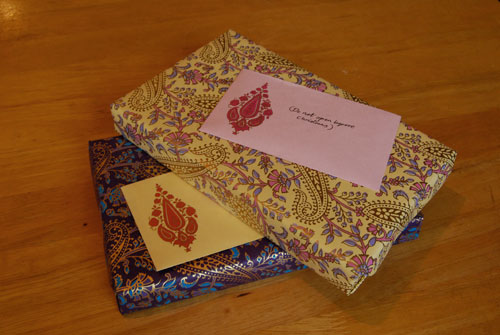
Above are the first volumes in our Christmas gift subscriptions, wrapped and ready to go out to their lucky recipients.
The paper we’re using is from The Paper Place in Rye (their site is still under construction). Their paper is handmade in India using traditional techniques and materials, and it’s beautiful stuff.
The wrapped books are volumes one and two, which we’re shipping out in time for Christmas; volumes three and four are also included in the subscription, and will be sent out on publication next year.
If you know somebody who’d love this for Christmas, you’ll find all the details, along with last order dates for Christmas delivery, over on our special Christmas subscription page. (You’ll need to order within the next couple of days for delivery outside the UK…)
Colin Corrigan on ‘The Romantic’
Thursday, 24th November 2011.
Here’s Colin Corrigan, writing about the background to his new story ‘The Romantic’, which appears in All These Little Worlds.
 Isn’t life great, sometimes? Except for when it all turns to shit. Except for how we’re all going to, one way or another, die, and then be forgotten, as our souls return to the void of the insignificant. Which they never really left. But, then, there’s chocolate fudge cake. The curve of a waist. A sunrise.
‘The Romantic’ began with the somewhat cartoonish idea of a poet who has never been in love, and so can only write very bad poetry. My hero, Martin, came to mind pretty easily, a chump who deludes himself into the idea that he’s a fine poet, and that he’s enjoying what for most people would be a terribly lonely existence.
From there, the story kind of took on a life of its own. Posed with the problem of how Martin survives without working (or publishing his poems), it occurred to me that he might be living off compensation he has received after an industrial accident. Researching accidents, I came across a report of a man who lost an arm after being dragged into a printing press. A missing arm seemed to make sense, for Martin, a symbolic extension of his lack (with the extra irony of his being maimed by the publishing industry). It also worked nicely, as the story unfurled, to serve as a reality with which he would be confronted.
The character came to mind pretty easily because Martin is, largely, me, stubborn as I am about being a writer when there are plenty of material reasons why another career might offer more security, less stress, and a bigger car. I too find new ways to lie to myself every day.
Because he represents, perhaps, my more vulnerable side, I wanted to be mean to him, and it was inevitable that by the story’s end he was going to be crushed under the weight of his own delusions. When the realisation hits him that his poetry has had an entirely different effect upon Aoife, a girl he meets, than he had hoped and expected, I am like her: part of me wants to laugh at Martin, and the other part to apologise.
— Colin Corrigan
Charles Lambert on ‘Pretty Vacant’
Monday, 21st November 2011.
Charles Lambert is one of two authors to have featured stories in both of our first two anthologies. I asked him to tell us a little more about the second story, ‘Pretty Vacant’.
 When I was in my twenties I spent five consecutive summers teaching English to teenagers on summer courses. The schools I worked for were expensive and this was reflected in the kind of kids they attracted, if that’s the word – few of them would have chosen to be there if they’d been given that choice. It’s hard to talk about the students without falling into facile racial stereotypes, but there was definitely an abundance of willingness to learn English among the German and Greek students, and a corresponding scarcity among those from Italy and Spain, who preferred to exchange their own languages at the cost of mine. The French tended to be, well, superbe, the Swiss slightly geeky, the Italians louder than all the others put together. Among the kids themselves, racial bonding was fierce. Nations would war against nations. During my first year, Greece and Italy were at each other’s throats from the first day. I remember one evening a Greek boy bursting into the staff room, where my colleagues and I were enjoying a joint after a visit to the pub, and wailing, ‘Someone has shit in my pantofolos’. It was hard not to laugh. The Greeks and Germans ate everything they were given, the Italians nothing but slices of factory-baked white bread, spending their money on Cadbury’s chocolate in the local shops. Still, apart from endemic shoplifting – a school trip rarely ended far from a police station – most of the children behaved themselves and may even have learnt some English. I know my badminton improved dramatically while I was there.
One year, though, was different. A girl arrived from Milan who was trouble from the start. She was gauntly beautiful, sullen in a sort of Kate Mossy way and utterly uncooperative. Her parents had provided her with more pocket money than I was earning that whole summer and then, as we found out later, disappeared to some exotic paradise. On the first school outing the girl wandered off and was eventually found in a pub; she vomited during the coach-ride home. On the second she was caught scoring coke in a café and had to be dragged out. There wouldn’t have been a third trip, but all the school’s efforts to track down a home she could be returned to came to nothing, and we spent the rest of the three weeks policing her as she became increasingly ratchety and wild-eyed. Months after the course had finished we were told by her family doctor that she had syphilis and had named half a dozen other students as contacts. It fell to the course director to write to their parents. Summer schools depend for much of their custom on parents’ networking and it took the school some years to recover from the blow to its reputation.
 I wanted to use this experience more than twenty years later in the context of a novel I was writing about the effects the wave of terrorism that swept over Italy in the late 1970s had had on present-day Italy, with so many people now in power the children – and ideological product – of that wave. My protagonist was an English woman who’d taught in a summer school in England while living in Turin and would later meet up with a girl who’d fascinated her almost thirty years before. The first version of ‘Pretty Vacant’ came from this. But novels grow and change and it soon became apparent that Francesca had no real part to play in the world that was being made there. I came back some time later to the piece I’d written and, when I looked at what I had, I saw that Francesca’s story was less about politics in a localized sense and more about loneliness. I also saw that I cared about her and wanted that to be evident in what I wrote. The story – as it stands now – came from that.
— Charles Lambert
You can read ‘Pretty Vacant’ for yourself in our second anthology, All These Little Worlds (available here).
Voluntary submission fee
Thursday, 17th November 2011.
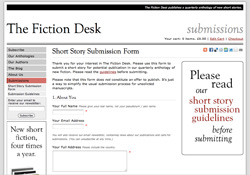 There’s been a lot of talk lately about publications charging small fees for online submissions. In the States, for example, both Ploughshares and the Missouri Review charge US$3 per submission. The idea is that the fee is set at about the level of printing and buying stamps for a posted submission, and helps to contribute to the costs of processing the submissions.
Opinions are divided on these fees: some people think it’s a good way to help raise money for publishing projects, while others feel that it’s an unfair burden on the writers.
Personally, I agree with many of the points made on both sides of the argument, and I’d certainly feel very uncomfortable about setting a fixed submission fee for The Fiction Desk. However, we do need the revenue: right now, only around one in three hundred of the people who submit actually purchase a single copy of our books, let alone a subscription. Even with other sales coming in from elsewhere, the figures just don’t add up. What this ultimately means is that there’s less time available for us to spend going through the submissions.
I’ve decided therefore to set up a voluntary submission fee, of £2 per story (about US$3). There’s now an option to pay the fee on our submissions form. You don’t have to pay it—writers who’d rather not can simply leave the box unchecked—but if you do, you’ll be helping to contribute to our running costs, which in turn will help us to promote the short story form.
There’s a side benefit too: our usual response time is three months, but where a submission fee is paid, we’ll make sure we reply within two weeks.
I think this voluntary system may be the best compromise between having an open submissions policy, and the need to raise money.
Let’s see how it goes.
Danny Rhodes on ‘A Covering of Leaves’
Tuesday, 15th November 2011.
 Here’s author Danny Rhodes talking about the inspiration behind ‘A Covering of Leaves’, which appeared in our first anthology, Various Authors.
I wrote ‘A Covering of Leaves’ after reading an interview (with Stephen King I think…) in which he explained how after 9-11 the New York authorities continually came across vehicles owned by people who had died in the attacks. These cars were found abandoned in parking lots and at kerb edges around the city and, I surmised, more often than not, in the car parks of subway stations in the suburbs. Thinking about this I started to imagine family members collecting these vehicles in the aftermath of a catastrophic event. But what of those vehicles owned by victims who did not have any family? How long would those cars sit gathering parking tickets and suffering the casual onslaught of seasonal weather?
The story idea came pretty quickly after that, suggesting as some have said before, that stories exist to be discovered by writers. Initially Webster’s journey took him into the home of the victim, where he discovered the loss she had already suffered, the remnants of a failed marriage etc. I chose to omit these scenes in later edits as I tried to get to the crux of the story.
 The leaf fall soon took on metaphorical qualities, becoming a veil that Webster has to sweep away in order to discover the next part of his life journey, but it also served a narrative function, being the initial cause of the loss he endured.
I did not expect to be writing a story about a car that mourns its deceased owner and a man who is already mourning the loss of his wife but that’s the story that emerged. And I think ‘A Covering of Leaves’ is essentially about that, about mourning and managing in the aftermath of the death of a loved one, or not managing, in seeking some sort of path back to the place where there was happiness and togetherness, however unusual the route a person might take to reach that place.
— Danny Rhodes
Story order in anthologies
Thursday, 10th November 2011.
The first review of All These Little Worlds has been posted, by Valerie O’Riordan over at Bookmunch. I’m pleased to see that it’s a good one, with the reviewer rating All These Little Worlds even more highly than Various Authors. You can read the review here.
Getting the first reviews is always exciting, almost regardless of whether they’re positive or negative. (One of the stranger aspects of moving from book blogging to publishing is finding oneself at the sharp end of a sword that one was previously wielding, and realising just how pointy it actually is.) As we have a tight publication schedule, review copies tend to go out around publication date, meaning that we have to wait a few weeks for the first ones to come in. It’s a tense wait, but when they do arrive, it’s interesting to see the different perspectives on the stories, and on the anthology as a whole. I’m always proud and excited when a story is received well, and when it hasn’t gone down well, I have to think about whether I could have presented the story better, perhaps through placing it elsewhere in the book, or next to other stories.
The order of stories in the book is one of the things that Valerie picks up on in the review, and it’s a key part of the editor’s art. Maxwell Perkins, the famous Scribner’s editor who worked with the likes of Fitzgerald and Hemingway*, believed in arranging anthologies with the strongest story collections at the beginning, middle, and end, with the weaker ones filling the gaps between. That’s a good approach, but much more practical with single-author collections than with anthologies containing multiple authors. (For a start, if you always do that, then the authors might take an implied insult to their work from where you put them…) Planning the order of stories in a multi-author collection takes in other ideas about theme, pacing, length, style and so on. It’s a fascinating skill, a big part of putting together an anthology, and one that I’m just now beginning (I hope) to acquire. It’s nice to see a reviewer address the order of stories.
Anyway, it’s a very interesting review, and does a good job of explaining what’s in the book, and perhaps also why you should read it. So go and have a look!
* And many others; Perkins had a fascinating career, which involved him with many of what we now think of as the great American authors of the period. It’s worth tracking down a copy of A Scott Berg’s biography if you can find one.
