

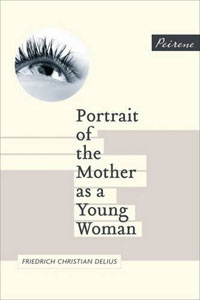
Portrait of the Mother as a Young Woman, by Friedrich Christian Delius
Monday, 13th September 2010.
 People seem to be waking up to the fact that too much time spent browsing the web can damage our ability to concentrate on a single subject for extended periods.
Nicholas Carr’s new book, The Shallows, has been raising questions about the way Internet use (at work as well as at home) may be rewiring our brains, while over in the Guardian, Charlie Brooker wrote a piece entitled Google Instant is Trying to Kill Me, in which he discussed the ways that evolving technology has been chipping away at his attention span. He also tries something called The Pomodoro Technique, a special system whereby, through the use of a kitchen timer, we can train our minds to concentrate on a single subject for up to 25 minutes at a time!
What better time, then, to pick up the latest title from Peirene Press, Portrait of the Mother as a Young Woman. Oh, it’s short, like all Peirene’s books. It’s just 125 pages, which should present no challenge to even the most hyperlink-addled brain. Just 125 pages. Just a single, 125 page sentence. (Keep reading …)
Book bloggers blog the Booker books
Sunday, 12th September 2010.
Each year I try to do a rundown of the Booker longlist according to the book blogs. (Here’s 2008 & 2009.) I’m running a little late this year – don’t look at me like that, I’ve been busy – so let’s get straight to the Booker shortlist, 2010:
Parrot and Olivier in America Peter Carey
 Peter Carey’s first Booker winner, Oscar and Lucinda casts a shadow over several of the reviews of his new book. Jackie at Vulpes Libris can’t help noticing that one of the characters shares Oscar’s dishevelled red hair, while Trevor at The Mookse and the Gripes finds himself revisiting Carey for the first time since reading that book (having skipped Carey’s other Booker winner, The True History of the Kelly Gang).
Kevin from Canada read this one with some reluctance, not being a huge Carey fan, or being familiar with Alexis de Toquevillle, whose journey to the USA inspired the book:
Carey is a competent and talented writer and he carefully and deliberately unfolds that story in a reader-friendly fashion. He has obviously researched his material thoroughly — too thoroughly for this reader, because long sections of the book are taken up with explanations of the obvious that left me wanting only for them to end. While I appreciate the author’s determination to chronicle the “American” story, he does not have much new to add — his respect for the obvious history is so great that it comes to dominate the book
See Kevin’s full review, and the subsequent discussion in the comments, here.
Room Emma Donoghue
 John Self kicked off his review on The Asylum by measuring it against his initial hopes…
Room has an intriguing premise: it’s narrated by a five-year-old boy who lives in a room twelve feet square and doesn’t know the outside world exists. This immediately set my reading glands salivating: I imagined an allegorical, philosophical novel, a European-style confection that provided an analysis of all our lives by an extrapolation to the extreme, something like Ishiguro’s Never Let Me Go. So my disappointment with Room is partly unreasonable, denouncing it for not being a different book entirely.
… before coming to the conclusion that ‘it’s clear that Room aims at the heart rather than the head, and for many people the emotional heft of the story will be enough to recommend it.’
If Room didn’t find its natural reader in John, it fared better with Jackie at Farm Lane Books, (Keep reading …)
Don’t you walk away from me with your hat on!
Tuesday, 7th September 2010.
Got a historical thriller in an urban setting? Well, nobody will know what you’re talking about unless you give it a sepia-toned cover in which a man in a hat (and preferably a cape or swishing frock coat) is walking away from the camera:
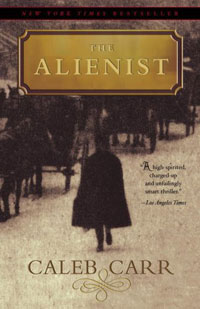
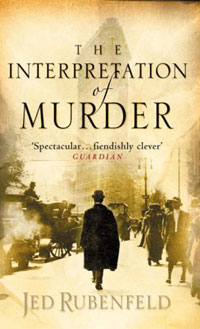
(Actually, is the guy on the cover of The Alienist walking towards us? Oh, and take note of the man on the cover of The Interpretation of Murder – you’ll be seeing him again in a moment…)
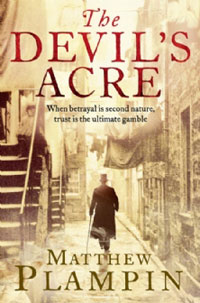
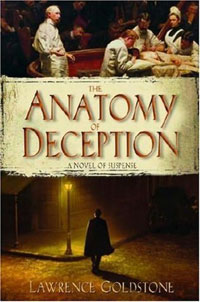
Sepia may be a bit old hat now, so you could always go with blue instead: (Keep reading …)
The curious incident of the free book in the night-time
Friday, 27th August 2010.
 Last year, publisher Gallic Books formed a partnership with London bookstore Big Green Bookshop. I loved the idea of a bookshop and publisher teaming up, which used to happen all the time (John Murray, for example, started as a bookseller / publisher), and the partnership between Gallic and the Big Green Bookshop seems to be still going strong today.
Now, Gallic Books have come up with another smart partnership, this time for their new novel, The Baker Street Phantom. They’ve partnered with a hotel, the Park Plaza Sherlock Holmes Hotel on Baker Street. Through September, anybody checking in at this “Holmes away from home”* will receive a complimentary copy of the novel.
It’s a nice concept, and another bit of smart promotion from Gallic.
*Sorry.
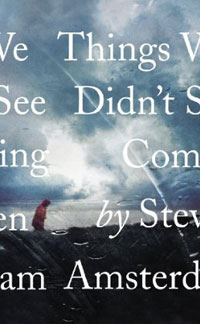
Things We Didn’t See Coming by Steven Amsterdam
Wednesday, 25th August 2010.
 You probably think that we survived the Millennium Bug. Perhaps you’ve even stopped nervously looking at the VCR’s clock when it starts blinking 00:00, you no longer think twice before booking flights over New Year’s Eve, or wonder whether there really are computer chips inside milk cartons.
Well, maybe you’re right. But step into the world of Things We Didn’t See Coming, the debut novel by Steven Amsterdam, and you’ll wish we’d all stuck with the abacus.
The nine or so chapters (which fill just under 200 pages), follow a single, unnamed narrator over roughly thirty post-apocalyptic years, taking him from childhood, just before the catastrophe, to an accelerated old age. (Keep reading …)
Any Human Face by Charles Lambert
Friday, 23rd July 2010.
 Last year, my review of Charles Lambert‘s debut novel Little Monsters included a hypothetical conversation with the author over a plate of pasta. A few months later, we had exactly that. The conversation resulted in a lengthy and (I hope) very interesting interview, in which we discussed the strange political situation in Rome, and Lambert also went into great detail about his new novel, Any Human Face.
In a sense, then, I’ve scuppered myself, because it’s difficult for me to write a review that would be half as interesting as Lambert was that day. So if you’re interested in finding out more about the background to Any Human Face, I’d suggest that you start with the Charles Lambert interview. (Keep reading …)
Sabra Zoo by Mischa Hiller
Monday, 3rd May 2010.
Telegram, the literary fiction imprint from Middle-East non-fiction specialists Saqi books, is an imprint that I’ve been meaning to check out for a while now. Their list looks interesting, and their titles—All My Friends are Superheroes, Metropole, etc—seem to get quite a bit of attention.
I first heard of them last year on Twitter (where I am @thefictiondesk, and they are @Saqibooks), at a time when they were justifiably pleased with themselves for having won the 2009 Diversity in Literature Award, and by the beginning of 2010, I even managed to have one of their catalogues in hand—I got all the way to page 3 before finding something I wanted to read. (Keep reading …)
Involuntary Witness by Gianrico Carofiglio
Thursday, 11th March 2010.
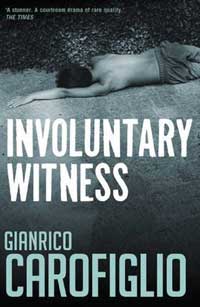 I’ve written about Bitter Lemon Press before, when I reviewed Saskia Noort’s Back to the Coast. They’re a solid niche press, publishing crime fiction, most of it translated, in paperback editions.
Involuntary Witness, which they’ve just republished with a new cover (see left) is the debut novel from one of their lead authors, the Italian one-time anti-mafia prosecutor Gianrico Carofiglio.
The protagonist, in this novel and its sequels, is Guido Guerrieri, a defence lawyer who lives and works in Bari, a coastal town in the Italian region of Puglia (the area usually referred to as “the heel of the boot”). At the beginning of the novel, we find Guido in a bad state: still reeling from the end of his marriage, which has left him unable to concentrate at work and suffering from claustrophobia. When you add the development of a flirtation between Guido and his upstairs neighbour Margherita; and his latest case, involving an African streetseller accused of child murder, you get a pretty good idea of the formula that Carofiglio is working with. (Keep reading …)
Where do eBooks go when you die?
Friday, 19th February 2010.
Here’s a question: What happens to eBook collections when the user dies? I’ve asked this a couple of times over on Twitter, but nobody seems to know.
Avid readers (or bibliophiles, or bibliomaniacs) can accumulate quite a collection of books over a lifetime. They’re sometimes dealt with separately in a will, sometimes fought over by descendants, and sometimes sold off as a job lot before the earth has settled on the grave. (Keep reading …)
Nazi Literature in the Americas by Roberto Bolaño
Friday, 8th January 2010.
I’m becoming increasingly reluctant to bother with doorstep novels, and when Roberto Bolaño’s much-lauded 2666 was published in English a year or so ago – all nine hundred pages of it – I decided that I didn’t have the time or the will to read it. Still, I was curious to see what kind of a writer lay behind the hype of 2666, and the recent UK publication of Nazi Literature in the Americas, one of Bolaño’s earlier, shorter works, has given me the chance. (Keep reading …)
