

Three new books on the way from Charles Lambert
Friday, 22nd March 2013.
 I was delighted to hear that Fiction Desk favourite Charles Lambert has secured publishers for not one but three new books.
It’s been almost three years since the publication of Lambert’s last novel, Any Human Face, making him the author equivalent of a city bus (you wait years for one, and then…).
Two of the new books are thrillers, which will be published by Exhibit A, the crime imprint of Angry Robot Books. This is exciting news in itself: Angry Robot are a terrific publisher, and I’m a fan of Robot Trading Company, through which they sell ebooks direct to readers.
The other book, described in The Bookseller as ‘a series of 120-word texts, arranged by theme, adding up to a picture of one man’s life,’ will be published by Scott Pack at The Friday Project. I know Scott’s a fan of Charles Lambert, so this intriguing book is in safe hands.
Good news all round, then!
(You can read stories by Charles in our anthologies Various Authors and All These Little Worlds.)
Matthew Licht on ‘Across the Kinderhook’
Thursday, 14th March 2013.
Here’s Matthew Licht on the origins of his story ‘Across the Kinderhook’, from our anthology Crying Just Like Anybody.
 Plans for a summer apartment/cat-sitter situation in Madrid went awry and I wound up basically a squatter in a rough neighborhood, with African temperatures, no electricity, cold water, a mattress on the floor and a cement table out in the overgrown abandoned garden.
Luckily, being comfortable isn’t the best circumstance for getting stories written.
The stories I like to read usually induce discomfort, unless they’re also the funny, sort of dirty kind I like even better. Disturbing ideas came fast and furious, one of them about a diabolical machine that allows newborn infants to speak. That story, written in a weirdo inteview form, got published nearly right away. This one, I held onto for a long, long time.
Long ago, while uncomfortably between jobs in New York, wandering around in search of something to do in order to not feel even more completely useless, drawn by carefree childish laughter perhaps, I strayed onto a school playground. The school cop, instead of getting busy with pistol or cuffs, escorted me into the handsome-but-delapidated building and upstairs to a classroom, where a harried young lady somewhat desperately had over forty kids spellbound over an esoteric point of geography. The interruption brought a shower of regard: who is this guy? The looks made me wonder too: who is this guy I supposedly am? The same fellow these happy, curious, hopeful kids might like me to be? Which led to ten years as a volunteer teacher. Grade school became writing school for a scribbler who’d pretty much given up.
Story Day became a once-a-month feature for the whole class.
The teacher who took me in had a problem with two girls who were stealing stuff, a classic means of getting attention when things are so bad that even the negative kind seems desirable. Teacher didn’t want troubled kids to get stuck with a larceny rapsheet, was also leery about alerting their parents, who were notoriously of the I’ll-beat-some-sense-into-your-thieving-little-head school. She asked me to deal with the situation.
Best I could come up with was a story about a non-gender-specific Kid who steals things because it’s oh so shockingly easy, feels bad about the new career in crime, discovers that repairing mistakes is difficult but definitely possible and worth the trouble. A free candy bar is the pay-off, a present.
The kids asked if I’d ever stolen anything. They didn’t want to hear hoary adages about amateurs who borrow. I confessed, spilled my guts on childhood heists. Maybe I felt better about the criminal past.
Another story, they wanted to know whence came the idea for a kid who kicks a girl in the ass because he’s secretly in love with her and she plainly doesn’t feel the same.
Think about it for about two seconds, I said. They got it.
One of the boys in the class was also a sixty-year-old woman named Esmé. He shared this slightly spooky metaphysical info with his classmates on Story Day in a delightful, totally matter-of-fact style. Because he felt he really was a divided soul. A little girl who was born in South Africa wrote about prenatal surgery she underwent. She said she remembered the hole in her heart, and the pain.
Can’t make this kind of stuff up, according to the old truth-is-stranger-than-fiction trope. The truth is, strange fiction’s usually based on something equally strange or even stranger that happened for real.
‘Across the Kinderhook’ is the most painful story I ever wrote. And I didn’t make it all up.
My gypsyish parents got jobs in a small college town in the northeastern USA. Another, more settled, professorial couple invited them for a kindness-to-new-people dinner. My mother, a sort of flesh-and-blood maternal machine, bonded with the couple’s daughter, whom she didn’t know was practically locked-in autistic. For some reason, the little girl responded to the woman who acted naturally. But their communication only lasted a few weeks, or until the little girl became aware my mother knew something was wrong with her. Maybe. Nothing’s terribly clear, in such cases.
The disturbed girl became an artist. She draws faint, gnomically complex geometric worlds and washes dishes in restaurants to support herself. She seems to enjoy her work.
Quite a few narrators in my stuff find jobs washing dishes. They claim to like it too. I was a pro dishwasher, for a happy while, in a hamburger-suffused jazz joint on Broadway. The chef had a sideline dealing psychotically strong weed. We all got along great.
It used to bother me that practically everyone I knew had careers, lived in houses, enjoyed family life. Always felt I’d missed some ineffable signal or opportunity to begin the real business of life. Didn’t occur to me that there were hideous downsides to most of life’s nice, normal stuff. Then, when it was more or less too late to change courses, it was driven home that it’s not even possible to miss out on real life’s nightmarish aspects by not participating. I guess that’s where this story came from. I felt particularly uncomfortable while I scribbled it down, and it wasn’t because the bench at the cement table was so hard, or that it was so incredibly hot there in Madrid that summer.
— Matthew Licht
Die Booth on ‘Phantoms’
Wednesday, 13th March 2013.
In the latest of our ‘stories behind stories‘ series, author Die Booth talks about the inspiration behind ‘Phantoms’, which appears in our anthology Crying Just Like Anybody.
 I always wonder why so many people are scared of dolls. Not dolls in general, but more specifically old ones, the type made of porcelain or wax, with glass eyes and human hair wigs. Maybe it’s the unfamiliarity of the old — you fear what is alien — even though I’d argue that modern children’s toys are every bit as surreal and creepy as antique ones: just look at Teletubbies! Maybe it’s the use of human parts, although nobody seems particularly scared of hair extensions! Maybe it’s the fact that old dolls are proportioned more like people, not like today’s large-eyed, tiny-waisted cartoons made solid: they were just too ‘real’.
‘Phantoms’ started off as a vague notion to update the old horror trope, the Creepy Doll. On various visits to museums and stately homes I’d seen my fair share of toys, and also of figures that weren’t quite dolls but were still human representations. The idea that they were not for play struck me as making them at once a little more potentially sinister. Obstetric phantoms are still used (as far as I know) for training purposes today, but historically were often made using real foetal skeletons as their framework. Well, Dead Babies has to rank right up there alongside Ghost Children and Creepy Dolls as an all-time horror classic. The artists’ lay figure at Packwood House also impressed me — a life-sized dressing-up doll that wasn’t quite a doll would be sure to give readers the shivers.
Now I had my basic inspiration I fully intended to write a horror story about the effect that irrational fear has on people: there is clearly nothing supernatural about these artefacts — they can’t even move — yet they can terrorise people all the same. It didn’t turn out like that, though. I set the story in a curio shop, where these items could feasibly cross paths, and the rest of the tale grew from there. I’m very interested in stories where the obvious ‘villain’ of a piece gains the reader sympathy. It’s too easy to see ‘the monster’ as automatically bad and I much prefer tales where that assumption is turned on its head. Therefore in ‘Phantoms’, the phantom and the lay figure become young Anna’s allies in a fight against her real enemy, school bully Beth. At school, I was always considered strange for my interest in old things, so that’s translated into the story. I decided that the protagonists would be little girls because, as Margaret Atwood shows so effectively in Cat’s Eye, little girls can often be the cruellest and most inventive bullies.
When Anna is bullied, her choice is to ignore or retaliate. Boosted by the new power to terrorise she has through access to the phantom, she chooses to fight back. But is there a point at which self-defence becomes attack and retaliation becomes bullying in its own right? Just as, when rendered familiar, the phantom and the lay figure lose their horror, so an enemy once conquered loses their mystery and power and instead instils a kind of disgusted pity. Beth becomes, like the phantom, broken, and the shine is taken off Anna’s final victory. But at least through conquering her enemy, Anna finally conquers her fears.
— Die Booth
Our ghost story writing competition is open now!
Friday, 1st March 2013.
 We’ve just launched a new writing competition: while the last one was about finding shorter stories than we usually publish, this one is about looking for stories in a genre we don’t see much of here at The Fiction Desk: the ghost story.
The top prize in this competition is £500, and the deadline for entries is May 31st; for more information about the competition, what we’re looking for, and how to enter, visit the competition page here.
Winners of our 2013 Flash Fiction Competition
Thursday, 28th February 2013.
Judging our first writing competition has been a real challenge. It’s a cliché to say that the standard of entries was high, but it was: there were some terrific stories in there.
Finally, though, we have our winners.
The finalists are:
- Gavin Cameron, with ‘A Big Leap’
- James Collett, with ‘The Clever Skeleton’
- Damon King, with ‘Simmo!’
- Paul Lenehan, with ‘For Joy’
- Matt Plass, with ‘Invisible Them’
- Ian Shine, with ‘Love Stops at Ten Metres’
And the overall winner is:
- Tania Hershman, with ‘A Call to Arms’
All of the above stories will appear in our next anthology, which will be along this spring.
I’ll be in touch with all of the winners over the next few days. In the meantime, congratulations to all of you, and thank you to everybody who took part in the competition.
I’ll be posting some more thoughts on the contest and our new experience with flash fiction in general around the time of publication.
Announcing the Fiction Desk Writer’s Award for Crying Just Like Anybody
Tuesday, 19th February 2013.
It’s that time again, when I get to announce the winner of the Fiction Desk Writer’s Award for our latest volume. Up today is the winner for volume 4, Crying Just Like Anybody.
The Writer’s Award is judged by the contributors to the volume, each contributor getting two votes, and the writer with the most votes wins.
 Without further ado, then, the winner of the Writer’s Award is — well, you’ve already seen his photo over there on the right — S R Mastrantone, with his story ‘Just Kids’. Congratulations S R!
‘Just Kids’ should be a popular choice: as well as walking away with the most votes in the Writer’s Award, it’s also been singled out for praise in reviews by Bookmunch (‘a dryly humorous and adroit consideration of modern society’) and Casual Debris. You can also read the author’s blog post about the background to his story here.
So if you’ve not yet read Crying Just Like Anybody, pick up your copy today and check out S R’s story – prices start at just £1.99 for Kindle and epub editions. Meanwhile, we’ll be working on the next volume, which will include among other stories, the winners of our flash fiction competition (to be announced next week).
Luiza Sauma on ‘Carolina Carioca’
Tuesday, 22nd January 2013.
Here’s Luiza Sauma on the inspiration behind her story ‘Carolina Carioca’, which appears in our anthology Crying Just Like Anybody.
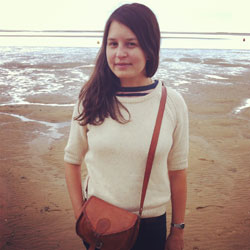 ‘Carolina Carioca’ is about a middle-class Englishman who falls in love with a working-class Brazilian woman, brings her home and realises how different they are. It’s about how love across cultures burns brightly, and often fizzles out.
I’m originally from Rio de Janeiro, but I moved to London with my family when I was a child. Growing up, I started to notice that young men were particularly intrigued when I told them I was from Brazil. Many would tell me about the romances they’d had with Brazilian women, and how superior they were to British girls – both in looks and demeanour.
I’ve heard it thousands of times: Brazilian women are the most beautiful in the world. This stereotype is extremely uncomfortable for me; not just because of the fear of falling short (I’m often told I don’t “look Brazilian”), but because this fetish is inevitably focused on dark-skinned, working-class women. It’s not just about beauty; it’s about power.
My protagonist, Adam, isn’t a sex tourist. He’s not one of those old white Americans you see walking down Ipanema beach at sundown, hand-in-hand with teenage prostitutes. But Carolina’s ‘otherness’ is still very enticing to him. He’s an amalgamation of many different men I’ve met over the years, who have brought Brazilian women to the UK. Sometimes it works out, sometimes it doesn’t – and of course many of these relationships are fruitful and genuine, particularly when the man hasn’t gone to Brazil in search of a sexual cliché.
Carolina was inspired by a girl I met many years ago. She started a relationship with a much older gringo, who was travelling around Brazil. She was infatuated with him, and he thought she was beautiful; he was as exotic to her as she was to him. He took her home to a small English town, where she spent months in depressed isolation before returning to Brazil. Carolina, at least, gets to go to London!
I toyed with the idea of writing the story from Carolina’s point-of-view, but it felt right to do it in the second-person, from Adam’s perspective – hopefully, it captures his self-absorption and the romance he creates around her. It reads like a love letter, but between the lines, he treats her pretty badly. He doesn’t appreciate how lonely and far from home she is, and that she has her own story to tell – she’s not just part of his gap-year narrative.
I like to think that, while Adam is miserable on the tube, pining for the past, Carolina is in Rio, happily married and working in a decent job. I hope she laughs every time she thinks about Adam; looking back fondly, but not with longing.
— Luiza Sauma
S R Mastrantone on ‘Just Kids’
Friday, 18th January 2013.
In S R Mastrantone’s story ‘Just Kids’, a young father-to-be’s becomes increasingly obsessed with a gang of noisy youths that congregates beneath the window of his apartment. Below, the author talks about how he came to write the story.
We had an idea that we might be superheroes, my girlfriend and I. Perhaps The Rooftop Avengers or something similar.
Our flat is on the top of this tatty old office block that’s scheduled for demolition soon. Our garden, or our ancient tarmac roof, depending on your capacity for self-deception, overlooks a charity shop and at night well-meaning but ultimately misguided people leave their donations outside the front door for the staff to find the next morning. Unbeknownst to them, there is a strange squad of villains that routinely comes by the charity shop and steals all the good stuff. Up until my girlfriend and I got involved they went about their nefarious business unopposed.
Enter the Rooftop Avengers.
We didn’t do much you understand, just yelled “Oi” or something similar, if we happened to be out on our mostly freezing cold roof and looking in the right direction, but it was enough to scare off the scoundrels and keep the neighbourhood safe for another night.
It was on one of these crime-fighting occasions that I saw a group of kids try to steal a pram. Now, despite Britain’s high underage pregnancy rates, I had the feeling these kids weren’t about to be using the pram for the purpose of baby manoeuvring. I had the feeling that they planned to do something bad with it, possibly even criminal. It was the confidence in their posture, nothing like the skulking figures we had previously seen on the pilfer. I actually had to think twice about saying something this time. What if they yelled something back at me that hurt my feelings? What if they waited for me outside my front door with a bat or let down the tyres of my car?
“Oi,” I shouted before I could wimp out, fighting to sound like a proper man who meant business. “Leave that pram alone.”
The kids didn’t even hesitate. They walked away very quickly with their heads down, looking chastised and a little embarrassed.
No longer feeling like a superhero, I went inside and dwelled upon what it all meant while feeling slightly ashamed. That was when I first had the idea for ‘Just Kids’. I imagined a man who is so threatened by the teenagers keeping him awake at night, he convinces himself into a war with them. It would start with something harmless and silly, like water balloons, but gradually the conflict would escalate as the man’s identity falls apart. While ‘Just Kids’ is partly a satire of the UK’s national fear of mostly harmless teenage children, it is also about male identity and how difficult some men find balancing their desire to be strong for the people they love with their desire not to be some sort of chauvinistic buffoon.
For the record, the Rooftop Avengers have never, and will never, use water balloons.
— S R Mastrantone
‘Just Kids’ appears in our anthology Crying Just Like Anybody. Read more about S R Mastrantone here.
Richard Smyth on ‘Crying Just Like Anybody’
Friday, 11th January 2013.
 Richard Smyth contributed the title story to our latest anthology, Crying Just Like Anybody. Below he talks about the inspiration and real-life history behind his story. (The post does contain spoilers, so you might want to read the story first.)
In the early nineteen-forties, the scientists working on the Manhattan Project had a running joke with the Hungarians in their midst. This was the joke: the Hungarians – who included Eugene Wigner, Edward Teller, Leó Szilárd, Theodore von Kármán and John von Neumann – must in fact be Martians. Didn’t they speak a logical language far removed from any other? They did: Hungarian is a Finno-Ugric language, with very few close relations (as Johnny remarks in ‘Crying Just Like Anybody’, nobody talks this way). Didn’t they rove far and wide, like extra-terrestrial gypsies? They did. And weren’t they just, well, a whole lot smarter than us mere earthlings? The brilliant von Neumann, in particular, was said to be an alien “who had made a thorough, detailed study of human beings and could imitate them perfectly”.
The Hungarians took this joshing in good part – especially Edward Teller, who on hearing the ‘rumour’, muttered: “Von Kármán must’ve talked…”
This was the genesis of my story ‘Crying Just Like Anybody’ (also in the mix was the legendary mathematician Paul Erdös, the absent-minded genius at the heart of Paul Hoffman’s awesome book The Man Who Loved Only Numbers (Fourth Estate, 1999) – Erdös was also Hungarian).
‘Crying Just Like Anybody’ is based on the premise that someone might take the Martian-Hungarian myth seriously.
This would have to be someone unworldly and relatively uneducated. And it would have to be someone who very badly wanted to believe that a fish-faced, gibberish-spouting little man they find lying in the street is, in fact, a man from Mars.
Fortunately, I knew just the people.
My novel Tom Quays is unpublished. It earned me a free lunch courtesy of Transworld a while back, but, since then, no dice. It’s set – or, rather, partly set – in Manhattan, in 1925. It’s about Tomas Quís, a.k.a. Tom Quays, who grows up to be a writer; it’s also about Jesca ‘Yes’ Möller, who grows up to be incarcerated in a lunatic asylum. Both earn a mention in ‘Crying Just Like Anybody’: Jesca is the older sister of Anna, the narrator; Tom is mentioned so as to illustrate how, according to Anna, “around here no one calls anyone by their right name”.
Anna and Johnny (and their Martian) slotted easily into this ready-made milieu. It’s a place of hustles and rackets. It’s also a place of dreams.
 ‘Crying Just Like Anybody’ is about – well, it’s about lots of things. I’m not the sort of writer who ever sets out to Say Something. I write stories; it’s the stories that should say something, and exactly what that something is is often not for me to say. To me, this story talks about aspiration and escape; about alienation and immigration (the characters are all of European stock: German, Italian, Irish, and of course Hungarian). Perhaps most of all it seems to be about imagination.
“They find the smartest guy in Europe just sitting in the street,” Anna laments, “and the best thing they can think to do with him is put him in a booth at goddamn Coney Island.”
Anna, I think, will make it out of midtown Manhattan, some day. I don’t think Johnny will. The reason why? Imagination.
— Richard Smyth
Read more about the anthology Crying Just Like Anybody.
You can also download free previews of the book (or buy it for just £1.99 during our sale) on Amazon for Kindle or iTunes for iPad / iPhone. Richard Smyth has also written a book about the history of toilet paper: Bum Fodder is in all good bookshops now.
Mike Scott Thomson on ‘Me, Robot’
Monday, 7th January 2013.
 Mike Scott Thomson’s story ‘Me, Robot’ appears in Crying Just Like Anybody, the most recent Fiction Desk anthology. We asked him to write a few lines about the inspiration behind the story…
While the maxim is to ‘write about what you know’, I can honestly say I have never been tempted to spray myself from top to toe in silver paint.
The idea of ‘Me, Robot’ came, as the story itself hints, from a walk along the London South Bank one Saturday afternoon. Among the musicians, magicians, dancers and puppeteers, there were at least three statue performers — either remaining utterly motionless, or making jerky movements like, indeed, robots.
It certainly wasn’t the first time I’d seen street artists like this — I’ve seen them all over Europe as well as the UK — but on this occasion something was triggered in my mind. These were guys who had decided, for whatever curious reason, that colouring themselves silver or gold, sticking a bottle down their trousers (for reasons best left to the imagination) and standing still for the greater part of the day was something they simply just had to do.
I was intrigued.
However, the idea of the main plot came not from any thoughts about the motivations of these people, but more when I mused aloud to myself: they could witness all sorts of things, undetected. Invisible, in plain sight. Conspicuous, yet anonymous. An ideal protagonist, I thought, for a story. But my idea was a simple one: what if one of them sees his partner with someone else?
After this initial concept, the back story of the character, and the details of his unfortunate situation, fell into place. The notion of a human being becoming a robot, as opposed to the famous science fiction tales where the reverse is sort of true, led to the (hopefully not too cheeky!) nod to Asimov in the story title.
It turned out to be a comic story, more by accident than design. Comic stories, however, to my mind need an undercurrent to run alongside the humour: something darker, or some pathos, to prevent the tale from turning into a long joke. Hence my attempts to make the reader sympathise as much as possible with the main character. Even if he does go around thumping people.
Nor did I immediately plan for it to be written in the style of one side of a conversation. I wrote a few stories like this in mid-2012 without really knowing why, and I’ve been wondering where the inspiration came from. Upon the death in December 2012 of the actress Daphne Oxenford, and having read in her obituary about her close work with Joyce Grenfell, it all came back. When I was little, I read and re-read, from cover to cover, Grenfell’s George, Don’t Do That. Wonderfully engaging humour and characterisation, despite only hearing the voice of a narrator: in her instance, a nursery school teacher attempting to control a class of unruly children. I guess this format stuck with me.
— Mike Scott Thomson
Read more about the anthology Crying Just Like Anybody.
You can also download free previews of the book on Amazon for Kindle or iTunes for iPad / iPhone.
