

Penguin Little Black Classics: a great resource for writers
Tuesday, 31st July 2018.
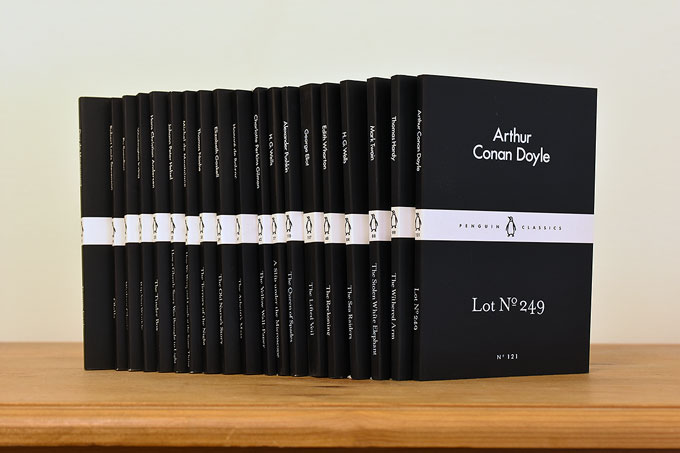
Penguin’s Little Black Classics are a collection of short books (mostly around 64 pages, although some are longer), originally published in 2015 as a series of eighty volumes, to celebrate the 80th anniversary of the founding of Penguin. These first books were priced at 80p each. The volumes cover short stories, poetry, miscellaneous bits and pieces, and the odd slice of non-fiction. All are older works, largely from the 19th century; but with some going much further back, and the odd volume creeping in from the early 20th century.
The first eighty volumes did rather well: within a year combined sales of these little books had comfortably exceeded two million copies, and so in 2016 Penguin added a further 46 volumes (the first Penguin Classic was published in 1946, you see). Now they dropped the 80p business, with the new titles priced at £1, or £2 for a few slightly longer volumes. In 2017 the United States Constitution was published as a sole additional title, making the total number of Little Black Classics in print today 127.
This isn’t the first time that Penguin Classics have bombarded us with tiny little books: the 1995 anniversary was celebrated with Penguin 60s: those cost 60p, and totalled 180 volumes covering a range of subjects including biography, travel, classics, and sixty more modern stories from the likes of Martin Amis and Muriel Spark — perhaps Penguin had more of a budget for licensing and royalties in those heady 1990s. (The full list of Penguin 60s is on Wikipedia.) In 2011 they marked the 50th anniversary of Penguin Modern Classics with fifty ‘Mini Modern Classics’, a series of slightly more recent volumes at £3 each.
#

Getting back to the current series, when the first volumes came out I took note, vaguely hoped to find a cheap boxed set of all eighty books somewhere, and then forgot all about them. I must admit, I expected them to disappear quickly. Not because they’re not worth buying (they certainly are), but because in the days of online free postage and real bookshops with squeezed margins, small very cheap books didn’t seem particularly practical. But as the list has grown, and been embraced by millions of readers and at least some bookshops (my nearest Blackwell’s has a full bay of them; or did until I got my hands on it), perhaps it bears revisiting.
For writers in particular, the Little Black Classics series is a fantastic resource. It’s vital that writers read as widely as they can, and familiarise themselves with as many authors, styles, and ideas as possible.
Anthologies are one great way to do this, whether they’re specific themed collections of periods or genres, or attempts to take in a wider picture, like the two-volume Penguin Book of the British Short Story that Philip Hensher edited a few years ago (and there are of course still wider pictures than just British short stories). As a quick overview, these anthologies are terrific; and for obvious reasons, The Fiction Desk likes anthologies.
Anthologies generally only contain one story by each author, however, and while these individual stories might bring a writer to your attention, they can only tell you so much about their work. The logical next step, the single-author collection, will take you much deeper into an author’s work, but it’s impractical to read as many of these longer collections as you might want to, particularly when you’re also trying to keep up with more modern writers.
The Little Black Classics come somewhere in between, usually containing two, three, or four stories by the featured author. Having these extra stories on hand gives you just a little of the context and depth that you normally need to go to a collection for, but the price and size makes them much more accessible, much easier to take a chance on.
#

Here then is an opportunity to find out whether Mark Twain’s humour still hits the spot, and think about why it succeeds or fails in the modern era; to take a look at how Arthur Conan Doyle’s supernatural fiction compares to the Holmes stories (sometimes Conan Doyle is surprisingly good, and sometimes he’s surprisingly bad); to examine HG Wells’ ability to spin a gripping tale with economy and vitality (Wells is one of the few authors to be honoured with two volumes in the series); to finally take a look at the short fiction of Thomas Hardy (another one); or Balzac or Washington Irving or whoever else you’ve not quite got around to yet — or whose work you need to revisit to freshen your memory.
I’m concentrating on the short fiction because that’s what we do here; the poetry and non-fiction volumes in the series offer similar delights and, again, further opportunities for exploration and discovery.
The Little Black Classics are available from some online outlets, but not all: Amazon has them in both paperback and Kindle form; The Book Depository — whose ‘free worldwide delivery’ seems to steer them away from any book costing under about £2 — have only the boxed set of the first eighty volumes. But ideally, you want to find a physical bookshop in your area that has them there on the shelf, where you can browse properly and make a habit of picking out a volume, or a handful, whenever you happen to be passing.
It would be great if the series could be expanded to include slightly more recent work, as was the case with the Penguin 60s, but there’s still plenty here to be getting on with. You’ll find that one of those nasty plastic fivers can be converted into a lot of nice black books.
— Rob
The Winners of the 2018 Newcomer Prize for Short Stories
Monday, 30th July 2018.

It’s the end of July, which means it’s time to announce the shortlist and winners of our 2018 Newcomer Prize for Short Stories.
The quality of the entries this year has been as high as ever, and the judging has been as difficult and exciting a job as ever. The shortlisted writers will all win a three-volume subscription to our anthology series, and the two winners will also receive a cash prize. The two winning stories will appear in an upcoming Fiction Desk anthology.
Let’s start with the shortlist, which this year features nine stories:
- Holly Barratt: ‘Daniel Sprinkles Stars’
- Lahra Crowe: ‘Seelence’
- Becky Docton: ‘Just Breathe’
- Michael Hurst: ‘Speed Awareness’
- Amy Smith Linton: ‘Pete and Jenny at the Starlite’
- Katherine Mezzacappa: ‘Rare Orchid, Late Flowering’
- Russell Reader: ‘The House That Jack Built’
- Poppy Toland: ‘Our Gaff’
- Declan Wilk: ‘Master of Cryptozoology’
*
Now for the winners:
In second place, with a £250 prize:
- Poppy Toland: ‘Our Gaff’
*
And in first place, with a £500 prize:
- Lahra Crowe: ‘Seelence’
*
I’ll be getting in touch with all the above authors to sort out their prizes over the next week or so. In the meantime, thank you again to everybody who took part in this year’s competition.
We aren’t running a writing competition this summer, as we’re turning all our attention to our standard short story submissions, which are open now. If you’re thinking of sending us something, you’ll find the guidelines here, and the submission form here.
Announcing the Winners of the 2018 Ghost Story Competition
Tuesday, 3rd April 2018.

It’s time to announce the shortlist and winners of the 2018 Ghost Story Competition. Judging this competition is always a challenge: it brings in some of the best writing we see here at The Fiction Desk. This year we’ve got three prizes: a first prize of £500, and second prize of £250, and a third prize of £100. Those three winners will also be published in our next anthology, while all of the shortlistees will receive a three-volume subscription to our anthology series.
So let’s get on with the shortlist, which this year consists of twelve stories:
- Kris Ashton: ‘Highway Memorials’
- Steve Bilsborough: ‘The Sweet Wrapper Incident’
- Michael Button: ‘A New Beginning in a New Home’
- Bruce Coker: ‘Leggers’
- Anthony Cule: ‘The Glass in the Bathroom’
- Jan Haniff: ‘Widow’
- Chris Hogben: ‘The Star That Stayed Till Morning’
- C B McCall: The Spare Room
- Alice Nuttall: ‘The Flat Above the Joke Shop’
- Rosalie Parker: ‘The Moor’
- A D Stuart: ‘Gnomsense’
- Christopher Williams: ‘The New Normal’
*
Now for the winners, in reverse order:
In third place, with a £100 prize:
- Kris Ashton: ‘Highway Memorials’
*
In second place, with a £250 prize:
- Chris Hogben: ‘The Star That Stayed Till Morning’
*
And in first place, with a £500 prize:
- C B McCall: The Spare Room
*
I’ll be getting in touch with the shortlistees and winners over the next week or so to arrange prizes. In the meantime, congratulations to all of the above – and to everybody else who entered the competition and sent in such fine work, making judging the entries an absolute pleasure.
The Ghost Story Competition will return this November. In the meantime, our Newcomer Prize for Short Stories is open now for entries, both supernatural and non-supernatural. Find out more here.
Do Fiction Writers Still Need Whitaker’s Almanack?
Monday, 12th February 2018.

This year marks the 150th anniversary of Whitaker’s Almanack, a reference book whose history is intertwined with the history of British literature, both as a tool for writers and, occasionally, as a plot device.
The Almanack, which stretches in the 2018 edition to 1141 pages (plus colour plates and index), covers subjects from the workings of the British government to tide charts; from a brief guide to politics in every country of the world to a series of essays on the year’s developments in a range of art, political, and financial fields.
Want a quick rundown of the past year in literature? It starts on page 999. Decide it’s time to find out how the European Union is actually run? Pages 611 to 620 will do their best to fill you in. Pages 365 to 377 list the current fees of (almost) every private school in the UK, while an explanation of the differences between the NHS in England, Wales, and Scotland begins on page 382. It’s effectively a user’s manual for residents of the United Kingdom.
Dracula and Sherlock Holmes both consulted Whitaker’s in the course of their adventures. A character in Somerset Maugham’s story ‘The Round Dozen’ passes on Trollope’s advice that ‘the two most useful books to a novelist [are] the Bible and Whitaker’s Almanack’ (admittedly Maugham’s narrator isn’t convinced, and doesn’t himself possess a copy). Whitaker’s crops up in Orwell, too: his early novel Keep the Aspidistra Flying contains the observation that, ‘After all, all works of reference are pornographical, except perhaps Whitaker’s Almanack’.
Of course, all of the information here – aside from the various essays – is also freely available online. Isn’t a reference book like this a bit of an anachronism? Something for retired civil servants to snooze over while they digest their Christmas dinner, rather than a genuinely useful tool? It’s not a cheap book, either: the RRP of Whitaker’s Almanack has climbed rapidly over the years, to the point where the complete 2018 edition is priced at £90 for a single hardback book. That price is largely academic, though: it sells at around £55 online, and is clearly priced to be discounted. (That’s not great for bricks and mortar bookshops, who tend to get a raw deal out of this kind of pricing strategy.) There’s also a concise edition available, containing a selection of the UK material, priced at a more High Street-friendly £25.
But if you can afford it, or settle for the concise edition, it might just be worth getting hold of a copy.
*
For general usage, it’s good to be able to consult Whitaker’s rather than disappear down the rabbit hole of the internet, or indeed going near a screen at all. Even using a book, you might very well find yourself starting to browse the pages and read up on other topics once you’ve found what you were looking for, but still, the context is at least relevant. There’s no clickbait, no advertising, no notifications, nobody trying to message you.
If a question comes up when you’re with friends or family, it’s a lot more pleasant to pull a book from the shelf, rather than have everybody cluster around an iPhone, or get drawn into one of those tedious information races where everybody is trying to be the first to Google the prime minister’s salary (p.177) or what happens if you die without leaving a will (p.545), or what the flag of Ghana looks like (unpaginated colour plates, following p.800).
For a writer, having a copy of Whitaker’s Almanack nearby – shelved somewhere close to the dictionary and the style guide – means that when a question comes up about the workings of the UK, you don’t have to leave the environment of your work-in-progress in order to open a browser window, with all the dangers to concentration and productivity that entails. And much of the information contained in Whitaker’s is useful for fiction: if a character dies intestate, you won’t want to give your readers a three-paragraph summary of the relevant legislation, but you probably want to make sure that whatever happens next in the story is realistic. If you’re writing crime, your chief inspector’s lifestyle is going to need to be funded on an annual salary of roughly £55,000 (p.309) – unless he’s bent, of course.
The other benefit to having all of this information in a physical book is that although most of it might be available online, that doesn’t mean writers will actually access it. Most of the short fiction written today doesn’t take the national context into account; there’s no suggestion that the writer is aware of the workings of the country, or the particular social and political backdrop against which their story is taking place. Again, it’s not necessarily information you’d use explicitly in your fiction, but it’s background that’s worth having at your elbow. A copy of Whitaker’s on the desk of a fiction writer might get consulted less often than it would be in the hands of a political journalist, but it could also serve as a reminder of the importance of context.
*
In a book printed late last year, there are obviously things that are out of date. Political appointments change, as do politics themselves: perhaps a little optimistically, p.613 tells us that Brexit negotiations are due to conclude in December 2017. There will certainly be times when you’ll want to confirm a detail online after consulting the book. There’s something comforting in this, though, in being able to step outside of the eternal ‘now’, the telescoping of time in the digital age, and to look at the world from a fixed, defined point in time. (This might explain why some people find themselves trying to collect a complete set of Whitaker’s, all 150 volumes from the last 150 years.)
You can even access Whitaker’s online, purchasing chapters at £1 a time, or sections for £5 – although this rather defeats the purpose of the whole thing, and anyway the execution feels a little rushed, with for example the list of abbreviations separated into 25 different chapters of just a few words each. (At least they don’t charge you for X, which has no entries.) Given that people going online will be able to find the information for free elsewhere anyway, the future of Whitaker’s would probably be best assured by embracing its merits as a physical object, and fundamental difference to the world of digital information.
One purpose of Whitaker’s Almanack is to describe in uncritical detail the workings of the British establishment. Depending on your own politics, some of the content might feel redundant or complacent to the point of being objectionable. The sheer breadth of the topics covered also means that most people won’t find every section useful. But think of the book in its entirety as the real-world equivalent of all those notes JRR Tolkien made for himself as background to the Lord of the Rings, or simply as a handbook to the great machine of which your characters – if they live in modern Britain – form a part, and you may just find a place for it on your desk.
Announcing the winners of the 2017 Flash Fiction Competition
Thursday, 30th November 2017.

Today we announce the shortlist and the winners of the 2017 Flash Fiction Competition.
First, a quick reminder of the prizes this year: the two runners-up will each receive £100, and the winner of the first prize will receive £300. The three winners will be published in our next anthology, and everybody on the shortlist will also receive a three-volume subscription to our anthology series.
We’ll start with the shortlist. This year it’s ten stories, and here they are in alphabetical order by author name:
- Alastair Chisholm: The Castle
- Steve Clarkson: Excuse Me
- Martin Dufield: In Memorium
- Justina Eckert: Hiding
- Sean Gill: The Computer Man
- Kevlin Henney: On the Science and Complexities of Having Sex in the Family Caravan While One’s Parents Are There
- Lynsey May: Beyond the Body
- Miha Mazzini: Rock’n’Roll Life
- Rachael Swindale: The Orchid
- Jud Widing: Hazards
And now the two runner-up stories:
- Alastair Chisholm: The Castle
- Sean Gill: The Computer Man
And finally, the first prize, which this year goes to:
- Steve Clarkson: Excuse Me
Congratulations to all of the above, and thank you again to everybody who took part in the competition this year.
The three winning stories will be published in our next anthology, which is due in early 2018. I’ll be getting in touch with the winners and all of the shortlistees next week to sort out prizes.
If you missed the flash fiction competition and still want to send us a story, our general submissions system is open now for stories over 1,000 words. Our ghost story competition is also open for entries until the end of January 2018.
Announcing the winner of the New Ghost Stories III Writers’ Award
Thursday, 9th November 2017.

It’s time to reveal the winner of the Writers’ Award for our latest anthology, New Ghost Stories III.
The Fiction Desk Writers’ Award isn’t like the other competitions we run from time to time: it’s awarded to the best story in each anthology we publish, and is voted for by the contributors to that anthology. It’s a great way to get the writers’ own view on their peers’ work, and it’s always a close race. There’s also £100 for the winner.
This time around the award goes to Will Dunn, for his story Des Nuits Blanches. Congratulations, Will!
New Ghost Stories III, featuring Will’s story and six other fine tales of the supernatural, is available now in paperback: you can get your copy right here. The 2018 edition of our Ghost Story Competition is open now for entries. See details over in our submission section.
The 2018 Ghost Story Competition: now open for entries.
Wednesday, 1st November 2017.
The 2018 edition of the Fiction Desk Ghost Story Competition is now open for entries. This year there’s a first prize of £500, along with second and third prizes. Entry costs £8, and the closing date is Wednesday, 31st January 2018. (The competition closes at midnight UK time, so don’t get caught out if you’re sending an entry from overseas.)
The main page of the competition can be found right here. Full terms of entry can be found at the bottom of our online entry form.
Winners from the last two years appear in our latest anthology, New Ghost Stories III. It’s well worth picking up a copy if you want to see the stories that have been successful in the past – or if you just want a good spooky read to get you through the winter nights…
New Ghost Stories III is out now!
Friday, 29th September 2017.
Copies of our latest anthology are available now. New Ghost Stories III contains seven substantial tales of the supernatural, including the winners of our last two ghost story competitions. The contributors are Amanda Mason, Barney Walsh, Seth Marlin, Jerry Ibbotson, Philippa East, Richard Agemo, and Will Dunn.
If you’re a subscriber or pre-ordered your copy, you should have already received it. If not, you can order your copy now directly from us right here. You can also take out a subscription to include this volume.
Announcing the winners of the 2017 Newcomer Prize
Monday, 31st July 2017.

It’s time to announce the winners of this year’s Newcomer Prize for Short Stories.
The standard of entries to our competitions is always high. People send in their best work, and judging the entries is as rewarding as it is challenging. Getting the entries down to a shortlist of ten stories was tricky, and picking two winners nearly impossible. But we’re short story publishers: we’re used to doing the impossible.
And so, here are the winners and shortlist of this year’s prize. First, our shortlist of ten stories. All of the writers below will receive a selection of paperback Fiction Desk anthologies through the post:
- Three More Days by Gayle Andrews
- The Bus Stop by Becky Carnaffin
- Uncle Dougie’s Suitcase by Alastair Chisholm
- The Insurance Policy by Christine Grant
- Not Waving, But… by Maureen Hanrahan
- All Washed Up by Chris Hogben
- The Black Squirrel by Christopher Howard
- Tool by Mac McCaskill
- Recalculating Route by Mat Osman
- Not Like Us by Sherri Turner
And now our two winners:
In second place, with a prize of £250:
- All Washed Up by Chris Hogben
In first place, with a prize of £500:
- Uncle Dougie’s Suitcase by Alastair Chisholm
So congratulations to all of the above, and thank you to everybody who took part in the competition. This year’s winners will be appearing in our twelfth anthology, due early in 2018.
The Newcomer Prize will open again for entries next year, but if you fancy trying your hand at very short stories, our flash fiction competition is open now. You’ll find details of that one over in our submissions section.
Announcing the 2017 Fiction Desk Flash Fiction Competition
Tuesday, 4th July 2017.
After taking a break for 2016, we’re delighted to announce that our annual Flash Fiction Competition is back for 2017 — and open now for entries!
This year we have a first prize of £300 and two runner-up prizes of £100. The entry fee for one story is £5, or you can enter two stories together for the special rate of £8.
The deadline is midnight (UK time) on Friday, 29th September. For full details, including our online entry form, head over to our submissions section.
