

Where are the new British short story writers?
Monday, 7th November 2011.
 In the early days of planning our anthology series, I worried about whether we’d have the resources to find enough writers from abroad, allowing us to feature an international blend of stories. In the event, I’ve been surprised to find that we have the opposite problem: despite being based in the UK, it’s been a real challenge for us to find British short story writers. We’ve been working hard to increase awareness, getting in touch with all sorts of different organisations around the country, but just 10% of our submissions come from the UK.
As this is National Short Story Week in Britain, it seems like a good time to ask: where are our new short story writers?
I’m not talking about famous, established, or dead writers, you understand. Let’s not get sidetracked by shouting ‘Somerset Maugham’ and ‘Graham Greene’ and, I don’t know, ‘M R James’ at each other. (Although we maybe should save that for another time.) I’m concerned with the new writers: the ones who are maybe just producing their first publishable material, or who have begun to make a name for themselves with longer works, and are now starting to take an interest in the short story. I’m thinking of the people who might be publishing their first collections in two or three years’ time, and who should now be placing their first stories and starting to get their names in front of readers. These are the kinds of authors that we’ve been featuring in our anthologies, and these are the kinds of authors that it’s hard to find in the UK.
We’ve been pretty active about encouraging more submissions from British authors. Aside from some online appeals (which have done very well), we’ve also worked with more than a dozen universities around the country, providing books to creative writing courses for workshopping, hopefully to encourage students to work with the short story. We’ve also contacted independent writing groups to encourage their members to send in material.
One problem is that short stories, especially new short stories, just aren’t widely read in the UK. Often, an otherwise keen reader will tell me that they simply “don’t read short stories”. For obvious reasons, this makes it hard for British publishers to maintain a regular, quality publication: when stories are published, it’s often with very limited resources, meaning the stories aren’t great, or are only by big names, or are Worthy rather than entertaining. As a result, readers don’t come back for more, and the momentum never builds.
(British short story publishing may be at its healthiest today not in mainstream fiction but in genre publishing, where the editors and writers still keep in mind—more often than not—the ability of short stories to entertain.)
It’s sometimes said that the short story is more an American form than a British one, but I don’t really believe that. The UK has produced some terrific short story writers in the past, and there are some around today too. I do think though that the Americans are better at promoting short stories: they have more magazines and journals, which they take more seriously. As a result, they have more opportunities to write and read quality short fiction.
I hope that The Fiction Desk’s anthology series will in its own small way help to improve the situation in the UK. By giving the country a decent quarterly publication dedicated to new short fiction, I hope we can encourage writers to write short stories, and encourage readers to buy and read them. If you’re a writer and you think you might have a story for us, you’ll find our submissions information here.
And if you’re a reader, please consider taking out a subscription to the anthology series, because the best way to support new writing is to read it, and because you might just be surprised by how much you enjoy it. You’ll find subscription information here.
James Benmore on ‘Jaggers & Crown’
Saturday, 5th November 2011.
James Benmore‘s story ‘Jaggers & Crown’, which features in our anthology All These Little Worlds, follows the careers of a fictional comedy duo from the days of music hall, through radio, to television. It’s an excellent story, with a strong voice, and I was curious about how James came to write it. He’s been kind enough to provide this guest post, explaining the background of the story.
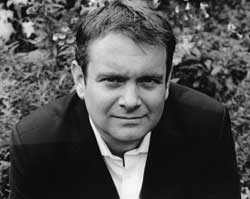 The story`Jaggers & Crown’ was very much inspired by my interest in British comedy programmes from the fifties and sixties, particularly radio shows such as Hancock’s Half Hour, The Goon Show and Round the Horne. Round the Horne is an especially fascinating programme: it was daring, ahead of its time, and the sketches involving the late Kenneth Williams are so funny and shocking considering homosexuality was still illegal back when they were recoreded.
Williams played one half of Julian and Sandy, who were gay in both senses of the word, and whose dialogue dripped with clever innuendo. I’m told that back then, many listeners would not have understood all the double meanings. It then occurred to me that as time went on, in the seventies and eighties, that depictions of homosexuality became more sadder and sexless, such as Mr Humphrey in Are You Being Served, who lived with his mother and was the butt of many homophobic remarks, and that sparked my interest in writing a short fictional journey through this period.
If Sonny Jaggers is based on anyone, it’s probably Kenneth Williams who was gay, took his own life and whose posthumous diaries showed he suffered from acute depression and had a spiteful streak. I also drew on the life of Tony Hancock, another depressive, an alcoholic and someone who also killed himself, as well as Peter Sellers who reguarly visited clairvoyants and wanted to be taken seriously as an actor.
Crown is more of a short cockney Norman Wisdom type in terms of his performance type. A loveable fool. But his real character isn’t modelled on anyone famous. I was more interested in creating an unreliable narrator and a false friend. Someone who admires and loves Sonny but who doesn’t have the courage to be him. — James Benmore
Proof!
Wednesday, 28th September 2011.

Above is a photo of the bound proof copy of our new anthology All These Little Worlds, which arrived this morning. This is the test copy, sent to us by the printers so that I can check everything is as it should be, and that I’ve not accidentally set all the pages upside down, or made the spine an inch too thick.
It’s all looking good, and the presses are running on the finished copies as I speak.
Finished copies will be going out to subscribers early next week, so there’s still time to subscribe! (Of course, you can also order it through your local bookshop or library.)
We’ve also posted a free .pdf sample, with the first few pages of each story. You can download that from the main anthology page.
Roast Books: an interview with Faye Dayan
Wednesday, 21st September 2011.
 Like many people, I first noticed Roast Books when they published A.C. Tillyer’s collection of short stories, An A-Z of Possible Worlds. It was a highly entertaining read, but also an exciting piece of publishing: the elaborate production, involving a boxed set of 26 booklets, was both eye-catching and perfectly suited to the material.
While An A-Z… might be Roast Books’ most elaborate volume, it’s be no means the only one: they started with a series of paperback novellas and short story collections called Great Little Reads, and more recent publications include Nik Perring’s collection of flash fiction, Not So Perfect. Their most recent book is Dogsbodies and Scumsters, a quirky collection of short stories by Alan McCormick with illustrations by Jonny Voss. Here’s the trailer:
With such a diverse and interesting selection of publications, I decided it was time to find out more about Roast Books and their plans, so I got in touch with their publisher Faye Dayan…
For a young publishing house with relatively few titles, you’ve managed to create a wonderfully diverse range: from the Great Little Reads with their textured covers, to the simple square of Nik Perring’s book, through to the extravagant A-Z of Possible Worlds, I’m not sure that you’ve tackled any two projects in the same way. What made you decide to take this approach?
Each book of short fiction Roast Books has published has deserved its own approach because we try to match form to content. I think it’s important that the shape and character of a book can reflect and relate to the stories inside.
Will you be revisiting the Great Little Reads series?
The novella is such a great genre, and often overlooked I think, so I would love to revisit the Great Little Reads series, although for the moment Roast Books is focused on short story collections.
Is it challenging to create a strong identity for Roast Books when you’re using a variety of formats? As opposed to, say, Peirene Press, who have one very distinct look to their titles.
You are right, this presents a challenge in creating an image for Roastbooks, but it is the philosophy of production, rather than the production itself which is consistent across all our books. The creative process of working with an author and collaborating on the design is very rewarding and something I would like to believe that our readers acknowledge and appreciate.
I’m sure they do. Your list is very focussed on short stories and novellas—a focus I can strongly identify with! I can see how short stories would be a logical choice for an experimental publisher like Roast Books, because the reading experience of shorter works can be more flexible than that of longer novels, where the book perhaps needs more to disappear more behind the writing. What’s the attraction for you in publishing short stories?
The genre of short stories is extensive, and there are fewer accepted publishing traditions associated with them. So firstly, as you said, as a new publisher, it gives more flexibility to experiment. Secondly many short stories are appreciated as they provide light bites of entertainment and stimulation, and the book format can be something which enhances this rather than detracts from it.

Do you see Roast Books moving into ebook publishing, or would you prefer to focus on the physical reading experience?
It’s interesting because the physical aspect of the book is intrinsic to Roast Books, so we will not release digital books without their physical counterpart. Having said that, we are developing an exciting little e-project which will give users the ability to self publish and distribute.
That’s interesting. More traditional publishers seem to be getting involved with self-publishing projects these days. It used to be very much a no-no, causing issues with credibility and conflicts of interest, but that certainly seems to be changing. How do you plan to reconcile the two very different types of publishing with Roast Books?
I agree it is changing. The type of self publishing where publishers put out a physical book in return for a hefty fee isn’t the only model any more. With ebooks, authors can create and distribute their own book online, in a speedy and cheap process, and this is something which part of our e-project will facilitate. Aspiring authors can bring their ebooks to the attention not just of potential readers but also potential publishers. There won’t necessarily be any overlap between this and our physical books at all.
How have you found the experience of entering the publishing industry? Do you think it’s a receptive world for new independents? Have you had any particular frustrations or pleasant surprises?
As you know things are changing very rapidly in the book industry and there is a lot of speculation about where it’s headed. But i have been certainly met some people within the industry who are extremely supportive and genuinely want new independents to succeed. It’s undoubtably tough, but you just have to keep going and see what’s around the next corner. We have just sold the film rights to My Soviet Kicthen by Amy Spurling, to Tailormade productions, which was an unexpected but welcome development.
What kind of team do you have? Do you work with a lot of people, or are you largely self-sufficient?
I work with the same designer, editor and publicist on each book, so its a very small operation, but I think this has its benefits! We work quickly, and it’s a lot of fun.
Are there any other emerging independent publishers that you particularly admire?
lol The Fiction Desk! Various Authors introduces a really interesting spectrum of new talent and I’m really enjoying it.
Thank you! I wasn’t fishing, I promise… Finally, what’s next for Roast Books?
We have some great projects planned for 2012, all collections of short stories, and also the development of our self publishing platform.
Find out more about Roast Books at their website, www.roastbooks.org.
All These Little Worlds: all the details.
Wednesday, 14th September 2011.
 It’s taken a little longer than expected, but I’m delighted to announce the imminent publication of our second anthology, All These Little Worlds.
All These Little Worlds contains nine new stories, including a special long story from Charles Lambert. (Several of the stories here are longer than the stories in Various Authors, as much by chance as anything, and I do think it gives the stories more time to build their worlds.)
Two contributors from Various Authors are returning for the new book, both with very different stories to their previous contributions. I’d originally considered Charles Lambert‘s ‘Pretty Vacant’ for that first book, but in the end it was too long to fit so we ran the equally good but shorter ‘All I Want’ instead. Since then, I’ve never quite managed to get ‘Pretty Vacant’ out of my mind. It’s Charles at his best, and fortunately I managed to grab it for All These Little Worlds.
Our other returning author is Jason Atkinson. His ‘Assassination Scene’ went down well in Various Authors; ‘Get on Green’ is a very different story, and shows off his range.
I think it’s good to have a few repeat visits from our contributors, as it gives the series a sense of continuity, but the main thrust of the anthology series is to showcase a variety of writers and writing, and the other seven contributors to All These Little Worlds are new to us.
Mischa Hiller should need no introduction: his two novels with Telegram have been critically acclaimed. (They’re crying out for movie adaptations too, especially the Hitchcockian Shake Off.) His story ‘Room 307’ represents a real change of pace from the novels.
If you read a lot of new short fiction, you probably already know about the American quarterly Electric Literature. Their editor Halimah Marcus has contributed ‘Dress Code’, one of several stories here with a school connection, although each is different: while ‘Dress Code’ follows the troubles of a new teacher, ‘Get on Green’ shows a schoolday from the perspective of a young African-American girl. Ryan Shoemaker‘s ‘After All the Fun We Had’ is the story of one principal’s attempt to engage bored students by injecting a little entertainment.
Colin Corrigan‘s story ‘The Romantic’ is a curiosity that I don’t intend to say too much about here. Colin was recently published in The Stinging Fly. Jennifer Moore provides some light entertainment in her story ‘Swimming With the Fishes’, while Andrew Jury opens a window on the relationship between a recently separated man and his mother-in-law in ‘”Glenda”‘.
Finally, James Benmore‘s ‘Jaggers & Crown’ is part story, part potted history of the transition from vaudeville comedy to television sketch shows. It’s a particularly interesting one, and I’ve asked James to blog here about the background to the story. Watch out for his post, coming up in the next couple of weeks.
Here are the contents in full (though not in order):
- Halimah Marcus – Dress Code
- Andrew Jury – “Glenda”
- James Benmore – Jaggers & Crown
- Colin Corrigan – The Romantic
- Ryan Shoemaker – After All the Fun We Had
- Jennifer Moore – Swimming with the Fishes
- Jason Atkinson – Get on Green
- Mischa Hiller – Room 307
- Charles Lambert – Pretty Vacant
Copies of All These Little Worlds will be sent out to subscribers as soon as they’re back from the printers, which should be around the end of September. For more information, or to pre-order if you haven’t subscribed, see All These Little Worlds.
Poetry Book Fair in London
Monday, 18th July 2011.
An email newsletter just arrived from Charles at CB Editions, containing full details of the poetry book fair that he’s been planning.
It’s on Saturday, 24th September, from 10am – 5pm. There are readings through the day, and the fair is being opened at 11am by Michael Horovitz.
Publishers in attendance will be: Anvil, Arc, Carcanet, CBe, Donut, Egg Box, Enitharmon, flipped eye, HappenStance, if p then q, Nine Arches, Rack Press, Reality Street, Salt, Shearsman, Sidekick, Waterloo, Ward Wood, Waywiser, and zimZalla.
They’re not getting any external funding, so if you like the sound of this and you’re in London, it’s worth going along and showing support.
Here’s the flier:

The poetry book fair is part of a project CB Editions is running called ‘Book Now’. You’ll find more information on the CBe site.
Various Authors in the Martello Bookshop, Rye.
Friday, 17th June 2011.
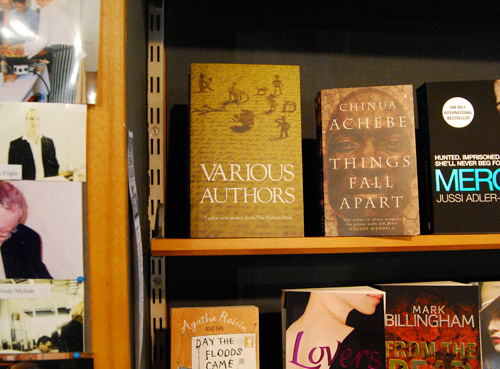
The Martello Bookshop, a lovely independent in Rye, East Sussex, is stocking Various Authors. There it is, right there, at the top left of the fiction section. It’s a terrific bookshop, so worth dropping in if you find yourself in town.
Peirene Press: an interview with Meike Ziervogel
Wednesday, 15th June 2011.
 The world of independent publishing, for all its challenges and controversies, is full of fascinating, energetic, and creative people. New publishers are appearing all the time, looking for fresh ways to connect readers with great writing. Over the next few months, we’ll be exploring some of this innovation by featuring a series of interviews with other independent publishers. First up is Meike Ziervogel (photo right) from Peirene Press.
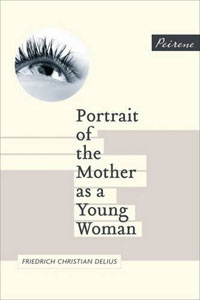
Peirene launched their first titles in 2010. They publish translated novellas, “that can be read in the same time it takes to watch a DVD.” We reviewed one of their titles, Portrait of the Mother as a Young Woman, last year.
I’m sure many of this blog’s readers are already familiar with Peirene, but for those that aren’t, would you like to start by telling me a little about your latest title, Tomorrow Pamplona?
Tomorrow Pamplona by Dutch author Jan van Mersbergen is a road movie in book form. It tells the story of two men, a family man and a boxer, who take a car journey from Amsterdam to Pamplona where they join in the bull run. It’s a book about men, their aggression and desire for freedom on the one hand, and their need for intimacy on the other.
Was it really only last year that Peirene published its first title? You’ve done a great job of establishing Peirene in a relatively short time. Part of that I think is down to the distinctive branding: the cream paperbacks with the cropped images and flaps. Could you tell me a little about how you settled on that design?
 Thank you for the compliment. From the start I knew that I wanted to go for a strong branding. I initially had a different designer and design, but that was before the first book was printed. I wasn’t happy with it. Then I found Sacha Davison-Lunt, Peirene’s current designer. She is great and we work well together because she understands to combine quality and elegance with individuality.
I think it would make me nervous to have one consistent design like that: What if I got bored of it? What if people stopped responding? Do you have any plans to publish in any other formats, or can you imagine doing so? I’m thinking of perhaps a hardback edition of a special title, as Hesperus have done a couple of times, or a radically different one-off cover design—say, as CB Editions did, breaking their distinctive typographic cover style for Knight Crew and Marjorie Ann Watts’s book.
Our design is very flexible. Next year will be Peirene’s Year of the Small Epic, short books with over 30 chapters each. Although the design will still be recognizably “Peirene”, the covers will reflect the annual theme.
Do you have any plans to release ebook editions of your titles?
Yes, we have just signed a contract with Faber Factory who will do the ebook distribution for us.
That’s interesting. What made you decide to work with another publisher on the ebooks?
About 60 publishers have already signed up with Faber Factory. They will do the e-book distribution for us. Since they are experts in that field, it’s much better that they do it for us rather than we trying to do it all by ourselves.
When do you expect to release the first ebook titles?
Very soon.
And in terms of content, can you see Peirene every publishing a book of short stories, or a longer novel, or even a book written originally in English?
Peirene No 6, Maybe This Time by Austrian Alois Hotschnig, which will be published in September, is a collection of short-stories. As for an English novella? If a well-known English language author has a novella in his or her drawer, I’d be delighted to have a look.
 Speaking of translation, one thing that worries me as a publisher about translated fiction is in the editorial side, the fact that one loses the immediacy of being able to work directly with the author, because effectively, however good the translation, the author and the publisher are always looking at different texts. This often wouldn’t apply to you, as I know you’re multi-lingual, but is that lack of an immediate connection ever an issue?
No, I wouldn’t say that. The original book and the translation are of course two different texts. I love texts. What is important to me is to present the English reader with a text that is true to the essence of the original but at the same time is a perfect English text, “as if it were written in English”, without of course changing names, street names etc.
Aside from the publishing, you also run a regular Salon. Could you tell me a little more about these events? Would you say they have played a big part in Peirene’s success to date? Do you have more plans for different types of event, perhaps touring the salon around the country?
The Peirene Salon is our flagship event. They take place in my own house, where I invite up to 50 people – readers, book lovers, critics, colleagues. Some people I know, others I have never met before. These Salons very much represent what Peirene stands for – to build a cohesive community of booklovers and readers. The evenings don’t present boring readings but are parties with performances, conversation, dinner and wine. In fact the Salons are now funded by The Wine Society and so the hospitality is always excellent. We are always booked up with a waiting list in place. The majority of the guests leave around 11pm but some stay on until 2 or 3 in the morning, drinking and talking. It’s wonderful. We also run regular Coffee Mornings in a local cafe. There we reach out to a different readership. Even children are welcome. And then we also have an event series called Peirene Experience where we present books in unusual places and different ways. For example, in March we held an event with the actor Jack Ellis and our German author Matthias Politycki in a bookshelf designer shop. The evening was a huge success.
Overall, how have you found the experience of entering the publishing industry? Any particular frustrations (naming no names, of course!) or pleasant surprises?
It’s an incredibly exciting journey because the book market is changing so fast and no one yet knows where it will take us. And to be right in the middle of this is a huge privilege.
And finally, just so that I’m absolutely certain, how exactly does one pronounce “Peirene”?
Watch the movie below and the mystery will be revealed…
Various Authors review round-up
Tuesday, 7th June 2011.
The publication of our first book has been followed, fortunately, by our first reviews. Even more fortunately, they’ve been very positive. I thought it might be worth rounding up some of what people have been saying about Various Authors.
The first one to come in was from Nylon Magazine:
From the creepy clone tale “Celia and Harold” to the heartwarming “Nativity,” these are 20-pagers that you can squeeze in at the gym, on the subway, or even in line at the grocery store.
Although we’re left wanting more when it’s all over, we don’t have to worry. It’s a quarterly anthology, which means there’s another load of mini-books on the way very soon.
If Nylon found the stories to be perfect reading for the grocery store (and they are! They are!), All Metaphor enjoyed the more serious side:
The authors of the dozen stories in this debut volume do not include any household names, but several can boast respectable track records, with novels or short story collections already in print. This is serious stuff: literary fiction of a high calibre, the contributors not genre writers but artists of the pen. (Though is there any reason why a genre writer shouldn’t be an artist too?)
(Of course there isn’t. Bring on the genre writers!) All Metaphor went on to highlight three stories written either by Americans, or with international settings:
The three stories that stand out here all have overseas settings and two of them are written by Americans. All I Want by Charles Lambert is about English teachers spending an uneasy weekend with an Italian family by Lake Garda, and is stiff with unspoken feeling. Nativity by Adrian Stumpp addresses the rarely described anguish of fatherhood. Topping the lot for me is Dave Tough’s Luck by Matthew Licht. This occupies familiar Licht territory in 1970s New York, but transcends the grubbiness and slease with a poignant account of an idiot savant drummer who can reproduce all the riffs of the jazz and rock greats but never create a thing himself.
Speaking of genres and the pointlessness of rigid barriers between them, it was great to get a review on the British Fantasy Society’s website:
Sometimes one has to read outside the confines of genre. And as much as I love fantasy/horror short stories there are times when I need to go off at a tangent. This is where Various Authors comes in. (Of course, one could argue that all fiction is just a bunch of lies and is, ergo, a form of fantasy fiction – but I’ll not go that route today.) Anyway … this anthology features twelve new stories from authors I’m not familiar with but, judging from their contributions, writers I’d like to encounter again.
Scott Pack was the first to review a specific story, singling out Lynsey May‘s ‘Two Buses Away’ for his blog Me and My Short Stories:
This is a well observed piece of writing. Uncomfortable and unsettling. I shall be dipping in further during the coming weeks.
He also had praise for the anthology series as a whole:
Once a quarter we will see a new anthology of short stories and if this first volume is anything to go by – featuring two of my favourite authors, Danny Rhodes and Charles Lambert – then we are in for a seasonal treat four times a year. […] If you like the idea of what The Fiction Desk is doing then you can subscribe for one year over at the website. It only costs £26.99 which is not at all bad for 4 books and nearly 50 stories a year.
A couple of people picked up on the introduction, and drew some parallels between our publishing venture and the independent music scene. Winston’s Dad had this to say:
I leave you there with the stories if you want to know more go out and support Rob, there isn’t a bad story in this collection to use the time-worn phrase they are all page turners and to take it back to Rob’s starting point of a dj, well this book is like the semi legendary NME MIXTAPE C86, which collected a group of acts in 1986, some were couple of hit wonders and some went on to be huge, this collection has tha feel anyone here could be huge and sure someone from this collection will but who or when is hard to say but if this is Rob’s mix of new writing in English, well it looks like we’re in good health.
…while Pauline Masurel at The Short Review concluded:
The premise of The Fiction Desk anthology collection appears to be to build up a subscriber base for this series of quarterly publications. But who subscribes to regularly buy collections of fiction from a range of (largely) unknown authors? Well, strange to tell, I’ve actually taken a punt on it myself – for the serendipity. In the same way that I sometimes listened to John Peel on the radio. I may not have liked all the music he chose, but I could be sure that he loved it or he wouldn’t be playing it. So too with Rob Redman’s selections. This feels like a very personal project and I was encouraged enough by what I read in Various Authors to tune in for the next installment.
The Review Review has detailed reviews of half a dozen individual stories, which are well worth reading, and summarises:
There were a couple of laugh-until-you-pee stories, some break-your-heart stories, and one or two I’m-not-sure-how-to-feel-now-but-I-liked-it stories. A couple of stories wobbled in places—an instance or two of awkward wording, perhaps—but I enjoyed the material enough that I never did give up on any of them, and I cheered the anthology on until its gorgeous, sweet, hysterical final story.
Finally, it doesn’t really count as a review, but Charles Lambert wrote a nice piece about the origins of the series on his blog:
The UK doesn’t really have a decent short story quarterly; those publications that do exist often feel too small-pressy, for economic reasons, or self-serving, for editorial ones. Granta, as far as I know, hasn’t published an unsolicited or un-agented piece of modern fiction for years. Rob’s plan was to produce something that looked, felt and read like a real book. Something that readers would be proud to own and writers proud to appear in. On the strength of the first number, Various Authors, he’s done just that.
So there you have it, all the reviews so far (not counting the ones on Goodreads and Amazon… phew!) The response has been fantastic, and hugely encouraging as we get to work on the next anthologies. And if you haven’t subscribed yet yourself, what are you waiting for?
The Voice of the Turtle
Monday, 23rd May 2011.
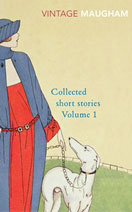 This brief quote from Somerset Maugham will come in handy if you’re the kind of person (like me) who can’t be bothered to read the latest Big Novel:
I have learnt by experience that when a book makes a sensation it is just as well to wait a year before you read it. It is astonishing how many books then you need not read at all.
It’s from the opening paragraphs of his story The Voice of the Turtle, in volume one of the Collected Short Stories.
