

Announcing the winner of the Various Authors prize.
Wednesday, 18th May 2011.
 As part of our commitment to encouraging new short fiction, we’re presenting a cash prize for the best story in each of our anthologies. The prize is judged by the contributors themselves, each of whom gets one main vote, and one secondary vote to be used in the event of a tie. The amount of the prize will vary, but the Various Authors prize is £200.
We did run into one little snag, though: despite the use of the secondary vote, we still wound up with a three-way tie. Jon Wallace, Matthew Licht, and Ben Lyle all received the same number of main and secondary votes.
Rather than toss a (three-sided?) coin, we decided to call in a special celebrity guest judge. Who better for this than respected book blogger and Twitter gadabout John Self, keeper of The Asylum?
John was kind enough to read the three stories and select the winner for us. I’m therefore pleased to announce that the winner of the Various Authors Prize is… Ben Lyle, for ‘Crannock House’. Here’s what John said:
I liked it because it surprises the reader’s expectations and doesn’t explain everything, and despite its short length, it manages to be a complex and affecting portrayal of two characters covering a long period of time without seeming rushed.
So, congratulations Ben. Speech! Speech!
And what do other people think of the winner? Any other favourites?
Broadsheet Stories
Tuesday, 17th May 2011.

Here’s another interesting publishing project that I’ve come across recently.
Broadsheet Stories print a monthly broadsheet—a single short story on one side of A3 paper—and distribute them to a selection of cafes and bookshops, mostly in south-west England, where customers are free to read them on the spot or take them home. (The photo above was taken in the Martello Bookshop in Rye.) Each venue begins with the first story and moves on one month at a time, meaning that there will be a different story available to read depending on where you are.
The stories are all necessarily short, coming in at just under 2000 words. Since starting in 2009, they’ve printed stories from a wide range of authors, including our own Matthew Licht.
Most of the stories can also be downloaded from the Broadsheet Stories website, but I think that takes away the fun of it: if you’re in the right part of the country, drop by one of the venues (listed here) and see which story they’ve got available this month.
Slightly Foxed: The (other) real reader’s quarterly
Monday, 16th May 2011.

I’ve been meaning to post something about Slightly Foxed for a while now, but something kept getting in the way. Since getting Various Authors off to the printers, I’ve had a little more time, and finally found the chance to open their Spring 2011 issue, no. 29.
Literary publications can approach their content in one of two ways: they can provide a range of essays, fiction, and poetry (Stinging Fly, The Paris Review, Granta etc.), or they can specialise, aiming to do one thing well. For The Fiction Desk’s anthology series, I decided to focus only on short stories. On the other hand, Slightly Foxed prints nothing but concise, personal essays about old books, both classics and forgotten gems.
Volume 29 contains 17 essays on titles as diverse as The Phantom Tollbooth and On The Origin of Species. They’re very well crafted, personal essays, of the sort that we encounter (and in my case, write) all too rarely on book blogs. The editors actually describe the content very well on their own website:
Slightly Foxed is more like a bookish friend, really, than a literary periodical. Companionable and unstuffy, each quarter it offers 96 pages of personal recommendations for books of lasting interest, old and new. It’s an eclectic mix, covering all the main categories of fiction and non-fiction, and our contributors are an eclectic bunch too. Some of them are names you’ll have heard of, some not, but they all write thoughtfully, elegantly and entertainingly.
The cumulative effect is that of visiting the best kind of used book shop, where you spend all day hanging around, talking to everybody that comes in and leaving with an armful of books. In fact, the publishers of Slightly Foxed do also have a bookshop, Foxed Books. I was in there once, a long time before I’d read the quarterly, and liked it very much.
The books themselves are beautifully produced, with very nice paper used throughout: the feel of each edition is more than enough to justify the relatively high price tag (a four-volume subscription costs £36). As you can see from the picture above, they also put a great deal of care and thought into the packaging.
As well as the quarterly, there’s a series of attractive limited edition reprints of lost or forgotten works, known as Slightly Foxed Editions.
All in all, Slightly Foxed is a must-read for literature lovers. Try it at least once, or you’ll never know what you’re missing out on.
One way to improve the relationship between bookshops and publishers.
Monday, 16th May 2011.
There is usually somebody in The Bookseller talking about the need to improve the relationship between bookshops and publishers. From today alone, we have High Street Bookshops Need Greater Support and Children’s Indies Concerned Over Cover Prices.
This kind of talk usually sparks fear and defensiveness all round: neither side can really afford to give up any discount, or to switch to some other stockholding method that involves moving books around without actually paying for them. While these arguments go round in circles, leading to nothing but bad feeling, ebooks and online sales steadily erode the bookshops’ market share.
However, there is one very clear way in which bookshops, publishers, and even book buyers could all get a better deal. It should be possible to improve relationships across the trade, and even reduce cover prices, all without reducing the quality of the books we all work so hard to produce and sell.
A look at two pricing models
Here are two potential pricing models for a new trade (large format) paperback:
(A)
RRP £9.99
Price through online retailers (e.g. Amazon): £9.99
Price direct from the publisher: £9.99
Price from your local independent bookshop: £9.99
(B)
RRP £13.99
Price on Amazon / online retailers: £13.99 around £9-£11
Price direct from the publisher: £13.99 £9.99
Price from your local independent bookshop: £13.99
Model (A) is the one we currently use at The Fiction Desk, which is why Various Authors is £9.99, a relatively low price for a large format paperback. Model (B) is much more common in the industry, as any regular book buyer will know.
It will surprise nobody to learn that we’re under a certain amount of pressure to move from (A) to (B). What might surprise you is the source of that pressure: it’s coming not from Amazon, but from the independent bookshops.
Behind the numbers
To explain what’s happening, we need to look at the economics behind those two pricing models.
To create model (A), we set up a very simple system. All the books that leave our distributor destined for the retail trade do so at the same discount, which is 40%. The tiniest independent or the largest chain (or online shop) receives a fixed 40%. Because of this, we can be sure of receiving the other 60% to cover our distribution, printing, author fees, handling returns, and other costs. At the moment, a £5.99 cut should do this for us, so we can comfortably set the RRP at £9.99.
The difference behind model (B) is that we would now be supplying wholesalers at a higher discount: they demand between 57.5% and 60% discount from RRP. So instead of receiving £5.99 from the price of a £9.99 book, the publisher would receive as little as £3.99. In order to make a reasonable margin per copy sold, the publisher therefore needs to push up the RRP: in fact, at £13.99, the publisher would still only make £5.59. (To keep the same revenue per unit they had before, it would be necessary to push the RRP up to a massive £14.99.) Economy of scale doesn’t really apply here either: wholesalers don’t create sales, so much as reroute them.
So, in order to supply through wholesalers, it’s necessary to push up the RRP, and this is a rise in price that adds no additional value to the end consumer. The retailer gets something close to the same 40% discount they would have got direct from the publisher, so it makes no great financial difference to them. But the publisher doesn’t need that higher RRP, so they can offer a little discount on their websites. The higher RRP, along with better relationships with wholesalers, also means that Amazon et al have more room for discounting. The final result, as in model (B) above, is that only the indies are left selling the books at a now too-high £13.99.
You would think that independent bookshops would do anything to avoid this situation, but in fact, many of them actively encourage it: they refuse to buy stock except from wholesalers, and we’ve even heard of people being told that our title isn’t available to purchase at all, when it’s setting in our distributor’s warehouse with immediate availability. The message is clear: the only way we’ll get our titles into many indie bookshops is to make them available to wholesalers, and therefore price them too high for the bookshops to be able to sell them.
Breakdown in communication.
Aside from creating artificially high RRPs, there’s another serious problem resulting from the presence of wholesalers in the supply chain.
When bookshops purchase stock from a wholesaler, the publisher has no idea who they are. When we launched, we had plans to feature an online list of stockists, to provide those stockists with promotional material, and to actively promote them on our website. We’ve had to shelve all of these plans, because we have no idea which bookshops are stocking us at all. Of the few trade sales we’ve had, the only stockist I definitely know of is the excellent John Sandoe in Chelsea. All the rest could be anybody—they could well be Amazon sales.
What can be done?
Put simply, if we want to retain (regain?) a healthy and efficient supply chain, we need to encourage bookshops to purchase stock directly from publishers and their distributors. Only by doing this can we maintain (regain) realistic RRPs, some level of price equality, and strong lines of bookshop-publisher communication on which to build joint promotional efforts.
For bookshops, this means turning away from wholesalers and maintaining and using accounts with larger publishers, and with the distributors who directly represent smaller publishers. This means extra paperwork—more small invoices instead of fewer large ones—but that’s a small price to pay for the benefits of a more efficient and fair supply chain.
For publishers and distributors, it means working to ensure that their ordering systems are as efficient and flexible as possible, with low minimum orders and delivery costs, and efficient customer services to make the process as easy as possible for the bookshops.
I can’t speak for the industry as a whole, but I can speak for The Fiction Desk: We intend to maintain our 40% trade discount, making the book immediately available to any bookshop that cares to stock it. But we won’t be offering additional discount to wholesalers, or getting involved in the kind of short-sighted high RRP / high discounting that’s causing so much damage right across the supply chain.
As always, comments from people across the industry are much appreciated. I’m sure there are things that I’ve missed in the above summary, but I do believe that this is the general direction in which we need to be heading.
Literary agents and publishing: a conflict of interest?
Friday, 13th May 2011.
According to this article in The Bookseller, the ethical dam that has traditionally prevented agents from becoming publishers may be about to break. At least one agent is in the process of setting up a list, with others ready to follow. This is a worrying development, as there is clearly a conflict of interest when an independent advisor enters the business on which he or she is supposed to offer independent advice.
Part of the debate centres on the wording of the constitution of the Association of Author’s Agents. Presumably, this is the line under debate:
An agency or agent who is also employed by publishers or purchasing principals, other than for selling rights, shall not be eligible for membership.
Although this refers to an agent also being employed by a publisher, it seems clear that this line is intended to avoid the same conflict of interest that arises when an agent also becomes a publisher.
It’s worth pointing out that the presence (or otherwise) of an idea in a constitution is not in itself a validation of that idea, but it does demonstrate a traditional perspective, and provide an appropriate starting point for debate.
Four questions immediately present themselves, although I suspect more will follow:
- How can an author hope for unbiased, independent advice from an agent who stands to make a great deal more money from one publishing route than from another?
- How can a publisher enter into potentially sensitive negotiations with a competitor?
- Will format fragmentation, with sales revenue potentially being split by format between different publishers, make it less possible for publishers to take a chance on new authors?
- What exactly are the agents’ motivations behind this move, and is there a more appropriate way to meet these goals, one which might benefit the industry as a whole and avoid potential ethical issues?
At some point, The Fiction Desk as a publisher will have to adopt a position on these changes. Before that happens, I’d be very interested in hearing people’s thoughts on any or all of the above questions.
Here we go!
Monday, 4th April 2011.
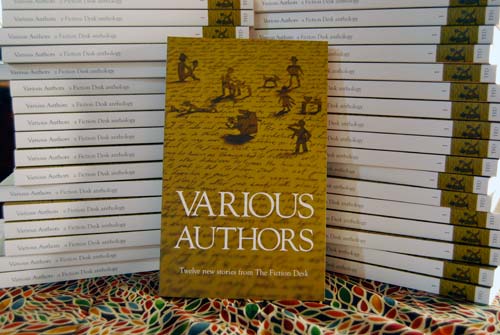
Here’s a stack of copies of Various Authors, photographed shortly before being sent off to the first eager readers.
Why The Fiction Desk has become a publisher
Thursday, 31st March 2011.
I tried several approaches to the introduction for Various Authors. I wanted to avoid the clichéd manifesto-style rant and focus instead on the quality of the stories, but I kept winding up with rather dry catalogues of the contents, essentially repeating what I’d written in the introductions to each individual story.
At the last minute, I found myself writing something a little more personal, which I hope explains a little more about what I’m doing here, and why I’m doing it. Here it is in full:
Back in the late nineties, just around the end of the big boom in alternative British music, I worked for a while as a DJ. I’d moved to a new city and hadn’t found much going on there in terms of good music, so one evening I wandered into a club and somehow talked them into letting me run their Monday nights for them. For the next year or so, I played records from bands like St Etienne, My Bloody Valentine, and half the back catalogue of the 4AD label.
The club wasn’t up to much: the beer was stale (but cheap), and they rarely replaced the bulbs in the lights, so there were times when the dance floor was lit for the entire evening by one meandering purple spotlight and an occasional burst of strobe. Both the turntables were broken and one of the CD decks skipped, so I’d put a long instrumental by Mogwai in the skipping one and use it to fill the silence while I quickly changed songs on the other deck. The crowd got used to hearing fifteen seconds of grinding guitars between each song, and occasionally losing half a Pixies chorus to a skipping disc. If there were complaints, a simple press of a button—under the decks, more or less where you’ll find the panic button in a shop—would make the complainer, the dance floor, and most of the club disappear in a cloud of raspberry-scented smoke.
On some nights the club was packed, while on others it was so empty that I’d put on a compilation CD and sit down for a drink with the regulars. It lasted for around a year, before collapsing during a particularly quiet summer. It had never been a huge commercial success (one night we managed a door take of minus fifty pee), but it had a loyal following, got people listening to new music, and sold quite a few records. A few bands formed among the regulars, and some of those went on to record albums of their own.
Then, a couple of years ago, I started a book blog where I do my best to talk about new fiction. It’s been a bit irregular, with some quiet months and some busy ones, but it’s sold a few books, introduced a few readers to new authors, and given me the opportunity to meet some interesting people.
I like to think that the club night and the blogging both came from the same place: a desire to seek out new and interesting things, the worthwhile but perhaps overlooked, and to share them with as many people as possible.
One advantage that the music had over the blogging is that it was more direct: it was a case of ‘listen to this’ rather than ‘let me tell you about this,’ sharing experiences rather than simply reporting them. Much as I enjoyed rambling to people about why they should like The Magnetic Fields, I found that it was better just to put on the CD.
It’s my preference for that directness that has led The Fiction Desk from blogging about fiction to publishing it: instead of boring you with why you should read Charles Lambert, or telling you to seek out Lynsey May’s stories, or how funny the new one from Jon Wallace is, I’m just going to show them to you.
So go and grab yourself a bottle of out-of-date beer, find somewhere comfortable to sit (not too close to the toilets, if I were you), and get ready to hear some things worth hearing.
Oh, and please bear with any odd noises you might hear: it’s not the music, just the CD player warming up.
Various Authors is available now. You can buy it from us (postage free), it’s available through bookshops in the UK, and there’s also a Kindle version. I hope you give it a try, and if you do, please come back and let me know what you think. Oh… and you can also download a pdf sample by clicking here.
Shake Off by Mischa Hiller
Friday, 25th February 2011.
 Regular readers of this blog might remember my review of Sabra Zoo, Mischa Hiller‘s excellent debut novel based around the 1982 massacre in Sabra Camp. I concluded that review by saying how much I was looking forward to Hiller’s next book.
Well, his next book is here now, and it doesn’t disappoint.
Shake Off is set in 1989 and is narrated by Michel, a young PLO agent living undercover in London as a student. Sabra rears its head here, too: Michel is both a victim and a creation of that event, which claimed the lives of his family and led to his adoption by a PLO operative who arranged his education and later his training in espionage. Now he lives alone in a bedsit, addicted to painkillers and shunning human contact. His life, from what he does to how he lives, has essentially become a complex coping mechanism for his past. The enforced solitude and paranoia of his work create a noise that blocks out the past from his days in the same way the codeine gets him through the nights:
So you have to be on continual alert: every public place is a potential meeting place; every alley or public toilet could be a dead-letter drop; every street, store and restaurant needs to be assessed for its counter-surveillance potential. You need to be constantly on the look-out for places to cache money and documents. Everyday objects must be considered potential concealers of microphones or cameras. Every person you meet could either be an agent wanting to get close or a possible recruit to the cause. Every woman that talks to you wants to trap you with the promise of sex. Every postcard has a hidden meaning. Everybody behind you could be following you, and it is your job to shake them off.
But while Michel is good at what he does—and we get plenty of insights into the tricks of his trade—he is still an unwitting pawn, and the comparison that kept coming to mind was Alfred Hitchcock. Michel is very much a Hitchcock innocent, drawn into a murky underworld that he shouldn’t have anything to do with—even if that drawing-in has taken place years before the story is set. The story too has a Hitchcockian feel to it: the tense but witty set-pieces involving counter-espionage in Foyle’s on the Charing Cross Road, or the move from the London of the opening chapters to a climax set in the wilds of Scotland. The novel as a whole feels like one of Hitchcock’s better films, and I doubt that the cinematic appeal of the book is entirely coincidental. Hiller certainly knows his cinema—his screenplay for Sabra Zoo won the European Independent Film Festival script competition.
That said, it doesn’t do this book justice to simply praise it as a cinematic book, or an embryonic movie. The writing is strong and confident, even when the narrator is not: Michel and his world are vividly evoked. Hiller is, I think, an excellent writer. Sabra Zoo went down well, and Shake Off is getting positive reviews absolutely everywhere. Well-written enough to please the serious reader, and fast-paced and engaging enough for the beach (if summer ever comes), Shake Off deserves to do very well.
Various Authors: all the details
Wednesday, 23rd February 2011.
It seems like only yesterday that I announced The Fiction Desk’s move into publishing. In the three months since then (and for quite a long time before then), we’ve been busy putting together our first book. With the proofs being corrected, I think it’s time to reveal all.
Our first publication, Various Authors: The Fiction Desk volume one, contains a dozen brand new stories.
I’ve tried to select a broad range of stories. While it wouldn’t make any sense to publish household names, we’ve been fortunate to get some very talented established writers on board. Regular readers of the blog will be familiar with Charles Lambert, for example. We were also fortunate enough to get a story from Danny Rhodes, the author of Asboville and Soldier Boy. Like Charles, Matthew Licht has published a short story collection with Salt; his contribution here suggests that there’s plenty more where that came from.
We’re based in the UK, and I think that there’s a greater need over here than there is in the US, where there are already a large number of literary journals. However, I’ve tried to include several stories from America, partly to provide context to the British selection, but mostly because they’re really good. As well as Matthew Licht, musician Jason Atkinson makes his fiction debut here. We’ve got a great story from Adrian Stumpp over in Utah, too. Alex Cameron is based in the UK now, but was born and brought up in Australia; I hope we’ll be able to get more stories from that part of the world in future volumes.
With the likes of the Postscripts anthology from PS Publishing and the Nightjar Press chapbooks, speculative fiction is already far better catered for than I could manage, but we’ve got our hands on a few interesting pieces that step outside the boundaries of the normal world. One of these is a new story from Patrick Whittaker, who won the 2009 British Fantasy Society Short Story Competition. I won’t flag the others up here, though: part of the fun is not knowing when things are going to go a little wonky.
I mentioned earlier that we won’t be publishing many household names, and a big reason for that is the importance of providing space for new writers to get their first publication, or to build on earlier successes. We’ve had a submissions page set up from the start, and there’s been a great response: more than five hundred submissions came in for the first volume alone. About five of the stories in this collection were requested—begged—from authors; all the rest came in as unsolicited submissions. (Please keep those submissions coming in!) Among the authors making their fiction debuts here are Jason Atkinson, Ben Lyle, and Harvey Marcus. Harvey’s story is also one of several that made me laugh out loud (LOL!) when I read it; another was Jon Wallace‘s contribution. When you read a lot, it’s easy to become jaded, to just process the words rather than really feeling them. The humour in some of these stories just cut right through that.
Here’s the full list, although the order isn’t yet finalised:
- Charles Lambert – All I want
- Lynsey May – Two Buses Away
- Matthew Licht – Dave Tough’s Luck
- Danny Rhodes – A Covering of Leaves
- Ben Lyle – Crannock House
- Ben Cheetham – Sometimes the Only Way Out is In
- Harvey Marcus – How to Fall in Love With an Air Hostess
- Jason Atkinson – Assassination Scene
- Patrick Whittaker – Celia and Harold
- Adrian Stumpp – Nativity
- Jon Wallace – Rex
- Alex Cameron – The Puzzle
So there we go. A dozen great stories from a dozen talented authors, in a bookshop near you from April 18th. For more information, see our pre-order page. You can also take out a four-volume subscription for £26.99 (a single, worldwide price).
Galleys!
Wednesday, 23rd February 2011.

We’re getting there… Pictured above are the galley proofs for Various Authors: The Fiction Desk volume one. The text is being checked over as I write this (or it would be, if I wasn’t writing this). The book contains a dozen new stories from a dozen talented writers. I’ve read them all several times now, as we’ve gone through the selection and editing process, but none of them has lost its ability to entertain or excite me as a reader. This is going to be a terrific collection. No resting on laurels, though: as soon as this one’s off to the printers, it’s time to get to work on Volume Two.
The full contents listing, along with details of all the writers involved, is here. If you haven’t yet signed up for our email newsletter, this would be a good time to do so.
