

In which we share the latest news from The Fiction Desk, including upcoming publications, writing competitions, and other odds and ends.
Our latest stockists: Shakespeare & Company
Tuesday, 31st January 2012. Comments are closed.
 I’m delighted to see that our anthologies are now being stocked by Shakespeare & Company, one of the world’s most iconic bookshops.
Although we’ve got subscribers in quite a few countries now, most of our bookshop sales to date have been at home in the UK, so it’s great to be on sale in France too.
Find out more about Shakespeare & Company at their website here, and if you’re in Paris, make sure you drop by.
(And if you’re a bookshop interested in stocking us, drop me a line, or get in touch with our distributors Central Books.)
James Benmore wins the Fiction Desk Writer’s Award
Thursday, 15th December 2011. Comments are closed.
 The votes are all in, and it’s time to announce that James Benmore has won the Fiction Desk Writer’s Award, for his story ‘Jaggers & Crown’. As well as the credit from his colleagues, James will be getting a cheque for £200 from The Fiction Desk, which should keep him in ballpoint pens for a while.
Read more about the award here, and if you’ve not yet read James’s winning story, you’ll want to grab a copy of All These Little Worlds.
The Fiction Desk Writer’s Award
Thursday, 8th December 2011. Comments are closed.
We’ve just finished the voting for the latest Fiction Desk Writer’s Award, which covers the stories in All These Little Worlds. I’ve not written much about the award before, but it’s quite an important part of what we do.
The Fiction Desk Writer’s Award is a cash prize for the best story in each volume, and it’s judged by the contributors themselves. The idea is that the stories are judged by the people who write them; as editor, even I don’t have a vote.
The amount of the prize and the exact voting method will vary from time to time, as we fine-tune it: for the first two volumes, it’s been a special prize of £200, and each contributor has had two votes (the second to be used in case of a tie).
Ben Lyle won the award earlier this year for his story ‘Crannock House’ in Various Authors, in a very close competition: we eventually had to bring in John Self from The Asylum to break the tie.
I’ll be announcing the winner for All These Little Worlds at the end of next week. The news will be here on the blog, and in our newsletter.
Story order in anthologies
Thursday, 10th November 2011. Comments are closed.
The first review of All These Little Worlds has been posted, by Valerie O’Riordan over at Bookmunch. I’m pleased to see that it’s a good one, with the reviewer rating All These Little Worlds even more highly than Various Authors. You can read the review here.
Getting the first reviews is always exciting, almost regardless of whether they’re positive or negative. (One of the stranger aspects of moving from book blogging to publishing is finding oneself at the sharp end of a sword that one was previously wielding, and realising just how pointy it actually is.) As we have a tight publication schedule, review copies tend to go out around publication date, meaning that we have to wait a few weeks for the first ones to come in. It’s a tense wait, but when they do arrive, it’s interesting to see the different perspectives on the stories, and on the anthology as a whole. I’m always proud and excited when a story is received well, and when it hasn’t gone down well, I have to think about whether I could have presented the story better, perhaps through placing it elsewhere in the book, or next to other stories.
The order of stories in the book is one of the things that Valerie picks up on in the review, and it’s a key part of the editor’s art. Maxwell Perkins, the famous Scribner’s editor who worked with the likes of Fitzgerald and Hemingway*, believed in arranging anthologies with the strongest story collections at the beginning, middle, and end, with the weaker ones filling the gaps between. That’s a good approach, but much more practical with single-author collections than with anthologies containing multiple authors. (For a start, if you always do that, then the authors might take an implied insult to their work from where you put them…) Planning the order of stories in a multi-author collection takes in other ideas about theme, pacing, length, style and so on. It’s a fascinating skill, a big part of putting together an anthology, and one that I’m just now beginning (I hope) to acquire. It’s nice to see a reviewer address the order of stories.
Anyway, it’s a very interesting review, and does a good job of explaining what’s in the book, and perhaps also why you should read it. So go and have a look!
* And many others; Perkins had a fascinating career, which involved him with many of what we now think of as the great American authors of the period. It’s worth tracking down a copy of A Scott Berg’s biography if you can find one.
Where are the new British short story writers?
Monday, 7th November 2011. Comments are closed.
 In the early days of planning our anthology series, I worried about whether we’d have the resources to find enough writers from abroad, allowing us to feature an international blend of stories. In the event, I’ve been surprised to find that we have the opposite problem: despite being based in the UK, it’s been a real challenge for us to find British short story writers. We’ve been working hard to increase awareness, getting in touch with all sorts of different organisations around the country, but just 10% of our submissions come from the UK.
As this is National Short Story Week in Britain, it seems like a good time to ask: where are our new short story writers?
I’m not talking about famous, established, or dead writers, you understand. Let’s not get sidetracked by shouting ‘Somerset Maugham’ and ‘Graham Greene’ and, I don’t know, ‘M R James’ at each other. (Although we maybe should save that for another time.) I’m concerned with the new writers: the ones who are maybe just producing their first publishable material, or who have begun to make a name for themselves with longer works, and are now starting to take an interest in the short story. I’m thinking of the people who might be publishing their first collections in two or three years’ time, and who should now be placing their first stories and starting to get their names in front of readers. These are the kinds of authors that we’ve been featuring in our anthologies, and these are the kinds of authors that it’s hard to find in the UK.
We’ve been pretty active about encouraging more submissions from British authors. Aside from some online appeals (which have done very well), we’ve also worked with more than a dozen universities around the country, providing books to creative writing courses for workshopping, hopefully to encourage students to work with the short story. We’ve also contacted independent writing groups to encourage their members to send in material.
One problem is that short stories, especially new short stories, just aren’t widely read in the UK. Often, an otherwise keen reader will tell me that they simply “don’t read short stories”. For obvious reasons, this makes it hard for British publishers to maintain a regular, quality publication: when stories are published, it’s often with very limited resources, meaning the stories aren’t great, or are only by big names, or are Worthy rather than entertaining. As a result, readers don’t come back for more, and the momentum never builds.
(British short story publishing may be at its healthiest today not in mainstream fiction but in genre publishing, where the editors and writers still keep in mind—more often than not—the ability of short stories to entertain.)
It’s sometimes said that the short story is more an American form than a British one, but I don’t really believe that. The UK has produced some terrific short story writers in the past, and there are some around today too. I do think though that the Americans are better at promoting short stories: they have more magazines and journals, which they take more seriously. As a result, they have more opportunities to write and read quality short fiction.
I hope that The Fiction Desk’s anthology series will in its own small way help to improve the situation in the UK. By giving the country a decent quarterly publication dedicated to new short fiction, I hope we can encourage writers to write short stories, and encourage readers to buy and read them. If you’re a writer and you think you might have a story for us, you’ll find our submissions information here.
And if you’re a reader, please consider taking out a subscription to the anthology series, because the best way to support new writing is to read it, and because you might just be surprised by how much you enjoy it. You’ll find subscription information here.
Proof!
Wednesday, 28th September 2011. Comments are closed.

Above is a photo of the bound proof copy of our new anthology All These Little Worlds, which arrived this morning. This is the test copy, sent to us by the printers so that I can check everything is as it should be, and that I’ve not accidentally set all the pages upside down, or made the spine an inch too thick.
It’s all looking good, and the presses are running on the finished copies as I speak.
Finished copies will be going out to subscribers early next week, so there’s still time to subscribe! (Of course, you can also order it through your local bookshop or library.)
We’ve also posted a free .pdf sample, with the first few pages of each story. You can download that from the main anthology page.
All These Little Worlds: all the details.
Wednesday, 14th September 2011. Comments are closed.
 It’s taken a little longer than expected, but I’m delighted to announce the imminent publication of our second anthology, All These Little Worlds.
All These Little Worlds contains nine new stories, including a special long story from Charles Lambert. (Several of the stories here are longer than the stories in Various Authors, as much by chance as anything, and I do think it gives the stories more time to build their worlds.)
Two contributors from Various Authors are returning for the new book, both with very different stories to their previous contributions. I’d originally considered Charles Lambert‘s ‘Pretty Vacant’ for that first book, but in the end it was too long to fit so we ran the equally good but shorter ‘All I Want’ instead. Since then, I’ve never quite managed to get ‘Pretty Vacant’ out of my mind. It’s Charles at his best, and fortunately I managed to grab it for All These Little Worlds.
Our other returning author is Jason Atkinson. His ‘Assassination Scene’ went down well in Various Authors; ‘Get on Green’ is a very different story, and shows off his range.
I think it’s good to have a few repeat visits from our contributors, as it gives the series a sense of continuity, but the main thrust of the anthology series is to showcase a variety of writers and writing, and the other seven contributors to All These Little Worlds are new to us.
Mischa Hiller should need no introduction: his two novels with Telegram have been critically acclaimed. (They’re crying out for movie adaptations too, especially the Hitchcockian Shake Off.) His story ‘Room 307’ represents a real change of pace from the novels.
If you read a lot of new short fiction, you probably already know about the American quarterly Electric Literature. Their editor Halimah Marcus has contributed ‘Dress Code’, one of several stories here with a school connection, although each is different: while ‘Dress Code’ follows the troubles of a new teacher, ‘Get on Green’ shows a schoolday from the perspective of a young African-American girl. Ryan Shoemaker‘s ‘After All the Fun We Had’ is the story of one principal’s attempt to engage bored students by injecting a little entertainment.
Colin Corrigan‘s story ‘The Romantic’ is a curiosity that I don’t intend to say too much about here. Colin was recently published in The Stinging Fly. Jennifer Moore provides some light entertainment in her story ‘Swimming With the Fishes’, while Andrew Jury opens a window on the relationship between a recently separated man and his mother-in-law in ‘”Glenda”‘.
Finally, James Benmore‘s ‘Jaggers & Crown’ is part story, part potted history of the transition from vaudeville comedy to television sketch shows. It’s a particularly interesting one, and I’ve asked James to blog here about the background to the story. Watch out for his post, coming up in the next couple of weeks.
Here are the contents in full (though not in order):
- Halimah Marcus – Dress Code
- Andrew Jury – “Glenda”
- James Benmore – Jaggers & Crown
- Colin Corrigan – The Romantic
- Ryan Shoemaker – After All the Fun We Had
- Jennifer Moore – Swimming with the Fishes
- Jason Atkinson – Get on Green
- Mischa Hiller – Room 307
- Charles Lambert – Pretty Vacant
Copies of All These Little Worlds will be sent out to subscribers as soon as they’re back from the printers, which should be around the end of September. For more information, or to pre-order if you haven’t subscribed, see All These Little Worlds.
Various Authors review round-up
Tuesday, 7th June 2011. Comments are closed.
The publication of our first book has been followed, fortunately, by our first reviews. Even more fortunately, they’ve been very positive. I thought it might be worth rounding up some of what people have been saying about Various Authors.
The first one to come in was from Nylon Magazine:
From the creepy clone tale “Celia and Harold” to the heartwarming “Nativity,” these are 20-pagers that you can squeeze in at the gym, on the subway, or even in line at the grocery store.
Although we’re left wanting more when it’s all over, we don’t have to worry. It’s a quarterly anthology, which means there’s another load of mini-books on the way very soon.
If Nylon found the stories to be perfect reading for the grocery store (and they are! They are!), All Metaphor enjoyed the more serious side:
The authors of the dozen stories in this debut volume do not include any household names, but several can boast respectable track records, with novels or short story collections already in print. This is serious stuff: literary fiction of a high calibre, the contributors not genre writers but artists of the pen. (Though is there any reason why a genre writer shouldn’t be an artist too?)
(Of course there isn’t. Bring on the genre writers!) All Metaphor went on to highlight three stories written either by Americans, or with international settings:
The three stories that stand out here all have overseas settings and two of them are written by Americans. All I Want by Charles Lambert is about English teachers spending an uneasy weekend with an Italian family by Lake Garda, and is stiff with unspoken feeling. Nativity by Adrian Stumpp addresses the rarely described anguish of fatherhood. Topping the lot for me is Dave Tough’s Luck by Matthew Licht. This occupies familiar Licht territory in 1970s New York, but transcends the grubbiness and slease with a poignant account of an idiot savant drummer who can reproduce all the riffs of the jazz and rock greats but never create a thing himself.
Speaking of genres and the pointlessness of rigid barriers between them, it was great to get a review on the British Fantasy Society’s website:
Sometimes one has to read outside the confines of genre. And as much as I love fantasy/horror short stories there are times when I need to go off at a tangent. This is where Various Authors comes in. (Of course, one could argue that all fiction is just a bunch of lies and is, ergo, a form of fantasy fiction – but I’ll not go that route today.) Anyway … this anthology features twelve new stories from authors I’m not familiar with but, judging from their contributions, writers I’d like to encounter again.
Scott Pack was the first to review a specific story, singling out Lynsey May‘s ‘Two Buses Away’ for his blog Me and My Short Stories:
This is a well observed piece of writing. Uncomfortable and unsettling. I shall be dipping in further during the coming weeks.
He also had praise for the anthology series as a whole:
Once a quarter we will see a new anthology of short stories and if this first volume is anything to go by – featuring two of my favourite authors, Danny Rhodes and Charles Lambert – then we are in for a seasonal treat four times a year. […] If you like the idea of what The Fiction Desk is doing then you can subscribe for one year over at the website. It only costs £26.99 which is not at all bad for 4 books and nearly 50 stories a year.
A couple of people picked up on the introduction, and drew some parallels between our publishing venture and the independent music scene. Winston’s Dad had this to say:
I leave you there with the stories if you want to know more go out and support Rob, there isn’t a bad story in this collection to use the time-worn phrase they are all page turners and to take it back to Rob’s starting point of a dj, well this book is like the semi legendary NME MIXTAPE C86, which collected a group of acts in 1986, some were couple of hit wonders and some went on to be huge, this collection has tha feel anyone here could be huge and sure someone from this collection will but who or when is hard to say but if this is Rob’s mix of new writing in English, well it looks like we’re in good health.
…while Pauline Masurel at The Short Review concluded:
The premise of The Fiction Desk anthology collection appears to be to build up a subscriber base for this series of quarterly publications. But who subscribes to regularly buy collections of fiction from a range of (largely) unknown authors? Well, strange to tell, I’ve actually taken a punt on it myself – for the serendipity. In the same way that I sometimes listened to John Peel on the radio. I may not have liked all the music he chose, but I could be sure that he loved it or he wouldn’t be playing it. So too with Rob Redman’s selections. This feels like a very personal project and I was encouraged enough by what I read in Various Authors to tune in for the next installment.
The Review Review has detailed reviews of half a dozen individual stories, which are well worth reading, and summarises:
There were a couple of laugh-until-you-pee stories, some break-your-heart stories, and one or two I’m-not-sure-how-to-feel-now-but-I-liked-it stories. A couple of stories wobbled in places—an instance or two of awkward wording, perhaps—but I enjoyed the material enough that I never did give up on any of them, and I cheered the anthology on until its gorgeous, sweet, hysterical final story.
Finally, it doesn’t really count as a review, but Charles Lambert wrote a nice piece about the origins of the series on his blog:
The UK doesn’t really have a decent short story quarterly; those publications that do exist often feel too small-pressy, for economic reasons, or self-serving, for editorial ones. Granta, as far as I know, hasn’t published an unsolicited or un-agented piece of modern fiction for years. Rob’s plan was to produce something that looked, felt and read like a real book. Something that readers would be proud to own and writers proud to appear in. On the strength of the first number, Various Authors, he’s done just that.
So there you have it, all the reviews so far (not counting the ones on Goodreads and Amazon… phew!) The response has been fantastic, and hugely encouraging as we get to work on the next anthologies. And if you haven’t subscribed yet yourself, what are you waiting for?
Announcing the winner of the Various Authors prize.
Wednesday, 18th May 2011. Comments are closed.
 As part of our commitment to encouraging new short fiction, we’re presenting a cash prize for the best story in each of our anthologies. The prize is judged by the contributors themselves, each of whom gets one main vote, and one secondary vote to be used in the event of a tie. The amount of the prize will vary, but the Various Authors prize is £200.
We did run into one little snag, though: despite the use of the secondary vote, we still wound up with a three-way tie. Jon Wallace, Matthew Licht, and Ben Lyle all received the same number of main and secondary votes.
Rather than toss a (three-sided?) coin, we decided to call in a special celebrity guest judge. Who better for this than respected book blogger and Twitter gadabout John Self, keeper of The Asylum?
John was kind enough to read the three stories and select the winner for us. I’m therefore pleased to announce that the winner of the Various Authors Prize is… Ben Lyle, for ‘Crannock House’. Here’s what John said:
I liked it because it surprises the reader’s expectations and doesn’t explain everything, and despite its short length, it manages to be a complex and affecting portrayal of two characters covering a long period of time without seeming rushed.
So, congratulations Ben. Speech! Speech!
And what do other people think of the winner? Any other favourites?
Here we go!
Monday, 4th April 2011. Comments are closed.
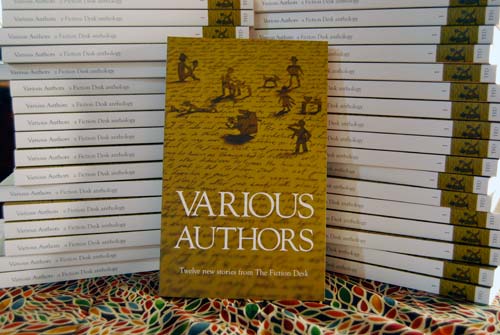
Here’s a stack of copies of Various Authors, photographed shortly before being sent off to the first eager readers.
