

In which we share the latest news from The Fiction Desk, including upcoming publications, writing competitions, and other odds and ends.
New books from Fiction Desk authors
Thursday, 5th June 2014. Comments are closed.
This summer is going to be a busy one for our authors, with new novels and other bits and pieces coming out. Here’s a round-up of what to look out for:
Miha Mazzini: Crumbs (Out now)

Slovenian author Miha Mazzini‘s stories have appeared in two of our anthologies: Crying Just Like Anybody and New Ghost Stories. He’s written several novels, although only a few have been translated into English. The German Lottery (published by CB Editions) is well worth a read, and this year Freight Books have published a translation of his debut novel, Crumbs. Here’s the blurb:
The best-ever selling novel from the former Yugoslavia, this is a hilarious, anarchic, irreverent black comedy about national aspirations and wanting things you can’t have, re-published in the year that Scotland votes on independence.
Egon is an amoral but charismatic writer, living on the breadline in a grim, unnamed communist factory town in Slovenia prior to the break-up of the former Yugoslavia. With little evidence of his real literary ambitions, he makes ends meet by writing trashy romances under a pseudonym. When not searching out sex with as many women as possible, or slagging off the literary establishment, Egon is full of schemes to feed his pathological need for the ruinously expensive aftershave, Cartier pour L’Homme.
Around him Egon has gathered a motley crew of friends and acquaintances, each of whom also has an equally obsessive, unattainable ambition. Poet is desperate to have his verse published in a leather bound volume, Ibro is in love with Ajsha, a factory girl to whom he cannot utter a single word, while Selim is convinced he’ll marry Nastassja Kinski, the world-famous actress. As Egon’s attempts to secure more perfume become ever more degenerate, his grip on his own identity loosens. The consequences are messy, as grim as they are hilarious, and allude to a nation undergoing radical change.
Crumbs is not only a ribald, dirty realist satire – a modern European classic – but also a fascinating and utterly unique commentary on the pathology of self-determination. It’s publication in the months before Scotland votes on independence lends a surprising, alternative but authoritative perspective on the debate.
James Benmore: Dodger of the Dials (Out now)

This is the second book in James Benmore‘s series of novels revisiting the Artful Dodger from Oliver Twist. Written in the Artful’s voice, these novels show off James Benmore’s talents as an impersonator, and the stories feel as much performance as literature. (For the performance of another, very different character, see James Benmore’s story ‘Jaggers & Crown’ in All These Little Worlds. Here’s what publishers Heron have to say:
Two years on from the events of Dodger, Jack Dawkins is back as top-sawyer with his own gang of petty thieves from Seven Dials. But crime in London has become a serious business—and when Jack needs protection he soon finds himself out of his depth and facing the gallows for murder.
The evidence against him seems insurmountable, until a young reporter by the name of Oliver Twist takes up his cause. After freeing Jack from gaol, the pair must bury their past differences and join forces to hunt down the men who framed Jack and stole that which he treasures most.
Charles Lambert: With a Zero at Its Heart (Out now)

This short novel is constructed of 240 paragraphs, each of 120 words, forming a semi-autobiographical narrative. There are always tensions in Charles Lambert‘s writing between structure and emotion, and the personal and political, and I’m particularly excited to see how those tensions resolve themselves in this new book. With a Zero at Its Heart has already been well received by the Guardian. Charles will be launching the book in London next week. Here’s what publisher The Friday Project says:
24 themed chapters.
Each with 10 numbered paragraphs.
Each paragraph with precisely 120 words.
The sum of a life.
In his beautiful and haunting new book, Charles Lambert explores the fragmentary nature of memory, how the piecing together of short recollections can reveal a greater narrative. Through chapters tackling elemental themes such as Sex, Death, and Money, Lambert assembles the narrator’s moving life story. Executed with all the grace and finesse of his previous acclaimed work, this is an incredible artistic achievement, breathtaking in its simplicity yet awe-inspiring in its scope.
With cover and text design by the renowned designer Vaughan Oliver, With a Zero at its Heart is as beautiful to look at as it is to read.
William Thirsk-Gaskill: Escape Kit (Out now)

This is a short novella from William Thirsk-Gaskill, whose story ‘Can We Have You All Sitting Down, Please?’ appeared in Crying Just Like Anybody. It’s available as a limited edition paperback and Kindle ebook. Here’s the blurb from publishers Grist:
Bradley is a fourteen-year-old school boy who escapes his troubled home life to visit his grandparents in Stevenage. On the train there, he is held hostage by a deluded gunman who thinks he is an escaped PoW from WWII and that Bradley is a member of the Hitler Youth. Now Bradley must try and escape using his mobile phone. William Thirsk-Gaskill’s novella is a gripping and beautifully told tale of innocence and experience.
Richard Smyth: Wild Ink (June 2014)

Richard Smyth provided the title story for Crying Just Like Anybody, and a supernatural tale to New Ghost Stories. He’s published several books of non-fiction, but Wild Ink is his first novel. Here’s what the publisher (Dead Ink) says:
Wild Ink is a blackly comic story of friendship and envy, love and memory, booze and uproar, secrets and scandal. Albert Chaliapin is dead – or at least, he feels like he ought to be. He lives in a world occupied only by the ghosts of his former life (and his nurse, who can’t even get his name right). Then, one day, his past – in the form of a drunk cartoonist, a suicidal hack and a corrupt City banker – pays a visit, and Chaliapin is resurrected, whether he likes it or not. He doesn’t, much.
Someone’s sending him some very strange cartoons. Someone’s setting off bombs all over London. Someone’s been up to no good with some very important people. This is no job for a man wearing pyjamas. Will Chaliapin make it out alive? And is being alive, when it comes down to it, really all it’s cracked up to be?
Jo Gatford: White Lies (July 2014)

Jo Gatford, who won our 2014 flash fiction competition, is also celebrating the publication of her debut novel from Legend Press. White Lies takes a look at the way a family’s secrets are exposed when the father develops dementia. Here’s the blurb:
When Matt’s half-brother Alex dies, his father refuses to hold onto the memory of his favourite son’s death. It was hard enough the first time, but breaking his dad’s heart on a weekly basis is more than Matt can bear.
Peter, Matt’s father, is terrified his dementia will let slip the secrets he’s kept for thirty-five years. Unable to distinguish between memory and delusion, he pursues one question through the maze of his mind: Where’s Alex?
Faced with the imminent loss of his father, Matt is running out of time to discover the truth about his family. Tortured by his failing memory, Peter realises that it’s not just the dementia threatening to open his box of secrets, but his conscience, too.
Announcing the Fiction Desk Writer’s Award for New Ghost Stories
Wednesday, 26th February 2014. Comments are closed.
 The winner of the Fiction Desk Writer’s Award for our latest anthology, New Ghost Stories, is… Jason Atkinson, for his story ‘Half Mom’. Congratulations Jason!
The Writer’s Award is voted for by the contributors to the anthology, and along with the acclaim of his peers, Jason receives £100.
‘Half Mom’ is the third story we’ve published by Jason, who made his Fiction Desk debut in our very first anthology, Various Authors, with the story ‘Assassination Scene’. His story ‘Get on Green’ later appeared in All These Little Worlds.
We’ll look forward to featuring more of Jason’s stories in future; in the meantime, why not pick up (or download) a copy of New Ghost Stories and read his winning story for yourself.
Designing the cover for New Ghost Stories
Thursday, 16th January 2014. Comments are closed.

The cover for New Ghost Stories, our sixth anthology, is pretty straightforward, but also a little bit revolutionary — at least by our standards. The covers for the first five volumes were simple photographs, with very little processing. They followed fixed rules: everything had to be in front of the camera, and only paper and the written — or printed — word could be featured in the photograph. New Ghost Stories was originally intended to follow those rules, but ended up breaking them in a last-minute rush to get the files to the printers.
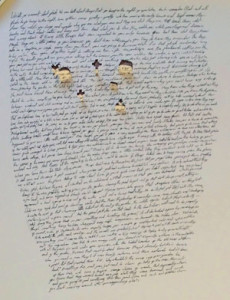 The original plan was to repeat the cover design from our first anthology, Various Authors, but with gravestones in place of the figures from the original cover.
Where the text on the cover of Various Authors is a rambling mission statement for the series, the text on New Ghost Stories is an equally rambling, stream-of-consciousness ghost story, made up on the spur of the moment to fill the page. (Don’t worry: the cover is the only place in a Fiction Desk anthology where you’re likely to find much in the way of stream-of-consicousness prose.)
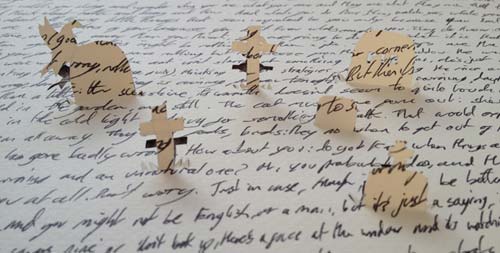
However, when the gravestones were cut out, they didn’t really work as well as the original figures had: there’s something, well, lifeless about gravestones, even with the addition of the bird from Richard Smyth’s story (er, top left).
 With a couple of hours to go before the files were due at the printers, there wasn’t time to start a new design from scratch. I ended up flattening the gravestones back down into the paper, and taking various shots of the text. I layered these on the computer with varying levels of opacity, altering the colours and inverting the top layer. There was a brief flirtation with the use of a ribbon to hold the title — see the photo at the top of this post — and the cover went off to the printers with minutes to spare.
It could have wound up as a complete dog’s breakfast, but actually I’m rather pleased with the cover of New Ghost Stories. And breaking the rules once has set a precedent for the future. Anything could happen… now, where’s my scalpel?
Announcing the winner of the Fiction Desk Writer’s Award for Because of What Happened
Tuesday, 12th November 2013. Comments are closed.
It’s time to announce the latest winner of the Fiction Desk Writer’s Award.
The Writer’s Award is given for the best story of each anthology, as voted by our contributors. Nobody else gets a vote, meaning that the award really does represent the judgement of the writers themselves; after all, they’re the ones who best know what makes a good short story.
Today’s award is for the best story in Because of What Happened, our fifth anthology. It was a tough contest, with fifteen stories to choose from, including Tania Hershman’s already-prizewinning story from our 2013 flash fiction competition. But we have a winner…
 I’m delighted to announce that our writers chose Cindy George’s story ‘The Coaster Boys’ as the winner of the Fiction Desk Writer’s Award. Congratulations Cindy!
Cindy George has written a post for us about the inspiration behind her story; you can read her post here, and you can read the story itself in Because of What Happened, out now in paperback, Kindle, and other ebook editions.
Announcing the Fiction Desk Writer’s Award for Crying Just Like Anybody
Tuesday, 19th February 2013. Comments are closed.
It’s that time again, when I get to announce the winner of the Fiction Desk Writer’s Award for our latest volume. Up today is the winner for volume 4, Crying Just Like Anybody.
The Writer’s Award is judged by the contributors to the volume, each contributor getting two votes, and the writer with the most votes wins.
 Without further ado, then, the winner of the Writer’s Award is — well, you’ve already seen his photo over there on the right — S R Mastrantone, with his story ‘Just Kids’. Congratulations S R!
‘Just Kids’ should be a popular choice: as well as walking away with the most votes in the Writer’s Award, it’s also been singled out for praise in reviews by Bookmunch (‘a dryly humorous and adroit consideration of modern society’) and Casual Debris. You can also read the author’s blog post about the background to his story here.
So if you’ve not yet read Crying Just Like Anybody, pick up your copy today and check out S R’s story – prices start at just £1.99 for Kindle and epub editions. Meanwhile, we’ll be working on the next volume, which will include among other stories, the winners of our flash fiction competition (to be announced next week).
Creating the cover of Crying Just Like Anybody
Friday, 28th December 2012. Comments are closed.
As I wrote in the introduction to The Maginot Line (and blogged here), we have certain self-imposed rules about our cover designs. Only paper and the written word are allowed.
 This wasn’t so bad when making the leaves of The Maginot Line, or the cut-outs of Various Authors, but it was a bit more of a challenge when I came to do the cover for Crying Just Like Anybody, which takes its cue from the title story by Richard Smyth.
I wanted a humanoid figure, but without simply repeating the technique used on Various Authors. At first, I tried out a few silhouettes, but they all looked a bit, well, flat. I made some three-dimensional figures from paper (calling them Alf 1, 2, and 3, for reasons that will make sense if you read Richard’s story, and are familiar with bad 80s television). Again though, they weren’t particularly inspiring. It was also important that the figure be slightly ambiguous.
The idea of using a shadow came from watching The Testament of Dr Mabuse (available in a very nice dual-format edition from Masters of Cinema), in which one character disguises his identity by only appearing as a shadow. Well, if the villain of that film could do it, so could Alf.
So I dug out one of the figures I’d made, and created a quick ‘warehouse’ out of boxes and printouts of Richard Smyth’s story. Job done, and all thanks to Fritz Lang:

The Fiction Desk Writer’s Award: The Maginot Line
Monday, 18th June 2012. Comments are closed.
The votes are all in, and it’s time to announce the winner of The Fiction Desk Writer’s Award for our latest anthology, The Maginot Line. The winner is…
… Matt Plass, for the title story!
The Writer’s Award is one of my favourite things about The Fiction Desk. It’s voted entirely by the authors who contribute to each volume — even I don’t get a vote — so it really reflects the views of the author’s peers. There’s also a cash prize of £100, which doesn’t hurt.
 So congratulations to Matt, who joins previous winners Ben Lyle and James Benmore in our award hall of fame. And those of you who enjoyed his story ‘The Maginot Line’ will be pleased to know that we’ll be featuring a new story from Matt in the next anthology.
Those of you who haven’t yet read The Maginot Line should now run to their nearest stockist, or buy it directly from us.
Or you could subscribe, of course, and help us to keep discovering and publishing excellent new stories like Matt’s.
Cover Stories
Thursday, 17th May 2012. Comments are closed.
(The following post is an extended version of the introduction to our anthology The Maginot Line. There were a couple of things I couldn’t talk about there, as I hadn’t seen a finished copy of the third anthology at the time of writing it.)
In the introduction to our first anthology, I wrote briefly about the background to the series, and why I decided to relaunch The Fiction Desk as a publishing house. In All These Little Worlds, I wrote a little about the process of putting the anthologies together, why we don’t do themed anthologies, and the way themes have a habit of emerging anyway.
In The Maginot Line, I thought I’d write about something really superficial: our covers.
We try to have a broad editorial policy, but it more or less amounts to a focus on traditional narratives with strong characters. To reflect those traditional values, I set certain limitations for our cover images: the designs can only consist of paper and the written word.
Various Authors
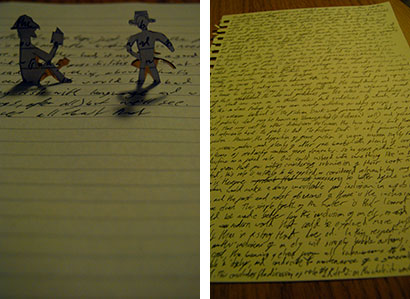
 The cover of Various Authors was in my mind for almost as long as the anthology series itself. I made a couple of tests (below left) by hacking away at scrap paper with a fruit knife, before upgrading to a sheet torn from a sketchbook (but the same fruit knife) for the final version.
The handwritten text is a deliberately rambling version of the editorial policy, and specifically talks about our openness to genre, and the limitations of that; I seem to remember there being some reference to elves, although I can’t find it on the cover now. The reference was not entirely complimentary.
The figures were drawn on the back of the paper, cut out along three sides and folded to stand up. I think it worked rather well, though it suffers from the rather shouty typesetting of the title (which I’ve done my best to tidy up in subsequent volumes).
All These Little Worlds
 The crumpled sheets of paper on the cover of All These Little Worlds are pages torn out of advance copies of Various Authors; copies that had been sent out to bookshops but returned to us with their envelopes marked ‘closed down’ or ‘out of business’. Each one therefore represents a different vanished bookshop, and while the title was originally intended to refer to the stories themselves, in retrospect it could equally apply to those lost shops.
The chalk was a nice bit of synchronicity given that the anthology ended up containing several stories related to education. (Technically those chalked lines probably aren’t ‘the written word’, making this a small bending of the rules, but we can call them dashes if you like.)

The Maginot Line
The cover of The Maginot Line is based on the title story, which opens the anthology. There’s a significance to the kind and order of the leaves, but you’ll discover that for yourself when you read Matt’s excellent story. This was the first cover for which I allowed myself real tools, rather than kitchen utensils: The Fiction Desk’s petty cash stretched to a cutting mat and craft knife.
The background to this cover is a sheet of paper made of elephant poo, which seemed to have the right sort of texture.
Make of that what you will.

Late unlamented laminate
The Maginot Line is also the first of our covers to be printed without any sort of laminate: the thin plastic coating that’s applied to almost all paperbacks published these days. Conventional wisdom seems to have it that a book just isn’t professionally finished without a laminated cover, but I’ve grown to really dislike it.
Laminate may protect books (slightly), but when the book does get damaged, the damage is plasticky in a way that looks incredibly cheap and unbookish: the thin plastic film starts to wrinkle, or blister, or peel like dead skin. When an unlaminated book gets knocked or scratched, it may lose a little ink, gain a white scuff mark or two, but it still looks a lot more like a book.
The laminate problem is also made worse by digital printing, as digital inks tend to prevent the laminate from bonding properly. That’s why so many digital books have nasty-looking thick glossy laminated covers: it’s an attempt to get it to stick on. To see the difference, compare a copy of All These Little Worlds (printed digitally and laminated) with a copy of Various Authors (traditionally printed and laminated). The Maginot Line is printed using the same processes as All These Little Worlds, but without the laminate. Personally, I think it has the nicest feel of all three volumes, and has my favourite cover design too.
I don’t think we’ll ever use laminate again for a Fiction Desk title, unless there’s a very good reason for it.
The Maginot Line update
Friday, 6th April 2012. Comments are closed.
A quick post to let you know that our new anthology, The Maginot Line, should be out by the end of next week. It’s running a few days late (blame Easter), but it’s well on the way. As ever, subscription copies and pre-orders will be sent out by first class post (or airmail) as soon as the copies arrive from the printers.
Ebook editions may be available a few days earlier: I’ll update the blog and our Twitter feed as the various formats are released.
In the meantime, have a good Easter.
Announcing The Maginot Line
Wednesday, 28th March 2012. Comments are closed.
Today we can finally announce our new anthology, The Maginot Line.
The Maginot Line contains nine new stories, including stories from returning authors Andrew Jury and Harvey Marcus, and the debut story from Benjamin Johncock.
Copies should be available from April 7th, in paperback and ebook formats – and of course, the first copies will be sent out to our subscribers.
For full details, head over to The Maginot Line.
