

Creating the cover of Crying Just Like Anybody
Friday, 28th December 2012.
As I wrote in the introduction to The Maginot Line (and blogged here), we have certain self-imposed rules about our cover designs. Only paper and the written word are allowed.
 This wasn’t so bad when making the leaves of The Maginot Line, or the cut-outs of Various Authors, but it was a bit more of a challenge when I came to do the cover for Crying Just Like Anybody, which takes its cue from the title story by Richard Smyth.
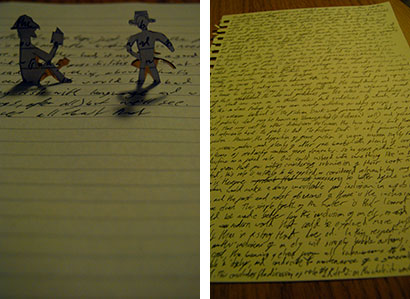
I wanted a humanoid figure, but without simply repeating the technique used on Various Authors. At first, I tried out a few silhouettes, but they all looked a bit, well, flat. I made some three-dimensional figures from paper (calling them Alf 1, 2, and 3, for reasons that will make sense if you read Richard’s story, and are familiar with bad 80s television). Again though, they weren’t particularly inspiring. It was also important that the figure be slightly ambiguous.
The idea of using a shadow came from watching The Testament of Dr Mabuse (available in a very nice dual-format edition from Masters of Cinema), in which one character disguises his identity by only appearing as a shadow. Well, if the villain of that film could do it, so could Alf.
So I dug out one of the figures I’d made, and created a quick ‘warehouse’ out of boxes and printouts of Richard Smyth’s story. Job done, and all thanks to Fritz Lang:

How personal is publishing?
Tuesday, 27th November 2012.
The following is an edited version of the introduction to our new anthology, Crying Just Like Anybody, which is due out in the next few days.
How personal is publishing?
It’s a question that hangs in the background of almost everything I do at The Fiction Desk, from the editorial policy to the cover design.
It’s fashionable these days to think of publishing as a technical, financial process in which manuscripts are selected using a spreadsheet and then processed into books with a minimum of human intervention. While we may identify certain imprints with a specific genre or style of writing, it’s easy to forget that — large or small — a publisher’s list usually represents the individual tastes of an editor, or a small group of editors. And the tastes of those editors in what they choose to publish can be as unique and personal as the books they choose to put on their shelves at home.
Publishers usually foster a semi-anonymous image for themselves: even the terms ‘editor’ and ‘publisher’ are confused and vague, especially in smaller publishing operations. The different roles, and who performs them, are rarely defined for the public, and I doubt most readers could name the editors behind even their favourite books. In Italy, the publisher is the editore and the editor the curatore, which in some ways makes more sense than our own terminology: I’m not talking here about the technical work on the text, which is necessarily invisible and anonymous because the text must always belong to the author, but about the curatorial editing.
In the early days of publishing, the publisher’s name usually was the publisher’s name: John Murray, Chapman & Hall, Martin Secker, and so on. When Herbert Jonathan Cape left (Gerald) Duckworth to found his own company in 1919, he may have called it Page & Co at first, but it wasn’t long before he rechristened it after himself. These days, new fiction publishers are almost always named for objects, mythological figures, or abstract ideas: Telegram, Hesperus, Peirene, Salt, The Fiction Desk. There are very few recent publishers that use the founder’s name for the imprint; offhand, the only one I can think of is Charles Boyle’s CB Editions.
There are probably a few reasons for this change in convention, from the phenomenal success of Allen Lane’s Penguin brand in the 1930s to the number of imprints now launched by large publishing houses rather than by individuals, and it’s by no means a change unique to publishing. Still, I wonder how it has affected readers’ perception of publishers, and even publishers’ and editors’ perception of their own roles.
I have no intention of changing the name of The Fiction Desk, or of introducing a red man as a new logo, but something that’s surprised me over the last couple of years has been just how personal my relationship to these books actually is. The stories presented here are very much my own selection; another editor would have chosen different stories from the same set of submissions. (As is normal for a publisher, we often publish stories rejected by other journals, and I’ve rejected several stories that I’ve subsequently seen published elsewhere.)
This is carried through to the design of the books: for example, they’re printed in Goudy Old Style because that typeface reflects my own belief in the values of traditional storytelling forms over more experimental techniques.
The introductions to individual stories are also a challenge: how personal should they be? Should they be in my own voice, or in a disembodied generic editorial voice? The former is a more honest and accurate reflection of the curatorial process; the latter perhaps quieter and less distracting from the stories. Should I start popping up from behind the furniture at the start of each story, like Rod Serling at the start of Twilight Zone episodes?
No. No, I probably shouldn’t. But I’ll continue to think about the editor’s role, the voice of that role, and where and how that voice should feature in these volumes, aiming to find a balance that renders the curatorial process transparent without detracting from the integrity of the individual stories.
Six rules for manuscript formatting.
Thursday, 5th July 2012.
Something I’ve noticed over the last couple of years is that most writers have trouble getting their manuscript formatting right.
I suspect this is partly due to the Internet. A few years ago, the standard way (in the UK) to plan your submissions was to get hold of a copy of the Writers’ and Artists’ Yearbook, which had handy sections on manuscript preparation. They were right next to the lists of magazines and book publishers, and hard to miss for writers getting ready to send out work.
These days, a lot of people submit just by Googling variations on ‘short story submissions’, or just by contacting their favourite publications direct, and so maybe miss out on that useful information. But even in the digital age, getting manuscript formatting right is very important. It doesn’t just show professionalism on the author’s part: it also helps the editor to connect to the words themselves. (If the editor spends the first 30 seconds with your manuscript adjusting it to be easily read, that’s your first impression gone.)
The key thing to remember about manuscript formatting is that it’s not about looking pretty, or showing off creative or literary credentials. The idea is to make the formatting itself disappear, so that the focus is on the words and nothing else. And the easiest way to make the formatting disappear is to make it look exactly the same as all the others. The six rules below should help you to do that.
Incidentally, I’ve written this post specifically with regard to electronic submissions, but the rules below apply equally to printed submissions (though the reasons may vary). And all publishers vary: if a specific publisher asks for different formatting, it’s always best to give them what they ask for.
The Basic Rules
1. Use 12-point Times New Roman. Everybody is used to seeing Times New Roman on their screen (or on paper), and every computer has it. It’s the most invisible font there is. On a standard paper size (see below), 12-point text is comfortable to read, and if reading on a screen, the editor will be set up for it.
2. Double space your text. Even if the days of making notes between lines are over—on the screen, at least—the extra white space helps your writing go down easily. Always apply double-spacing through the formatting menu: don’t just hit ‘return’ twice at the end of each line. (We get a few of those.)
3. Mark a new paragraph by indenting the first line; don’t leave an empty line between paragraphs. Each new paragraph, or line of speech should be indented. Again, there’s an option to indent the first line of each paragraph automatically in the paragraph formatting options: don’t use the tab key to do it. Leaving a complete blank line between paragraphs is something you’ll see when reading online, including on this site but, has no place in text documents.
3a. If you want to mark a change of scene or time, the kind of thing that would have a blank line left in a printed book, mark it with a centred hash, as I’ve done at the bottom of this list. This means it will still be visible when the text is copied into other software for typesetting. An empty line may just get lost at this stage.
3b. Don’t indent the first line of the story, or the first line following a chapter break or scene change – anywhere you would expect to see a blank line left in a printed book, or marked with a hash as in (3a) above. (The job of an indent is to make it clear that there’s a new paragraph starting, and this isn’t necessary in these cases as there’s no paragraph immediately above.)
4. Leave margins of roughly an inch and a half. A little more or less won’t hurt, but don’t go too far in either direction. There’s no need to shrink the margins to squeeze more words onto the page, or to make them larger to give the text ‘breathing space’.
5. Use a normal ‘paper’ size. In Europe this means A4, in the USA use US Letter. Don’t try to mimic the page of a book or use any other size.
6. Use a simple header. Personally, I’d suggest having author name on the left, title centred, and page number on the right. For the first page, use a unique header (it’s a Word setting) that has your full name and contact details, and word count. All of these details belong in the header and nowhere else: never try to put the page number at the top of each page within the body of the manuscript, because the smallest edit near the top will make a mess of the whole thing. (It’s rare that people do this, but it does happen.)
#
So there are six basic rules. If you can stick to those, your formatting will be in the top 1% of manuscripts we see. And while it may feel like you’re jumping through hoops, it’s really just about making sure that you’re showing off your writing to its best advantage.
How travel can damage your prose
Tuesday, 19th June 2012.
 For writers, international travel is generally a very good thing: even if you don’t write about your travels directly, encountering different places, cultures, and people gives you a certain perspective and insight when you come to write about your own.
There are however certain dangers, afflictions that can show up in a travelling writer’s prose, a sort of literary equivalent of 19th century Grand Tourists coming home with venereal disease. I’ve identified four of them below.
(The examples are invented, but the afflictions are all too real.)
1. A pedant writes…
This condition is particularly common among visitors to cities that have a strong and visible history, a typical example being Rome. The sufferer becomes so overwhelmed by the information they receive and research about the city that they need to pass it on to their readers, whether it belongs in the story or not.
Example:
The two new lovers arrived at the Trevi Fountain in Rome, and stopped to admire the elaborate Baroque craftsmanship.
‘It was originally designed by Bernini in 1629,’ he said lovingly. ‘But not constructed until a century later. It’s 26 metres high and 20 metres wide.’
‘I notice that people are throwing coins into it,’ she said, pointing at a coin glimmering in the water and hoping that he might continue to talk about it for ages. He sounded so erudite when he spoke; just like Wikipedia. She moved a little closer to him.
‘It’s funny you should notice that,’ he said. ‘They say that up to €3,000 are thrown into the fountain every day. The money has been used in part to subsidise a supermarket for the city’s poor. People often try to steal the coins, too.’
‘That’s very interesting,’ she said. ‘Now could you recommend me three hotels in the €50-€75 bracket, and perhaps share some useful weblinks?’
2. “I am literally the only person who has ever eaten a pizza!”
Or a baguette, or a croissant, or a frankfurter actually served in Frankfurt.
Example:
I bit into the pastry: it was sweet and fresh, not at all like the croissants sold in supermarkets at home. It was still a little warm from the oven; the pastry flaked lightly away as I bit, and drifted around me in a cloud of flour-based ecstasy that nobody who hadn’t been to Paris could possibly imagine.
I lingered for a while. I may have been a space detective sent back in time to capture the evil Marspirate CheLuck, but right now I was having my croissant moment.
3. “The Henry Miller rush”
This one is most frequently found in prose coming from Paris, where idealistic young authors go in search of poverty and cheap wine, in the mistaken and perplexing belief that sleeping under a stolen urine-stained blanket will somehow make a writer of them.
The symptoms visible in the prose are an almost complete lack of story, an impressive amount of energy expended going nowhere, a hint that there’s probably a very interesting rhythm underlying the prose, if only you as a reader can consume the exact same combination of cheap French wine and narcotics as the writer. Some extreme cases will also leave the reader with the slightly uncomfortable feeling that the author was probably sat naked at a typewriter when he wrote it.
Example:
I’m walking down the streets and they’re the wet streets, the wet, the rain-soaked, the boulevards under the torrents and the thunderclouds that aren’t like the ones back home but this is something new and different and I can feel it in my veins like back home and like where I’m going. Pierre told me once that the real wine, the good wine is like another thing, not wine at all but a way forwards, into your life and into yourself and Pierre was right, damn him, damn Pierre, damn Pierre with his moustache that cried in the winter back there in Avignon where I was before my trust fund ran out.
But there are other Pierres and I have other trust funds and the sky is grey like the mercy they showed him and maybe they’ll show me; like God’s mercy and the mercy of these boulevards that they call the boulevards of dreams, the old dreams, European dreams and hopes and I have my notebook in my pocket and two old pencils with the ends chewed and the leads blunt but my wits are alive under this rain; as alive as Pierre is no longer alive; as alive as the cockroaches in my garret that costs me three thousand euros a month, money I stole – I had to steal! – from the Trevi Fountain when I was there.
Now, let me tell you about the girl.
No. Let’s not let him tell us about the girl.
4. This story sponsored by Linguaphone
More of a technical problem, this, but some writers can get terribly unstuck when it comes to dealing with foreign languages.
Example:
‘Guten tag,’ said Berthold in German. Hello.
‘Hello,’ I said, using Gerthold’s own language: Guten tag.
‘Wie geht’s?’ he asked me: how was I? ‘I hope that you had a good trip, and didn’t have too much trouble with your passport at the border. The guards have been getting more strict later, since the recent political changes.’ He said all that in German as well, but I can’t be bothered to transcribe it.
‘Nein,’ I replied in the negative. ‘Es war nicht a difficult trip, aber it could have been shorter.’
There was a pause. Somewhere in the distance, ein hund barked.
So there you go: four conditions to watch out for when travelling with your muse. The cure, sadly, is almost certainly not less travel but much, much more.
The Fiction Desk 100
Monday, 18th June 2012.
Until now, I’ve been running The Fiction Desk anthology series as a kind of experiment, to see what’s possible with short story publishing, where the challenges are, and whether a quality anthology series might be viable. Over the last year or so The Fiction Desk has published three anthologies, all of which have been well received by readers. So far, so good. But is it enough?
I’m now reaching the point where I need to plan the future of The Fiction Desk. There will certainly be more anthologies, but I think we can do better. I’d like to get us to the point where we can really put out a book every three months (rather than waiting five or six months between volumes, as we do now). I’d like to discover more new authors, and I’d like to help them to reach more readers.
In order to reach that next stage, we’ll need more subscribers.
Subscribers aren’t just anonymous punters; they’re very much part of the team. Just as the writers put in their time and talent, and take out (a little) money and exposure, so the subscribers put in their money and attention, and take out some rewarding, quality reading. (My job is to work between the two, trying to maximise the benefits to both parties.)
To give us this chance to grow, I’m launching an appeal to find one hundred new subscribers over this summer. That will effectively double our subscriber base, and give me the resources to start building The Fiction Desk into something bigger and better.
This isn’t an either/or situation: the lights won’t go out if we don’t reach our target. But the closer we get to it, the more we can achieve.
If this is something you’d like to be a part of, please head over to our subscription page. You can start your subscription from the next volume, due later this summer, or start it from an earlier volume and get caught up.
Be one of our one hundred new subscribers this summer, and help us promote inspiring, entertaining, excellent short stories.
The Fiction Desk Writer’s Award: The Maginot Line
Monday, 18th June 2012.
The votes are all in, and it’s time to announce the winner of The Fiction Desk Writer’s Award for our latest anthology, The Maginot Line. The winner is…
… Matt Plass, for the title story!

The Writer’s Award is one of my favourite things about The Fiction Desk. It’s voted entirely by the authors who contribute to each volume — even I don’t get a vote — so it really reflects the views of the author’s peers. There’s also a cash prize of £100, which doesn’t hurt.
 So congratulations to Matt, who joins previous winners Ben Lyle and James Benmore in our award hall of fame. And those of you who enjoyed his story ‘The Maginot Line’ will be pleased to know that we’ll be featuring a new story from Matt in the next anthology.
Those of you who haven’t yet read The Maginot Line should now run to their nearest stockist, or buy it directly from us.
Or you could subscribe, of course, and help us to keep discovering and publishing excellent new stories like Matt’s.
Cover Stories
Thursday, 17th May 2012.
(The following post is an extended version of the introduction to our anthology The Maginot Line. There were a couple of things I couldn’t talk about there, as I hadn’t seen a finished copy of the third anthology at the time of writing it.)
In the introduction to our first anthology, I wrote briefly about the background to the series, and why I decided to relaunch The Fiction Desk as a publishing house. In All These Little Worlds, I wrote a little about the process of putting the anthologies together, why we don’t do themed anthologies, and the way themes have a habit of emerging anyway.
In The Maginot Line, I thought I’d write about something really superficial: our covers.
We try to have a broad editorial policy, but it more or less amounts to a focus on traditional narratives with strong characters. To reflect those traditional values, I set certain limitations for our cover images: the designs can only consist of paper and the written word.
Various Authors
 The cover of Various Authors was in my mind for almost as long as the anthology series itself. I made a couple of tests (below left) by hacking away at scrap paper with a fruit knife, before upgrading to a sheet torn from a sketchbook (but the same fruit knife) for the final version.
The handwritten text is a deliberately rambling version of the editorial policy, and specifically talks about our openness to genre, and the limitations of that; I seem to remember there being some reference to elves, although I can’t find it on the cover now. The reference was not entirely complimentary.
The figures were drawn on the back of the paper, cut out along three sides and folded to stand up. I think it worked rather well, though it suffers from the rather shouty typesetting of the title (which I’ve done my best to tidy up in subsequent volumes).
All These Little Worlds
 The crumpled sheets of paper on the cover of All These Little Worlds are pages torn out of advance copies of Various Authors; copies that had been sent out to bookshops but returned to us with their envelopes marked ‘closed down’ or ‘out of business’. Each one therefore represents a different vanished bookshop, and while the title was originally intended to refer to the stories themselves, in retrospect it could equally apply to those lost shops.
The chalk was a nice bit of synchronicity given that the anthology ended up containing several stories related to education. (Technically those chalked lines probably aren’t ‘the written word’, making this a small bending of the rules, but we can call them dashes if you like.)

The Maginot Line
The cover of The Maginot Line is based on the title story, which opens the anthology. There’s a significance to the kind and order of the leaves, but you’ll discover that for yourself when you read Matt’s excellent story. This was the first cover for which I allowed myself real tools, rather than kitchen utensils: The Fiction Desk’s petty cash stretched to a cutting mat and craft knife.
The background to this cover is a sheet of paper made of elephant poo, which seemed to have the right sort of texture.
Make of that what you will.

Late unlamented laminate
The Maginot Line is also the first of our covers to be printed without any sort of laminate: the thin plastic coating that’s applied to almost all paperbacks published these days. Conventional wisdom seems to have it that a book just isn’t professionally finished without a laminated cover, but I’ve grown to really dislike it.
Laminate may protect books (slightly), but when the book does get damaged, the damage is plasticky in a way that looks incredibly cheap and unbookish: the thin plastic film starts to wrinkle, or blister, or peel like dead skin. When an unlaminated book gets knocked or scratched, it may lose a little ink, gain a white scuff mark or two, but it still looks a lot more like a book.
The laminate problem is also made worse by digital printing, as digital inks tend to prevent the laminate from bonding properly. That’s why so many digital books have nasty-looking thick glossy laminated covers: it’s an attempt to get it to stick on. To see the difference, compare a copy of All These Little Worlds (printed digitally and laminated) with a copy of Various Authors (traditionally printed and laminated). The Maginot Line is printed using the same processes as All These Little Worlds, but without the laminate. Personally, I think it has the nicest feel of all three volumes, and has my favourite cover design too.
I don’t think we’ll ever use laminate again for a Fiction Desk title, unless there’s a very good reason for it.
The Maginot Line update
Friday, 6th April 2012.
A quick post to let you know that our new anthology, The Maginot Line, should be out by the end of next week. It’s running a few days late (blame Easter), but it’s well on the way. As ever, subscription copies and pre-orders will be sent out by first class post (or airmail) as soon as the copies arrive from the printers.
Ebook editions may be available a few days earlier: I’ll update the blog and our Twitter feed as the various formats are released.
In the meantime, have a good Easter.
Why you shouldn’t start a short story with a quotation
Monday, 2nd April 2012.
Quite a few of the short story manuscripts we receive at The Fiction Desk are headed with quotations from other sources. These can be anything from religious texts to ’80s pop lyrics; sometimes the writer provides two or three — or a pageful — before getting to their story.
We are very, very unlikely to publish a story that starts like this, and if we did accept one, it would almost certainly be conditional on losing the quotation(s). I thought it might be worth writing a quick blog post here on why that is, and why writers might want to avoid the temptation to add quotations to their short stories.
As usual with our posts aimed at writers, the following is specifically from the point of view of The Fiction Desk, but much of it will apply to other publishers as well, or to good writing practice in general.
1. Thematic cannibalisation
Often, quotes are used by writers to simply express in brief the idea or theme that the story is going to explore in more detail. If the story explores the ideas well, there’s probably no need for an accompanying quote, and it can even take some of the punch out of the story. If the story doesn’t succeed, sticking a quote on the front won’t save it. (That said, there are times when a quote might give a different or more humorous take on the subject to the one the story provides.)
2. Typography
Take a look at the first page of one of our short stories: at the top is a comment introducing the story, then there’s a space, then the title, then the author’s name. The story itself begins at least halfway down the page. If we were to shoehorn a quote in there between the author’s name and the start of the story, there would probably only be three or four lines of story on the page, and so many different styles of text that the first page would be a hell of a mess, and not terribly tempting for the reader.
3. Pomposity
Using a quotation, especially a poorly chosen one, can sometimes make the writer look a little pompous. Novels seem to get away with it in a way that short stories often don’t.
4. Depowering the opening
The first few lines of a short story are where you meet the reader and have your chance to engage them and set the tone. Why compromise such an important moment by delegating it to Janis Joplin?
5. Rights issues
This doesn’t always apply, but if the quoted text is still in copyright, we’d likely have to get permission to use it. This takes time and often money, neither of which we really have to spare.
There are of course exceptions to every rule, and certainly not all of the above points apply in every case. But it’s worth thinking them over, even if you ultimately decide you disagree; and if you’re sending work to us, it’s definitely worth clipping Cicero or Pink Floyd off the top before you do.
Announcing The Maginot Line
Wednesday, 28th March 2012.
Today we can finally announce our new anthology, The Maginot Line.
The Maginot Line contains nine new stories, including stories from returning authors Andrew Jury and Harvey Marcus, and the debut story from Benjamin Johncock.
Copies should be available from April 7th, in paperback and ebook formats – and of course, the first copies will be sent out to our subscribers.
For full details, head over to The Maginot Line.
