

In which we share the latest news from The Fiction Desk, including upcoming publications, writing competitions, and other odds and ends.
Announcing our latest Writers’ Award winner
Monday, 26th November 2018. Comments are closed.

Today we’re announcing the latest winner of the Fiction Desk Writers’ Award.
Although we’ve recently stopped running writing competitions (here’s why), the Writers’ Award is something a little special. It’s awarded to the best story in each anthology, as voted for by the contributors themselves. As well as getting the thumbs-up from their fellow writers, the winner also receives £100.
In the case of our latest anthology, And Nothing Remains, we have a tie between two stories: ‘Thirteen Wedding Dresses’ by Douglas Bruton and ‘All Washed Up’ by Chris Hogben. To break the tie between these two very fine, and very different, stories, we’ve asked our previous contributor S R Mastrantone – now writing as S R Masters – to cast a deciding vote. Over to you, Simon:
And Nothing Remains is an extremely strong collection, and it is unsurprising that this issue’s Writers’ Award came down to a tie. I found plenty to admire about Douglas Bruton’s ‘Thirteen Wedding Dresses’, an optimistic story on the unifying meaning of objects that had an exceptional sense of place. In the end I chose Chris Hogben’s ‘All Washed Up’, which grabbed me from the opening sentence right up until the final moving image of a man drifting in and out of visibility beneath street lights. Chris’s voice is confident and compelling, and the first section of dialogue between the friendly bear and Tommy was very funny and incredibly clever.
So congratulations are due to Chris Hogben (and to Douglas Bruton, for running him such a close race), and thanks to Simon for casting the deciding vote. Now it’s time to get back to work on our next anthology…
(If you’re wondering how to enter a story for the Writers’ Award, it’s simple: just submit your work to our anthology series. All the stories we publish are entered automatically to the competition.)
Why we’ve stopped running writing competitions
Thursday, 25th October 2018. Comments are closed.
Over the years we’ve found some fantastic stories through the writing competitions we’ve run here at The Fiction Desk. There’s no doubt that our pages have been enlivened by ghost stories, newcomers, and flash fiction that we might not otherwise have had the chance to see – and there’s more to come, as our most recent winners will be appearing in our next anthology.
Still, we’ve decided to take a break. We won’t be running any writing competitions in the foreseeable future – although we continue to welcome both general fiction and ghost stories through our standard submissions system.
So why such a drastic change? There are a few reasons:
- By choosing stories through a regular submissions process, we can go much deeper into the work. We can take into account context, and if necessary follow up with the writer before making a decision. We can look at the synopsis, the bio, the writer’s other work, and any other information people choose to include with their submission. We can get back to potential contributors with questions or suggestions if we need to. Publishing is about development as well as selection, and the binary yes/no of a writing competition doesn’t allow for this.
- Although rewarding, running writing competitions takes a lot of time and energy: from launching a competition to publishing the winner can take anything up to a year, and we’d rather put that energy into reading regular submissions and creating great anthologies. Freeing ourselves of the competition timetable also allows us to be more agile in terms of trying out new ideas in editorial and publishing.
- There are a lot of writing competitions around these days, and more seem to launch all the time. We’re seeing a lot of writers whose bios are little more than a long list of prizes and shortlistings. It’s great if that’s working for them, and writing competitions definitely have their place, but at the moment we can probably make a better contribution to the short story in other, more unique ways.
So there it is. We’re stepping away from writing competitions, but continue to welcome the same kinds of story through our regular submissions system, which we will continue to evolve to create better opportunities and support for writers. If you were thinking of entering one of our competitions, please do consider sending us the story as a regular submission anyway. You’ll find full details over in our submissions area.
Incidentally, the competitions did serve one other purpose: the entry fees helped to keep us going. So if you like what we’re doing, please consider supporting us in the old-fashioned way: by picking up one of our anthologies!
Announcing the winner of the New Ghost Stories III Writers’ Award
Thursday, 9th November 2017. Comments are closed.

It’s time to reveal the winner of the Writers’ Award for our latest anthology, New Ghost Stories III.
The Fiction Desk Writers’ Award isn’t like the other competitions we run from time to time: it’s awarded to the best story in each anthology we publish, and is voted for by the contributors to that anthology. It’s a great way to get the writers’ own view on their peers’ work, and it’s always a close race. There’s also £100 for the winner.
This time around the award goes to Will Dunn, for his story Des Nuits Blanches. Congratulations, Will!
New Ghost Stories III, featuring Will’s story and six other fine tales of the supernatural, is available now in paperback: you can get your copy right here. The 2018 edition of our Ghost Story Competition is open now for entries. See details over in our submission section.
New Ghost Stories III is out now!
Friday, 29th September 2017. Comments are closed.
Copies of our latest anthology are available now. New Ghost Stories III contains seven substantial tales of the supernatural, including the winners of our last two ghost story competitions. The contributors are Amanda Mason, Barney Walsh, Seth Marlin, Jerry Ibbotson, Philippa East, Richard Agemo, and Will Dunn.
If you’re a subscriber or pre-ordered your copy, you should have already received it. If not, you can order your copy now directly from us right here. You can also take out a subscription to include this volume.
Announcing the winner of the Writer’s Award for Separations
Wednesday, 23rd November 2016. Comments are closed.

It’s time to announce the winner of the Fiction Desk Writer’s Award for our tenth anthology, Separations.
The Writer’s Award is a prize of £100, presented to the author of the best story in each of our anthologies, and voted for by the contributors to that volume. This makes it a genuinely peer-judged prize, and a great way of recognising talent.
Separations featured some tough competition for the award, as it contained some superb work, including two stories by previous winners: S R Mastrantone and Alex Clark. In the end our authors decided that the Writer’s Award should go to Fiction Desk newcomer Hannah Mathewson, for her story ‘Two Pounds, Six Ounces’, which tells of a hospital visitor’s crisis when a power cut knocks out the lights in the building.
Congratulations, Hannah!
Quays: revisiting Manhattan with Richard Smyth
Wednesday, 21st September 2016. Comments are closed.
Fiction Desk contributor Richard Smyth is in the process of crowdfunding his new novel Quays through publishing platform Unbound. Here he tells us about the novel, and its connections to his Fiction Desk story, Crying Just Like Anybody:
Richard has now added a new reward for supporters on his Unbound page. For £35, pledgers can choose to receive both a signed copy of Quays and a signed paperback of Crying Just Like Anybody. Visit his Unbound page and scroll down for details.
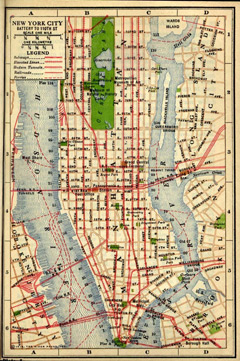
I had this map of Manhattan tacked up over my desk for a couple of years. It shows Manhattan Island in 1916, a century ago, just before the US entered the war. The Battery, on the tip of the island, is at the bottom; 110th street, north of Central Park and south of Harlem, is at the top. In the middle – “way out of the way in midtown”, to be exact – is where I set my story ‘Crying Just Like Anybody’. And it’s where Tom Quays, the hero of my new novel Quays, grew up.
Around here no-one calls anyone by their right name. There’s little Tomas Quis who’s Spanish but he’s called Tom Keys, and there’s my sister Jesca and the boys call her ‘Yes’ and make dirty jokes about it. At the repair shop Mr White is really Mr Weiss and then there’s Si Portman who works for the grocer and wears braces on his legs, and he’s just called Dumdum. Johnny ought to be Gianni really but everyone calls him Johnny. He doesn’t mind.
I’m not sure which Tom Quays – or Tom Keys, or Tomás Quis – came first; I have an idea that the Tom of Quays (then barely even a work in progress) strolled into the New York of ‘Crying Just Like Anybody’, but it could have been the other way around, and in any case these things are seldom clear-cut – all these little worlds bleed into one another.
Why New York? Why midtown Manhattan? Why there, and why then? In one sense, there’s a straightforward answer: books. In my early twenties I was led through urban America by a succession of library paperbacks: Upton Sinclair’s The Jungle, Henry Roth’s Call It Sleep, Theodore Dreiser’s Sister Carrie, and, from after the war, John Dos Passos’s Manhattan Transfer most of all. Non-fiction fleshed out the picture: Luc Sante’s Low Life, Anne Douglas’s Terrible Honesty.
I found that there was room in this world for the stories I wanted to tell. Of course, some of these stories – stories about love, death, war, sex – could have been told in any place at any time, but others played on themes that I picked out most clearly in the madly symphonic Manhattan of the early 20th century. These were stories of immigration and identity, of political radicalism, of literary fame, of escape, ambition and opportunity.
 The Fiction Desk chose to publish ‘Crying Just Like Anybody’ as the title story in its fourth short-fiction anthology in 2012. It remains one of the stories I’m most proud of; it’s certainly one of the stories I’m most fond of. I’ve spent a lot of time thinking about these streets: sending Tom Quays stumbling drunk along Broadway, or putting Dorothy Parker on Pearl Street at midnight, or letting Anna Moller look up at the stars from Coenties Slip. I know this place better than anywhere else I’ve never been.
If it’s possible to escape from the places you grew up (and I’m not at all sure that it is) then Tom, in Quays, does escape the crowding alleys of midtown: he goes to war, first of all, and then is plunged into the smoke and glitter of the Jazz Age literary scene. But his past – the grimy Manhattan of ‘Crying Just Like Anybody’ – won’t ever really let him be. He finds its shadows in an upstate mental asylum, in the offices of Metropolitan magazine, in the history of his city, in his own books and stories.
It’s been kind of like that for me. I spent a lot of time in this place – pretty much all of it without leaving my office chair – and it probably won’t ever really let me be, either.
People seemed to connect with ‘Crying Just Like Anybody’, with Anna and Johnny and the sorry-looking Martian they find in midtown Manhattan. I think they’ll connect with Quays, too: I think anyone who ever feels lost in a big city, or who has ever wanted to escape without quite knowing where from or where to, will get along with the novel (as will anyone who wants to read about Damon Runyon reporting from a WW1 shell-hole or a drunk novelist applying Freudian theory to the Dempsey-Tunney fight – it has something for everyone).
The Manhattan of Quays is my Manhattan; Unbound’s crowdfunding model means that it can stay like that, just as I dreamed it up, without creative compromises or focus-grouped revisions, all the way to the bookshop shelf. It’s a terrific place, and it’d be wonderful if you could read the excerpt, pledge to the book, and maybe (cue clink of cocktail shaker, hum of passing El train, opening bars of Rhapsody In Blue) join me there.
Richard Smyth’s prize-winning stories have been published in The Fiction Desk, Structo, The Stinging Fly, Riptide, Minor Literature[s], The Stockholm Review, Foxhole, The Lonely Crowd, Haverthorn, Firewords Quarterly, Vintage Script, The Nightwatchman, Cent and anthologies from Arachne Press and Ink Lines.
His first novel, ‘Wild Ink’, was published in 2014; he also writes for the TLS, The Guardian, The New Statesman and a few others.
You can pledge to buy his new novel ‘Quays’ – and pick up rewards including one-to-one writing mentorship – at: https://unbound.com/books/quays.
Long Grey Beard and Glittering Eye: The Writer’s Award
Friday, 25th March 2016. Comments are closed.

It’s time to present the Fiction Desk Writer’s Award for our latest anthology, Long Grey Beard and Glittering Eye.
If you’re not familiar with the Writer’s Award, this is a a special £100 prize awarded to the best story in each of our anthologies, as judged by our contributors. Each writer with a story in the volume casts two equally weighted votes, which are then totalled up to reveal the winner.
This time, we had two stories tie for the award: Mark Newman’s ‘Before There Were Houses, This Was All Fields’, and Adam Blampied’s ‘The Cobble Boys’. In cases like this, we invite a guest judge to break the tie. As both stories have something to do with our relationship with the built environment, the obvious choice was Alex Clark, whose own story ’The Stamp Works’ won the Writer’s Award for There Was Once a Place.
Here’s what Alex had to say:
“I was gripped by ‘Before There Were Houses…’, and I loved the analogy between the construction of landscape and the construction of the human heart. The writing is multi-layered and packed with elegant metaphors. It’s such an engaging read. In the end, though, I’ve chosen ‘The Cobble Boys’. It’s so assured that I believed completely in its world. It’s vivid, brutal and authentic, and has some important things to say about the weight of history. It’s left a lasting impression on my mind.”
So it’s congratulations to Adam Blampied for winning the Fiction Desk Writer’s Award for his story ‘The Cobble Boys’, and to Mark Newman for giving him such a close race.
Look out for Alex Clark’s new story, ‘Poor Billy’, coming in our next anthology.
Announcing the Writer’s Award for New Ghost Stories II
Tuesday, 10th March 2015. Comments are closed.

It’s time to announce the Writer’s Award for our latest anthology, New Ghost Stories II.
The Writer’s Award is one of my favourite things about running The Fiction Desk. The Award is given for each anthology that we publish, and is judged by the contributors themselves: each contributor votes for what they think are the two best stories, and the writer of the winning story gets £100.
The votes for New Ghost Stories II are in, and the winner this time is…
… Tamsin Hopkins, for her short story ‘The Table’.
Congratulations, Tamsin! The virtual cheque is in the digital post.
You can read the winning story (well, all the stories) in New Ghost Stories II, out now in paperback and Kindle editions: see here for details.
Announcing the Writer’s Award winner for There Was Once a Place
Friday, 15th August 2014. Comments are closed.

Today we’ll be announcing the results of not one but two competitions.
Later, we’ll be revealing the winner and runners-up of our 2014 ghost story competition. But we’re starting with the Writer’s Award.
The Fiction Desk Writer’s Award is given for the best story in each of our anthologies. It’s judged by the contributors themselves, who each get two votes.
The votes for There Was Once a Place ended in a draw, with Alex Clark‘s ‘The Stamp Works’ and Chris Fryer‘s ‘The Loop’ both in first place. Last time this happened, we called in The Asylum’s John Self to decide the winner. For this volume, our special guest tie-breaking judge is none other than author (and Fiction Desk contributor) Charles Lambert, whose new novel With a Zero at Its Heart is one of 2014’s must-reads. So over to Charles:
It’s a tough decision, because the stories are so different and have such different aims, so that what it comes down to is, finally, a question of personal choice. There’s much to admire in ‘The Loop’ – it’s inventive, intelligent, thought-provoking — but I’d choose Alex Clark’s story. It’s cleanly written, beautifully handled — the risk with this kind of tale is always to over-egg the cake with one special effect too many, and she resists that admirably. It’s rooted in believable detail and surprisingly moving. I liked it a lot.
So it’s congratulations and £100 to Alex Clark, winner of the Fiction Desk Writer’s Award for her story ‘The Stamp Works’. And it’s thanks to Charles Lambert for taking the time to break our tie.
You can read ‘The Stamp Works’, along with Chris Fryer’s excellent story and all the others, in There Was Once a Place. And don’t forget to check out Charles Lambert’s With a Zero at Its Heart too. Both books are out now in all the usual paperback and ebook formats.
New Books from Fiction Desk Authors Part Two
Thursday, 24th July 2014. Comments are closed.
June’s round-up didn’t even come close to listing all the new books coming out from The Fiction Desk’s authors this year. So here are some more:
Matthew Licht: Justine, Joe, and the Zen Garbageman

Over the years Matthew Licht has become one of The Fiction Desk’s regulars, with stories appearing in Various Authors, Crying Just Like Anybody, and New Ghost Stories. His new book is out now from Salt, who have this to say:
Justine’s a famous poet. Joe’s a self-styled Private Investigator without a clue. The Garbageman has cleaned his mind through immersion in filth. What he has to offer his clients, and even his enemies, is serenity. Three characters in search of a reader: you.
Jon Wallace: Barricade

Jon Wallace‘s story ‘Rex’ appeared in our first anthology, Various Authors, back in 2011. His debut novel, a road thriller set in a post-apocalyptic future, was released this summer by Golancz. Here’s what they have to say:
Kenstibec was genetically engineered to build a new world, but the apocalypse forced a career change. These days he drives a taxi instead.
A fast-paced, droll and disturbing novel, BARRICADE is a savage road trip across the dystopian landscape of post-apocalypse Britain; narrated by the cold-blooded yet magnetic antihero, Kenstibec.
Kenstibec is a member of the ‘Ficial’ race, a breed of merciless super-humans. Their war on humanity has left Britain a wasteland, where Ficials hide in barricaded cities, besieged by tribes of human survivors. Originally optimised for construction, Kenstibec earns his keep as a taxi driver, running any Ficial who will pay from one surrounded city to another.
The trips are always eventful, but this will be his toughest yet. His fare is a narcissistic journalist who’s touchy about her luggage. His human guide is constantly plotting to kill him. And that’s just the start of his troubles.
On his journey he encounters ten-foot killer rats, a mutant king with a TV fixation, a drug-crazed army, and even the creator of the Ficial race. He also finds time to uncover a terrible plot to destroy his species for good – and humanity too.
Danny Rhodes: Fan

Danny Rhodes is another author who helped launch our anthology series with his story ‘A Covering of Leaves’ in Various Authors. His third novel, Fan, is out now from Arcadia Books. Here’s the blurb:
In 1989, eighteen-year-old John Finch spends his Saturdays following Nottingham Forest up and down the country and the rest of the week trudging the streets of his hometown as a postal worker. 2004 sees Finch spending his days teaching in a southern secondary school, delaying the inevitable onslaught of parenthood. Leading inexorably towards the FA Cup semi-final at Hillsborough, the worst sporting disaster in British history, Fan glides between 1989 and 2004 when the true impact of this tragic day becomes evident. A book of personal and collective tragedy; it s about growing up and not growing up, about manhood and about what makes a man, and above all about football s role in reflecting a society that is never more than a stone s throw away from shattering point.
Jonathan Pinnock: Take it Cool

Jonathan Pinnock is a relative newcomer to The Fiction Desk: his story ‘A Whole Bloody Century’ appeared in New Ghost Stories. His new book, Take it Cool, is out now from Two Ravens Press, who have this to say about it:
If you’re born with the name Pinnock, you are just two consonants away from disaster, and that proximity pretty much wipes out any chance you have of being cool. Jonathan Pinnock knows this. He has never been cool. The word “Pinnock” is printed through his every bone like Brighton rock.
But then one day he finds out about Dennis Pinnock. That’s Dennis Pinnock, the reggae singer. The reggae singer who recorded over twenty singles on a dozen different labels but never made it to a full-length album, despite working with some of the biggest names in black British music.
So who is this Dennis Pinnock guy? Is he still alive? Is he a big star somewhere? What is a black man of West Indian origin doing with that daft surname? And what in God’s name is a white, middle-class, middle-aged bloke doing on a quest like this anyway?
In the course of the search for Dennis Pinnock, Jonathan digs up some long-forgotten cuts of reggae music, tries to re-inter one or two others, marvels at some unfeasibly shiny suits and encounters some unpalatable truths about how his surname might have crossed the race boundary.
